
In this article
Most people don’t realise how much of their life exists digitally until something goes wrong. Banking details, company documents, personal photos, emails; all of it are stored somewhere across devices, systems or cloud platform. And because it’s so normal, it’s easy to forget how exposed that can be. Security is simply about protecting that information. It covers both your data and your identity, making sure they aren’t accessed, misused, or altered by the wrong people.
It’s not a single tool or system. It’s a combination of practices and technologies that keep your digital environment secure.
Why People Are Taking Digital Security Seriously Now?
In the past, it felt like something only large companies had to worry about. That’s not the case now. Now even individuals are targets. And most breaches don’t happen because of highly complex attacks. All they need is just one mistake.
A reused password.
A phishing email that looks convincing.
A shared file without proper controls.
And suddenly, your data is no longer just yours.
The problem is that the data at risk isn’t trivial. It can include financial details, personal identification, or confidential business information. Once exposed, the consequences can be difficult and sometimes impossible to fully reverse.
What is the Difference Between Digital Security And Cyber Security
The two terms are often used interchangeably, but there’s a difference.
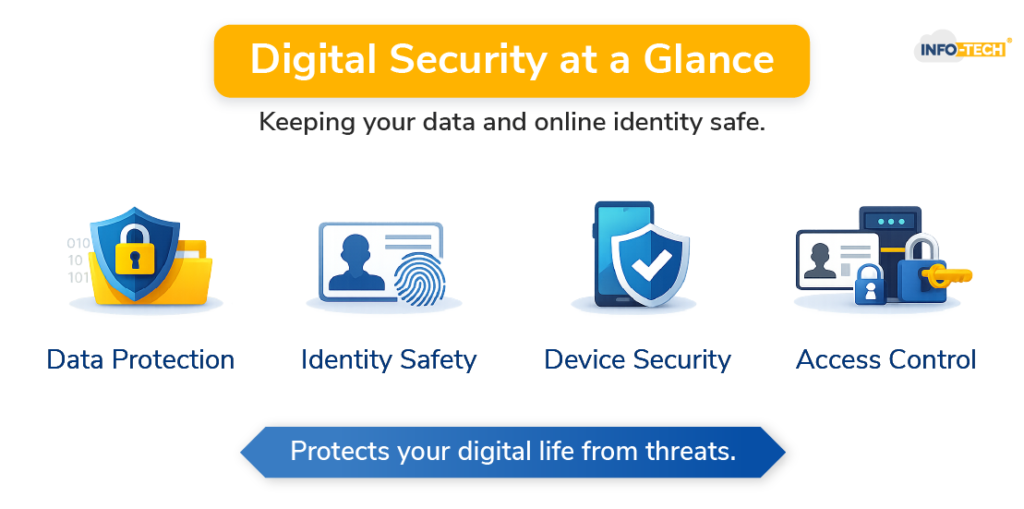
Digital security focuses more on protecting data and identity; things like personal information, login credentials, and digital assets. Cyber security is broader. It includes networks, systems, infrastructure, and everything required to keep an organisation’s technology environment secure.
A simple way to remember it: digital security sits within the larger cyber security framework.
What Are the Types of Digital Security
There’s no single tool that solves everything. Security works more like layers stacked together.
| Type | What it covers | Example |
| Network security | Internet connections | Firewalls, VPN |
| Application security | Software safety | Secure coding |
| Endpoint security | Devices | Antivirus |
| Cloud security | Online storage | Cloud protection tools |
| Access control | Who gets in | OTP, multi-factor login |
If one layer is weak, the rest can get affected. That’s why relying on a single method is rarely enough.
Why Passwords Alone Are Not Enough Anymore
Let’s be honest, most people reuse passwords or keep them stored in an insecure way that make them an easy target. That’s exactly why companies are moving towards stronger authentication methods that don’t rely solely on what user knows.
Fingerprint and Facial Recognition System
You’ve probably unlocked your phone using your thumb or your face. That’s biometric security using fingerprint and facial recognition system.
- Fingerprints are unique
- Faces are mapped using specific patterns
It’s also faster, which is why it’s becoming more common in both personal and workplace settings.
Biometric Authentication Systems (EPSS)
In workplaces, these systems are used more seriously.
A biometric authentication system (EPSS) doesn’t just check what you know (like a password), it checks who you are. That makes a big difference.
It helps prevent things like:
- Someone logging in as someone else
- Fake attendance marking
- Unauthorized system access
It’s a more reliable way of confirming who is actually using a system.
Door Access Systems
Security isn’t only about data on a screen.
Security doesn’t stop at data. Offices now use door access systems that are connected to digital controls. Instead of keys, access might depend on:
- Fingerprint scan
- Face recognition
- Access cards
Every entry is recorded, which creates a clear audit trail. This adds another layer of accountability and security.
Security Tools You Don’t Always Notice
Most of the time, you don’t even notice the tools protecting you.
Things like:
- Antivirus software
- Firewalls
- Encryption tools
- Vulnerability scanners
They’re just running in the background, blocking threats, scanning for issues, keeping things in check.
Where Digital Security Matters?
Some industries depend on it more than others, but honestly, it affects everyone.
- Hospitals need it to protect patient data
- Banks rely on it for secure transactions
- Retail businesses use it to protect customer information
- Offices use biometrics and access systems to control entry
Without proper security, even a small issue can escalate quickly and result in serious matters.
Summing Up
Digital security isn’t something you can ignore anymore. It’s not just an IT team’s job or something only large companies deal with. Anyone using a smartphone, laptop, or the internet is part of this ecosystem.
You don’t need to know everything about it. But being aware and taking small steps goes a long way. Because once your data is exposed, fixing the damage is always harder than preventing it in the first place.
Read More: Improve Payroll Accuracy with a Digital Clocking Solution
Digital Security FAQs
What are examples of digital security?
Digital security includes things like passwords, OTPs, antivirus software, firewalls, encryption, and VPNs that protect your data and systems from unauthorized access. It also includes advanced methods like fingerprint and facial recognition system, biometric systems, and door access controls to verify identity and restrict access.
What are the 5 areas of digital security?
The five main areas of digital security are network security, application security, endpoint security, cloud security, and identity & access management (IAM). Together, they protect systems, software, devices, online data, and control who can access information.
What is a digital security risk?
A digital security risk is any potential threat that could expose your data, systems, or identity to unauthorized access, loss, or misuse. This includes things like hacking, phishing attacks, malware, weak passwords, or data breaches that can compromise sensitive information.
What are the 4 types of security threats?
The four common types of security threats are malware, phishing attacks, man-in-the-middle (MITM) attacks, and denial-of-service (DoS) attacks. These threats can damage systems, steal data, intercept communication, or disrupt services.
