

In this article
Sales communication has always been a mix of skill, timing, and instinct. A good salesperson knew when to follow up, how to phrase a message, and how to keep a conversation moving. But even the best teams struggled with one thing—consistency. What one salesperson wrote could be completely different from another, even when handling similar leads.
That inconsistency is exactly where AI is starting to make a real difference. Today, with AI deeply integrated into modern CRM software, sales communication is no longer just reactive. It is guided, structured, and increasingly data-driven—without losing the human touch that actually closes deals.
Is Writing Still a Bottleneck for Sales Teams?
For many sales teams, writing has always been an invisible drain on productivity. Drafting follow-ups, summarising meetings, or even starting a simple email often takes more time than expected.
AI changes the starting point.
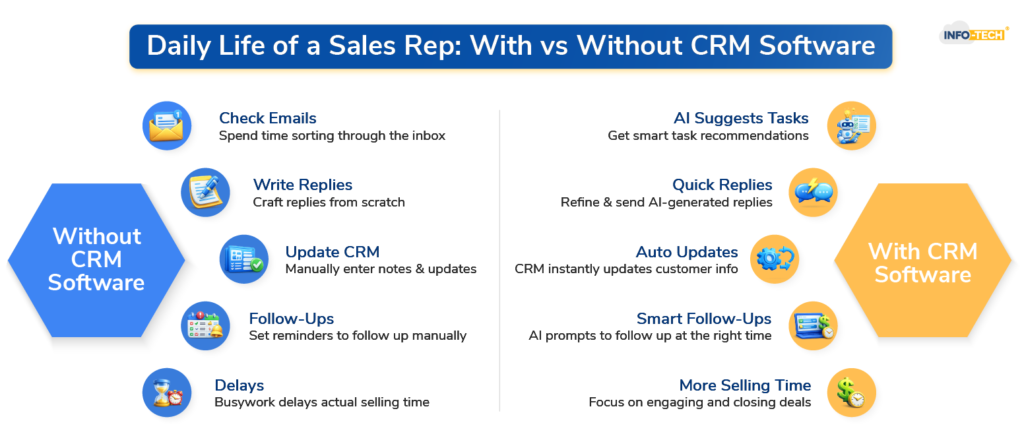
Instead of writing from scratch, sales reps now work with drafts that are already shaped by context—previous conversations, deal stage, and customer behaviour. This doesn’t remove human input; it removes the struggle of getting started.
A typical shift looks like this:
- Earlier, sales reps spent time figuring out what to say
- Now, they spend time refining and personalising what’s already suggested
This small change has a large impact. It reduces delays, improves clarity, and ensures that communication doesn’t lose momentum between touchpoints.
Read More: How AI in Accounting Software Helps Tax Planning & Forecasting
Are Sales Responses Becoming Faster or Smarter?
Speed in sales has always mattered. But speed without relevance often leads to ignored emails and missed opportunities.
AI improves both.
By analysing interaction history inside CRM software, AI can suggest replies that are not just quick, but also aligned with the customer’s situation. A prospect who has gone quiet may receive a gentle re-engagement message, while an active lead might get a direct push toward the next step.
What’s important here is not automation—it’s relevance at scale.
Instead of sending generic responses, teams are now able to maintain a level of personalisation that was previously only possible for a handful of high-value deals.
Explore: How AI in Accounting Software Helps Tax Planning & Forecasting
Conversations Are Becoming More Context-Driven
Customers today expect sales conversations to feel continuous. They don’t want to repeat themselves or receive disconnected responses.
This is where AI, combined with CRM software, quietly improves the experience.
Every interaction—emails, calls, meetings—is captured and analysed. When a salesperson responds, they are no longer relying on memory or scattered notes. The system brings context forward instantly.
This leads to a noticeable shift:
| Traditional Approach | AI-Driven Approach |
| Messages based on memory | Messages based on full interaction history |
| Generic follow-ups | Context-aware communication |
| Missed details between conversations | Continuity across every touchpoint |
The result is simple—customers feel understood, and conversations move forward without friction.
Learn More: Will AI Replace Accounting Roles or Enhance Them?
Sales Teams Now Have Real-Time Guidance
One of the more subtle but powerful changes AI brings is guidance.
Salespeople are no longer left to decide the next step entirely on their own. AI analyses patterns across deals and suggests what action makes the most sense at any given moment.
In practice, this might look like:
- A reminder to follow up when engagement drops
- A suggestion to schedule a meeting after multiple email opens
- A prompt to share pricing when a deal reaches a certain stage
This doesn’t replace decision-making. It supports it.
For newer team members, this is especially valuable. It shortens the learning curve and helps them avoid common mistakes, while experienced reps benefit from sharper timing and better prioritisation.
Less Time on Admin, More Time on Actual Selling
Ask any sales team where their time goes, and a large portion of it isn’t spent selling. It’s spent managing communication and updating records.
AI reduces that load significantly.
By automatically drafting emails, organising notes, and updating interactions within CRM software, it frees up time for what actually matters—building relationships and understanding customer needs.
Instead of juggling multiple tools and tasks, sales reps can stay focused on conversations that move deals forward.
Better Communication Is Leading to Better Outcomes
When communication improves, the impact shows up across the entire sales process.
Clear and timely responses help reduce confusion. Customers don’t have to chase for information or clarification. This builds trust naturally.
Consistent follow-ups ensure that opportunities don’t go cold. And when every message is backed by context, the chances of saying the wrong thing—or missing something important—drop significantly.
Over time, these small improvements add up to:
- Shorter sales cycles
- Higher engagement rates
- More predictable conversions
And all of this is driven by how effectively AI works within your CRM software environment.
Consistency Is Becoming the New Standard
One of the biggest challenges in sales teams has always been uneven performance in communication.
Some reps naturally write better emails or handle responses more effectively. Others struggle, which affects overall team performance.
AI helps bridge that gap.
By setting a baseline for quality and tone, it ensures that every message meets a certain standard. It doesn’t remove individuality, but it prevents communication from falling below expectations.
Managers also gain better visibility into how teams are interacting with customers, making it easier to coach and improve performance where needed.
Final Thoughts
Sales is still, at its core, about people. That hasn’t changed.
What has changed is how salespeople are supported in their day-to-day communication. AI is removing the friction that slows them down—whether it’s writing emails, deciding when to follow up, or figuring out what to say next.
When combined with the right CRM software, AI becomes more than just a feature. It becomes part of how modern sales teams operate—quietly improving every interaction, every response, and every opportunity.
And in a competitive market, that difference is hard to ignore.
CRM Software FAQs
How is AI improving sales communication in modern businesses?
AI improves sales communication by helping teams write faster, more relevant, and personalised messages. It analyses customer data, past interactions, and deal stages to suggest better responses. When integrated with CRM software, it ensures every email or follow-up is context-driven, reducing delays and improving engagement, which ultimately leads to stronger customer relationships and higher conversion rates.
Can AI replace salespeople in writing and responding to customers?
AI does not replace salespeople—it supports them. It handles repetitive tasks like drafting emails and suggesting replies, allowing sales teams to focus on building relationships and closing deals. With crm software, AI enhances human communication by providing context and recommendations, but the final interaction and decision-making still depend on the salesperson.
Why is crm software important for AI-driven sales communication?
crm software acts as the foundation for AI in sales communication. It stores customer data, interaction history, and deal progress, which AI uses to generate accurate and relevant responses. Without structured data from crm software, AI cannot deliver meaningful insights, making it essential for effective automation and personalised customer engagement.
What are the biggest benefits of using AI in sales responses?
The biggest benefits include faster response times, improved message quality, and better consistency across teams. AI also reduces manual workload by automating drafts and follow-ups. When combined with crm software, it ensures that every communication is timely, personalised, and aligned with customer needs, helping businesses shorten sales cycles and improve overall performance.
