

In this article
- 1. What is the Ministry of Finance Singapore?
- 2. What Does the Ministry of Finance Singapore Do?
- 3. How Does the Ministry of Finance Manage Government Revenue?
- 4. What is the Role of MOF in Maintaining Singapore’s Reserves?
- 5. How Does MOF Affect Businesses in Singapore?
- 6. How Does Ministry of Finance Affect Individuals?
- 7. Why is the Ministry of Finance Important to Singapore?
- 8. Ministry of Finance Singapore – FAQs
Singapore is widely recognized for its strong economy, sound public finances and business-friendly environment. At the centre of this is Ministry of Finance Singapore (MOF) which plays an important role in managing government revenue, expenditure, taxation, reserves and Singapore’s overall fiscal strategy.
The ministry works to ensure that public resources are managed responsibly while supporting economic growth, social needs and Singapore’s long term financial sustainability. Its responsibilities affect individuals, businesses and other government agencies in different ways.
What is the Ministry of Finance Singapore?
The Ministry of Finance commonly known as MOF is the Singapore government ministry responsible for overseeing the country’s public finances and fiscal policies. Its main mission is to create a better Singapore through finance.
MOF focuses on three major outcomes,
- Responsible stewardship of public resources
- Inclusive and sustainable economic growth
- A high-performing and accountable government
It develops financial policies, manages the government resources and work with other government agencies to maintain the long-term fiscal position of the country.
What Does the Ministry of Finance Singapore Do?
The responsibilities of the Ministry of Finance cover several areas of financial management of the government.
Develops Fiscal Policies:
One of the major activities is to develop the country’s fiscal policies. The fiscal policies refer to how the government raises revenue and how it spends public money. MOF develops fiscal policies intended for the following purposes,
- Maintain sustainable public finance
- Support economic growth
- Promote social equity and
- Meet Singapore’s long term expenditure needs
Singapore generally aims to maintain balanced budget over the long time ensuring that enough resources are available for the areas such as education, healthcare, infrastructure and social support.
Oversees Tax Policies:
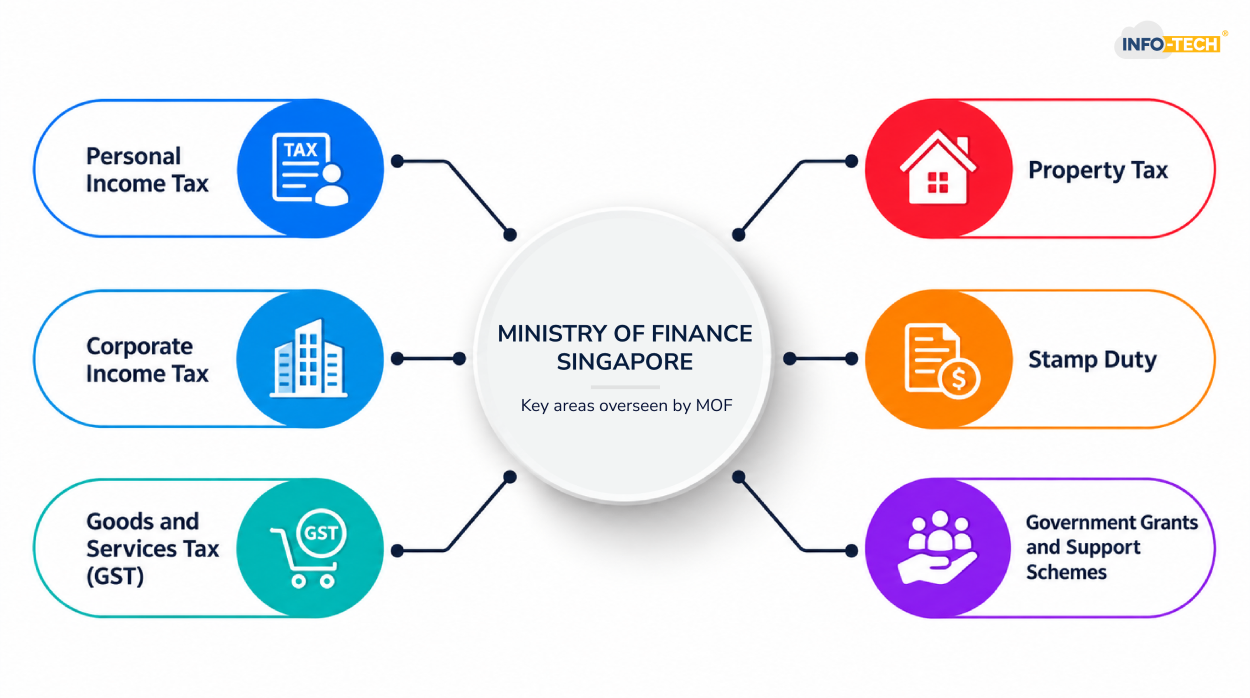
Taxation is another major responsibility of MOF. Singapore uses different types of taxes to fund government expenditure while maintaining competitive business environment.
Major areas of taxes that MOF oversees include,
- Personal income tax
- Corporate income tax
- Goods and Services Tax (GST)
- Property tax and
- Stamp duty
How Does the Ministry of Finance Manage Government Revenue?
Singapore receives revenue from several sources to manage its expenditures. Taxes are the major contributors to the revenue and include corporate tax, property tax, personal income tax and GST.
However, taxation is not only the source of revenue for the government. Another significant source of revenue is the Net Investment Returns Contribution (NIRC) which allows the part of investment returns from the country’s reserves to the used for the public spending. MOF states that NRIC funds about 20% of annual government expenditure.
With this system, returns from Singapore’s resources be used for present expenditure and preserves resources for future generations.
What is the Role of MOF in Maintaining Singapore’s Reserves?
Singapore’s Reserves serve a major part of the country’s financial strength. The Ministry of Finance helps develop policies on how the country’s reserves are protected and used. These reserves act as an important financial safeguard to the country during economic crises or any national emergencies.
They also generate investment returns, part of which can be used for the government spending. MOF makes sure that the reserves are managed carefully so they can support both current needs and future generations.
How Does MOF Affect Businesses in Singapore?
The Ministry of Finance can affect businesses through policies that are related to corporate tax, GST, tax incentives, grants and government support schemes. Businesses can use accounting software to manage GST calculations more efficiently
Changes announced in Singapore budget can affect the costs, investment decisions, hiring and cash flows.
MOF also develops polices aiming to keep Singapore a competitive and attractive business place for local companies, SMEs and international businesses.
Read Also: Top 5 Government Grants for SMEs in Singapore
How Does Ministry of Finance Affect Individuals?
The Ministry of Finance can affect individuals through changes in policies such as personal income tax, GST, stamp duties and different government support measures.
During the annual budget announcement, the government can introduce payouts, rebates, vouchers and other forms of assistance for eligible households.
These policy changes can bring an impact on cost of living, household expenses and personal financial planning.
Why is the Ministry of Finance Important to Singapore?
The Ministry of Finance is important to Singapore because it ensures that the public money is managed responsibly. It carefully plans how the government raises revenue and how it funds to the areas such as education, infrastructure, social support and healthcare. By spending current spending with long-term financial goals of the country. MOF helps Singapore maintain its financial stability and prepare for future economic challenges.
Ministry of Finance Singapore – FAQs
Is IRAS under Ministry of Finance?
Yes, the Inland Revenue Authority of Singapore is one of the statutory boards under the Ministry if Finance. IRAS administers Singapore’s tax system, while MOF develops the broader tax policy framework.
Does the Ministry of Finance collect taxes?
The Ministry of Finance develops Singapore’s tax policies. But the tax administration and collection are handled primarily by IRAS.
Who is the Minister of Finance in Singapore?
As of October 2026, prime minister Lawrence Wong is also the Minister of Finance in Singapore.
What is Singapore’s fiscal policy?
The Singapore’s fiscal policy manages how the government raises revenue and allocates expenditure.
