

In this article
- 1. What is the EDGE Grant?
- 2. How is EDGE Different From PSG, EDG and MRA?
- 3. What Can the EDGE Grant be Used For?
- 4. What Happens to PSG, EDG and MRA Applications Already Submitted?
- 5. What Rules Should You Know Before Applying for EDGE?
- 6. How Do You Prepare an EDGE Application?
- 7. Can You Combine EDGE with Tax Deductions for AI Spending?
- 8. Should You Apply for EDGE Now or Wait?
- 9. EDGE Grant Singapore FAQs
Enterprise Singapore’s EDGE grant is now the main source of support for businesses that want to digitalise, work more efficiently or expand overseas. It replaces three familiar schemes and is open to far more companies than before.
This guide covers what EDGE funds, how it differs from the old grants, what happens to applications already in progress, and how to prepare yours.
What is the EDGE Grant?
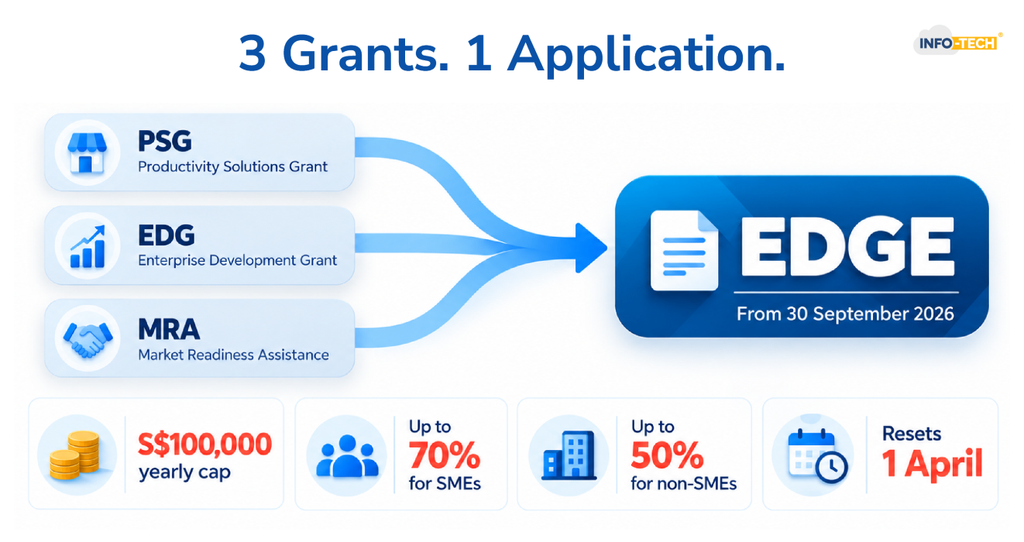
EDGE is Enterprise Singapore’s new all-in-one business grant, announced under the Business Refresh Package in March 2026. It brings three older schemes together:
- PSG (Productivity Solutions Grant), used for pre-approved software and equipment
- EDG (Enterprise Development Grant), used for bigger transformation projects
- MRA (Market Readiness Assistance), used for overseas expansion
All three stopped taking new applications on 29 September 2026, and EDGE opened the next day. Instead of working out which scheme fits, you now apply based on what you want to do, such as digitalising a process or improving efficiency.
How is EDGE Different From PSG, EDG and MRA?
The biggest shift is who can apply. Larger companies that were shut out of PSG and MRA can now get support for the same kinds of projects.
| Old grants (closed) | EDGE | |
|---|---|---|
| Who can apply | PSG and MRA were for SMEs only. EDG covered non-SMEs at up to 30% | Any Singapore-registered business, including non-SMEs |
| How you apply | Choose the right scheme first | Apply by activity, all in one place |
| Support level | Fixed by scheme | Up to 70% for SMEs and 50% for non-SMEs, set per activity |
| Funding cap | Separate limits under each scheme | One S$100,000 yearly cap shared across all activities, reset every 1 April. Higher amounts are assessed case by case |
Because the S$100,000 is shared, it helps to plan the year’s projects together. Software, consultancy and overseas expansion all come out of the same pot.
What Can the EDGE Grant be Used For?
Enterprise Singapore groups EDGE support by activity. Based on what the three older grants covered, projects usually fall into one of these areas.
| Activity | Examples |
|---|---|
| Digitalisation | Accounting software, CRM, e-invoicing through InvoiceNow, and HR tools like payroll, time attendance and claims management |
| Enterprise efficiency | Process redesign, automation equipment, ERP systems, management consultancy |
| Brand and capability building | Brand strategy, marketing development, innovation projects |
| Overseas expansion | Market promotion, business development, setting up in a new market |
| Other areas | Standards and sustainability work |
Support rates and vendor requirements differ by activity. Some need a pre-approved vendor, so check the Business Grants Portal for your specific project before you commit.
What Happens to PSG, EDG and MRA Applications Already Submitted?
Nothing changes for them. If you filed before 30 September 2026:
- Your application is assessed under the rules of the scheme you applied under.
- Approved projects continue to completion, and you submit claims as usual.
- If you used SkillsFuture Enterprise Credit (SFEC), claim it by 30 November 2026. EDGE does not support the SFEC top-up.
What Rules Should You Know Before Applying for EDGE?
A few habits from the old grants still apply, and one new rule catches people out.
- Approval comes before spending. Don’t sign a vendor contract or pay a deposit until you have your Letter of Offer. Signing early can count as starting the project, which makes it ineligible.
- You pay first, then claim. The grant is paid back after the project is complete and fully paid.
- Your application is mostly locked once filed. Only the project end date and claim due date can be changed. Switching vendor or adding modules means cancelling and applying again.
How Do You Prepare an EDGE Application?
Since you can’t change scope after filing, most of the work happens before you apply.
- Update your ACRA details and financial statements. Assessment draws on both.
- Write down the problem in numbers. For example, “payroll takes 3 days a month and we fix errors every cycle” is stronger than “we need new software.”
- Settle the full scope now. If you expect to add modules or project phases within a year, include them in this application.
- Get a detailed quotation from your vendor or consultant that matches that scope.
- Check the vendor and solution on the Business Grants Portal before you submit.
Can You Combine EDGE with Tax Deductions for AI Spending?
Possibly, under the Enterprise Innovation Scheme (EIS). It’s a tax route, separate from EDGE.
| EIS detail | What it means |
|---|---|
| Deduction | 400% on qualifying AI spending |
| Spending cap | Up to S$50,000 a year (the cap is on the spending, not the deduction) |
| Years covered | YA 2027 and YA 2028 |
If you’re buying AI-powered tools, such as an AI-enabled HRMS or analytics software, there’s a catch. Qualifying spending is usually worked out after subtracting any grant received, so costs covered by EDGE would shrink your EIS claim. It’s worth asking your tax advisor which route gives you more before you apply.
Should You Apply for EDGE Now or Wait?
If your project is clearly scoped, there’s no reason to hold off. EDGE is open and the rules are set. If you’re still unsure what you need, spend a few weeks mapping out your processes first, since getting the scope right the first time saves you from reapplying later.
Details like activity lists, support rates and approved vendors can change, so check the Business Grants Portal and Enterprise Singapore’s EDGE page before you file.
EDGE Grant Singapore FAQs
Who is eligible for the EDGE Grant?
Any business registered in Singapore can apply for the EDGE Grant, including larger companies that aren’t SMEs. SMEs can get up to 70% support and non-SMEs up to 50%, depending on the activity. All businesses share the same S$100,000 yearly cap.
How much funding does EDGE provide?
EDGE covers up to S$100,000 per company each year. That cap is shared across every activity you apply for, and it resets on 1 April. Companies that need more can ask Enterprise Singapore to assess their case individually. The share of costs covered depends on the activity and your company size. SMEs can get up to 70%, and non-SMEs up to 50%. For example, an SME with a S$40,000 project supported at 70% could get back up to S$28,000.
Can I still apply for PSG, EDG or MRA?
No. PSG, EDG and MRA stopped accepting new applications on 29 September 2026. From 30 September, new projects go through EDGE. If you applied on or before 29 September, you’re not affected. Your application is assessed under the rules of the scheme you applied for. Approved projects continue as normal, and you submit claims the usual way.
How is EDG grant different from the EDGE grant?
EDG was one of the three grants that EDGE replaced, and it closed to new applications on 29 September 2026. EDG funded growth and transformation projects, such as brand building, innovation and market access. EDGE covers all of that, plus pre-approved software and equipment (previously under PSG) and overseas expansion (previously under MRA).
