

In this article
- 1. What is a General Ledger?
- 2. How Does a General Ledger Work?
- 3. What are the Main Accounts in the General Ledger?
- 4. What is the Difference Between General Ledger and Journal Entry?
- 5. Why is it Important for the Singapore Businesses?
- 6. How General Ledger Supports Financial Reporting?
- 7. How it is Maintained in Accounting Software?
- 8. What are the Best Practices for Maintaining it?
- 9. General Ledger FAQs
Running a business involves hundreds or even thousands of business transactions every day. The business transactions may include sales, purchase, salary payment, purchase of assets, bank payments and GST. Keeping a track of all these transactions accurately becomes essential to understand the company’s financial performance and make informed decisions. This is where a general ledger comes into role.
For businesses in Singapore, maintaining accurate accounting records is also an important part of meeting the tax and financial reporting obligations.
What is a General Ledger?
A general ledger is a central accounting record that contains all the business transactions organised according to individual accounts.
Instead of looking at every transaction separately, businesses can use it to see how the transactions affect each account such as,
- Cash account
- Bank account
- Accounts receivable
- Accounts payable
- GST accounts
- Loans and
- Operating expenses
At the end of an accounting period, the balances in these accounts can be used to prepare the financial reports which can be used to analyse the financial performance of the company.
How Does a General Ledger Work?
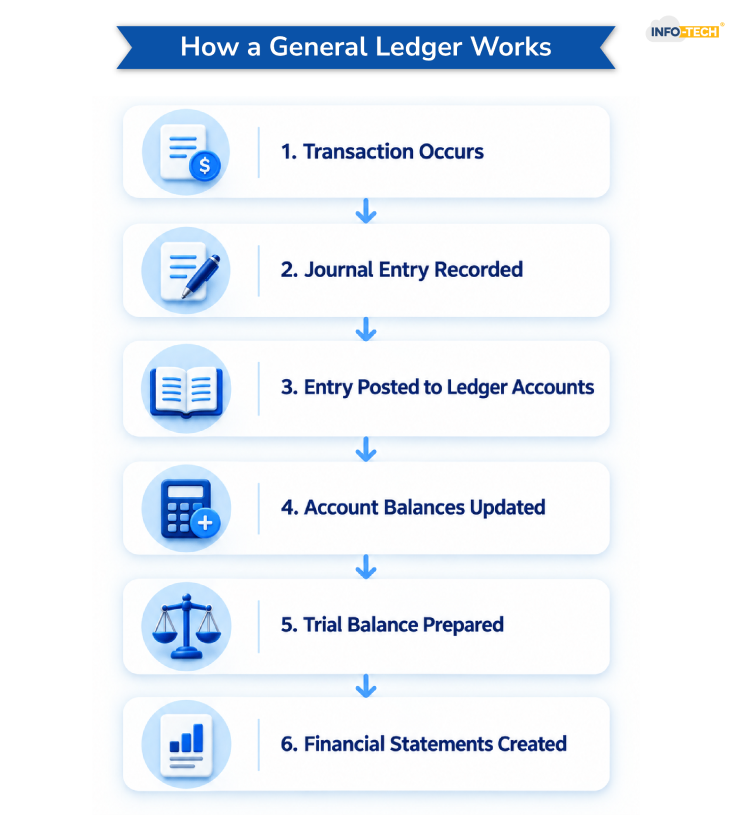
It typically works as a part of wider accounting process. It usually follows the double-entry accounting system. Under double entry accounting system, every transaction affects at least two accounts. One side of the transaction is recorded on the debit side and the other on the credit side.
The following is the accounting process,
1: A financial transaction such as purchase, sale or payment occurs.
2: A financial transaction is recorded in the accounting system, often through a journal entry.
3: The entry is posted to the relevant ledger account.
4: The account balances can be updated after posting al the transactions.
5: The trial balance is prepared to balance the total debit and credit values.
6: Financial statements are prepared using the information in the ledger accounts.
What are the Main Accounts in the General Ledger?
It usually contains the five broad categories of accounts.
Asset:
Assets are resources owned or controlled by business like cash, land, bank balance, inventory and prepaid expenses.
Liability:
Liabilities are the amount that the businesses owe to other parties. The examples include, bank loans, GST payable, accounts payable and accrued expense.
Equity:
Equities represent the owner’s interest in the business after the value of liability is deducted from the assets. Share capital and retained earning are the common examples.
Revenue:
Revenue account records the income generated by the businesses. This includes product sales, subscription revenue or operating income
Expense:
Expenses are the costs incurred for operating the business. The examples are rent, wages, office expenses and depreciation.
What is the Difference Between General Ledger and Journal Entry?
The general ledger and journal entries serve different purposes. A journal entry records all the business transactions chronologically, while the latter organises those transactions by accounts.
For example, journal entry records all the transactions occurring on different dates. The other groups the relevant transactions under accounts such as cash, bank, rent, salary and debtor.
Here is a simple way to remember the distinction,
- Journal entry: Records transactions in chronological order.
- General ledger: Organises transactions by accounts.
Why is the General Ledger Important for the Singapore Businesses?
It is more than a record of past transactions, supports a lot of accounting and business functions.
It can help the businesses in the following ways,
- Track the income, expenses, assets and liabilities.
- Prepare financial statements.
- Identify errors or unusual transactions.
- Support budgeting and informed decision-making.
- Support tax complaint processes.
For companies in Singapore, proper accounting records become crucial because businesses have record keeping obligations under Singapore’s corporate and tax framework.
How General Ledger Supports Financial Reporting?
The information in general ledger serves as one of the key sources to prepare the financial statements.
For example,
- Income statement uses revenue and expense account balances.
- Balance sheet uses asset, liability and equity balances.
- Cash flow statement uses information about cash movements alongside other accounting records.
Therefore, the accuracy of financial statements relies highly on the quality of accounting records.
How General Ledger is Maintained in Accounting Software?
Modern accounting software usually maintains the ledger automatically.When a user creates an invoice, records a bill and enters a payment, the software can post the corresponding accounting entries to the relevant accounts.
This can reduce the manual work and make it easier to,
- View account balances
- Generate a trial balance
- Produce financial reports
- Search transaction histories
- Reconcile accounts
- Maintain supporting records
However, automation does not eliminate the need for proper accounting processes. Incorrect account classification, duplicate transactions and incomplete records are some of the factors that result in inaccurate financial reports.
Also Read: Accounting Trends Today
What are the Best Practices for Maintaining a General Ledger?
The following are some of the ways for Singapore businesses to improve it:
- Use of consistent chart of accounts
- Performing regular bank reconciliations
- Review the unusual transactions
- Check the GST-related entries when applicable
- Reviewing account balances regularly
General Ledger FAQs
What is a general ledger?
A general ledger summarizes all the transactions recorded through the double-entry bookkeeping method. Under this method, at least two accounts are affected for each transaction.
What are the main accounts in general ledger?
Assets accounts, liability accounts, equity accounts, revenue accounts and expense accounts are the main accounts in the general ledger.
What are assets in general ledger account?
Assets are resources owned or controlled by businesses that have an economic value and are expected to provide benefits in the future.
What is the difference between a general ledger and a journal entry?
A journal records the business transactions, whereas the general ledger organises those transactions according to accounts and shows their balances.
