

In this article
- 1. What is Salary in Lieu Of Notice?
- 2. When Can Employment End Without Notice?
- 3. Can An Employee Really Just Resign Without Notice?
- 4. What If the Contract Doesn’t Mention a Notice Period?
- 5. Does It Include Bonuses and Allowances, Or Just Basic Pay?
- 6. Does CPF Apply to It?
- 7. Who Handles All This on The Company Side?
- 8. Salary In Lieu Of Notice FAQs
If you’ve ever had to leave a job (or let someone go) without working through the notice period, you’ve probably come across the term “salary in lieu of notice.” It sounds official, but the idea behind it is pretty simple. Here’s what you need to know if you’re on either side of the table.
What is Salary in Lieu Of Notice?
It’s basically a payoff for the notice period nobody served. When an employment contract ends and either the employer or the employee decides not to go through the full notice period, the party ending things early pays the other side what they would’ve earned during that time. It works both ways. An employer can pay it to let someone go immediately, and an employee can pay it to walk out early.
Also read: Off in Lieu Meaning: A Detailed HR Guide
When Can Employment End Without Notice?
A few situations come up often:
- Employer stops paying on time — if your salary is more than 7 days late, you’re allowed to leave without serving notice. That said, it’s worth checking in with your employer first to understand why the payment is late before making a call.
- Repeated unexplained absence — an employer can end your contract without notice if you’re away from work for more than 2 straight working days without approval, or without even trying to let them know why.
- Changes to your job terms — if your employer wants to change your terms of employment and you don’t agree, neither side can force it through. If no compromise is reached, either party can end the contract in the end, but this still needs proper notice to be served.
- Misconduct — if the termination is due to misconduct of an employee, the employer doesn’t need to give notice or pay anything in lieu of it.
Can An Employee Really Just Resign Without Notice?
Yes, but only in specific circumstances. The main reason being unpaid salary. Apart from that, if you want to leave earlier than your notice period allows, you’ll usually need to pay your employer the equivalent salary for the days you didn’t serve in the organisation.
How to calculate Salary in Lieu of Notice?
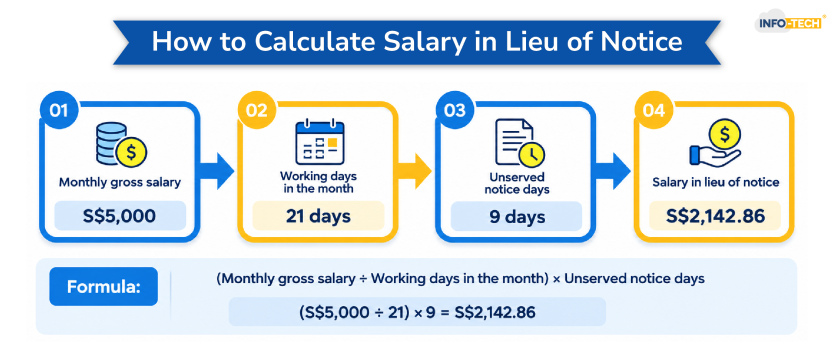
The standard formula used in Singapore is: (Monthly gross rate of pay ÷ number of working days in that month) × number of unserved notice days
For example: Alan earns S$5,000 a month. February 2027 has 21 working days, and he resigns with 9 days’ notice unserved. His payment adds up to: (S$5,000 ÷ 21) × 9 = S$2,142.86
There’s also a slightly different way some companies calculate this, depending on whether the unserved notice covers a full month or just part of one:
| Scenario | How it’s worked out |
| Full month unserved | The complete monthly gross salary is paid (excluding bonuses, overtime, and other extras) |
| Part of a month unserved | (Monthly gross salary × 12 ÷ 260) × number of unserved days |
Either way, the goal is the same; pay the person exactly what they’d have earned if they’d stayed throughout their notice period.
What If the Contract Doesn’t Mention a Notice Period?
Then the default periods based on length of service kick in:
| Length of service | General notice period |
| Less than 26 weeks | 1 day |
| 26 weeks to less than 2 years | 1 week |
| 2 years to less than 5 years | 2 weeks |
| 5 years and above | 4 weeks |
Does It Include Bonuses and Allowances, Or Just Basic Pay?
Generally, yes. It’s meant to cover whatever the employee would normally have earned, so basic salary, commissions, bonuses, and regular allowances stated in the contract are usually all factored in for salary in lieu of notice.
Can both sides just skip the notice period entirely?
Yes, if both parties agree to waive it off. But this needs to be documented in formal writing, not just a verbal understanding. Employees can also use their accrued annual leave to shorten the notice period; this needs the employer’s sign-off, and it won’t get you any extra pay on top.
Is it taxable?
Yes, IRAS treats salary in lieu of notice as taxable income, same as regular wages paid.
Does CPF Apply to It?
No, CPF contributions aren’t payable on salary in lieu of notice itself. However, CPF still applies as usual on the regular wages earned up until the employee’s actual last day of work. And if an employer offsets an employee’s owed compensation against their final wages, CPF is still due on those wages before the offset is applied.
When should the payment actually come through?
The final salary, including any amount in lieu of notice should be paid on the last day of work, or within 3 working days from the termination date. If it’s the employee who owes the payment (because they’re the one wanting to leave early), this is usually settled within 7 days.
What if someone just refuses to pay?
This happens, and it can turn into a dispute pretty quickly. Either the employer or the employee can take the matter to the Tripartite Alliance for Dispute Management (TADM) or the Ministry of Manpower (MOM) to recover what’s owed.
Who Handles All This on The Company Side?
In most organisations, it falls on HR to sort out. A few things they’re usually responsible for:
- Checking the contract and working out the correct notice period or payment
- Coordinating with payroll to make sure the amount and timing are right
- Communicating clearly with the employee about what they’re being paid and when
- Documenting everything properly; the termination letter should spell out that it’s a payment in lieu of notice, how much, and what else is included
- Keeping the process consistent across the company to avoid disputes or claims of unfair treatment down the line
At the end of the day, salary in lieu of notice exists to make sure nobody loses out financially just because a notice period wasn’t served in full. Getting the calculation and timing right and putting it in writing goes a long way in keeping things fair and dispute-free for everyone involved.
Salary In Lieu Of Notice FAQs
How do I calculate salary in lieu of notice?
The standard Singapore formula is: (Monthly gross rate of pay ÷ number of working days in that month) × number of unserved notice days.
What is the meaning of “in lieu of notice”?
“In lieu of” just means “instead of” or “in place of.” So “in lieu of notice” literally means “instead of serving notice.”
When to pay salary in lieu of notice?
Salary in lieu of notice is paid on the last working day or within 3 working days of termination by the employer (7 days if the employee owes it), instead of the person serving out their notice period.
Is salary in lieu of notice subject to CPF?
No, CPF contributions are not payable on salary in lieu of notice itself.
