Seamless E-Invoicing
Certified Peppol Access Point Provider by IMDA
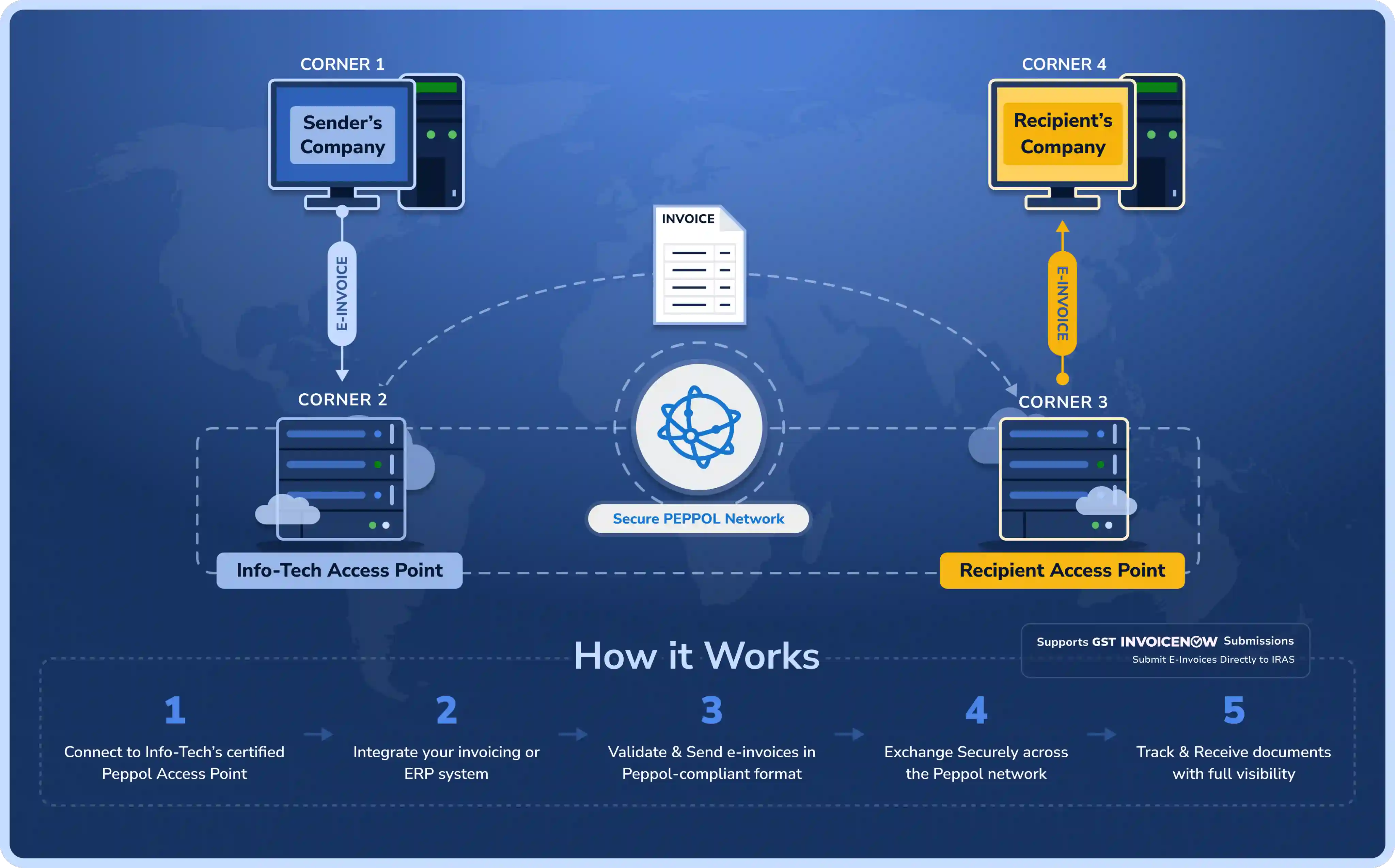
Info-Tech’s Peppol Access Point Service enables businesses to send and receive electronic invoices and documents securely through the global Peppol network. Designed for compliance, scalability, and ease of use, our solution helps organizations streamline invoicing, meet regulatory requirements, and accelerate digital transformation.

18+
Years of Presence
33,000+
Customers
600+
Dedicated Staff
1M+
Info-Tech Users

Secure E-Invoicing Network for Business Transactions
The Peppol 4-Corner Model
GST
 Submission
Info-Tech’s Access Point supports GST InvoiceNow submission , enabling businesses in Singapore to transmit invoice data directly to IRAS via the InvoiceNow network.
As part of Singapore’s e-invoicing mandate, GST-registered businesses are required to submit invoice data to IRAS using InvoiceNow-Ready solutions on the InvoiceNow network.This requirement will take effect progressively from 1 November 2025 for companies voluntarily registering for GST within six months of incorporation, and from 1 April 2026 for all new voluntary GST registrants.
Support for GST-registered businesses
Automated submission of required invoice data to IRAS
Alignment with IMDA and IRAS requirements
Key Features
Info-Tech Access Point Service
Send & receive Peppol E-Invoices and business documents
Support for Peppol BIS Billing (E-Invoice) formats
Secure AS4-based document transmission
API integration options
Monitoring, logging, and delivery status tracking
Onboarding and validation support
Why Choose Info-Tech Access Point Service
IMDA-Ready & Standards Compliant
Built to comply with Peppol BIS standards and local regulatory requirements, including Singapore IMDA einvoicing guidelines
Secure & Reliable Connectivity
Encrypted, authenticated, and reliable document exchange across the Peppol network with enterprise-grade security and uptime
Easy Integration
Integrate seamlessly with your existing ERP, accounting, or billing systems via APIs
Local Support, Regional Expertise
Backed by Info-Tech’s regional presence and technical expertise, you get responsive support and guidance throughout your access point journey

Discover How Info-Tech Access Point Simplifies E-Invoicing
Send and receive Peppol-compliant E-Invoices securely through a certified access point, fully aligned with IMDA and InvoiceNow requirements in Singapore
Peppol Access Point (FAQ)
What is Info-Tech’s Peppol Access Point Service?
Info-Tech provides an API-based Peppol Access Point
service that enables
businesses to send
and receive InvoiceNow (Peppol)
e-invoices securely and
compliantly through the Peppol
network.
Is your solution InvoiceNow-ready and IMDA accredited?
Yes. Info-Tech’s Peppol Access Point service is IMDA-accredited and fully InvoiceNow-ready.
How does integration work?
Info-Tech provides an API integration platform. Customers integrate their internal systems (ERP/accounting/billing platforms/custom applications) to our API to send and receive InvoiceNow e-invoices.
Do you provide a connector/plugin for our ERP system?
No. Info-Tech does not provide ERP-specific connectors or implementation services. We provide:
- API guide/documentation
- API access credentials/onboarding support
- Clarification and technical Q&A during integration
What systems can integrate with your platform?
Any system capable of making API calls can integrate, including:
- ERP systems
- Accounting platforms
- Billing/invoicing systems
- E-commerce platforms
- Custom applications / internal systems Integration can be done directly or via middleware.
How long does it take to go live?
Info-Tech onboarding and documentation handover can be done quickly. The overall timeline depends mainly on the customer’s internal development and testing. Typical go-live timelines range from 4 to 8 weeks, depending on complexity and readiness.
What are the typical implementation milestones?
Common milestones include:
- Service onboarding and access point activation
- API documentation handover
- Customer-side development and mapping
- UAT testing (customer-driven)
- Production go-live
Does your solution support IRAS compliance requirements?
Yes, our access point is IMDA-accredited and supports InvoiceNow-compliant e-invoice transmissions
As an Access Point service provider, how does Info-Tech support the GST InvoiceNow Requirement?
Info-Tech provides an IMDA-accredited Peppol Access Point that connects your system to the InvoiceNow network. Through this, InvoiceNow-ready solutions can transmit invoice data to IRAS using GST-compliant structured formats.
What invoice data must be transmitted to IRAS?
Under the GST InvoiceNow Requirement, prescribed invoice data elements (e.g., GST-relevant fields such as invoice totals, tax amounts, supplier/buyer details) must be transmitted to IRAS using an InvoiceNow-ready e-invoicing solution.
What support does Info-Tech provide during integration?
We provide:
- API documentation / guide
- Clarification support (technical Q&A)
- Guidance on API usage and expected payload formats Customer performs the actual integration development and testing.
Do you provide ongoing support after go-live?
Yes. We provide platform support for access point service availability and API-related issues. Customers maintain their own internal integration logic and system workflows.
What other software systems are provided by Info-Tech?
In addition to various HR-related software, Info-Tech also provides systems such as, Accounting Software , CRM Software, E Scheduling, Digital Door Lock System, E-Invoicing, Payroll Outsourcing Services and more