

In this article
- 1. What Does GST Mean for a Singapore Business?
- 2. When Does GST Registration Become Compulsory?
- 3. Which Sales Count Towards the S$1 Million Limit?
- 4. Is Voluntary GST Registration Worth Considering?
- 5. How to Register for GST?
- 6. What Should Be Prepared Before Applying for GST?
- 7. What Changed With InvoiceNow in 2026?
- 8. How Can Accounting Software Make GST Registration Easier?
- 9. What Happens After Registration or When a Business Is Late?
- 10. GST Registration FAQs
GST registration is not something a business should think about only after crossing the S$1 million mark. A large order, a new contract or a sudden rise in sales can change the position quickly. When that happens, the company has only limited time to act.
The paperwork itself is manageable. The bigger problem is often knowing when the registration duty began and whether the turnover calculation is correct.
What Does GST Mean for a Singapore Business?
GST is a tax on consumption. It applies to most goods and services supplied in Singapore, as well as goods brought into the country. Singapore’s GST rate is 9% in 2026.
A GST-registered business adds the tax to its taxable sales and collects it from customers. At the same time, it may be able to claim the GST paid on eligible business purchases. The difference is reported and settled with IRAS.
This is why GST should not be confused with corporate income tax. It is tied to transactions, not simply to whether the company made a profit.
Read also: How Much Is GST in Singapore (2026)?
When Does GST Registration Become Compulsory?
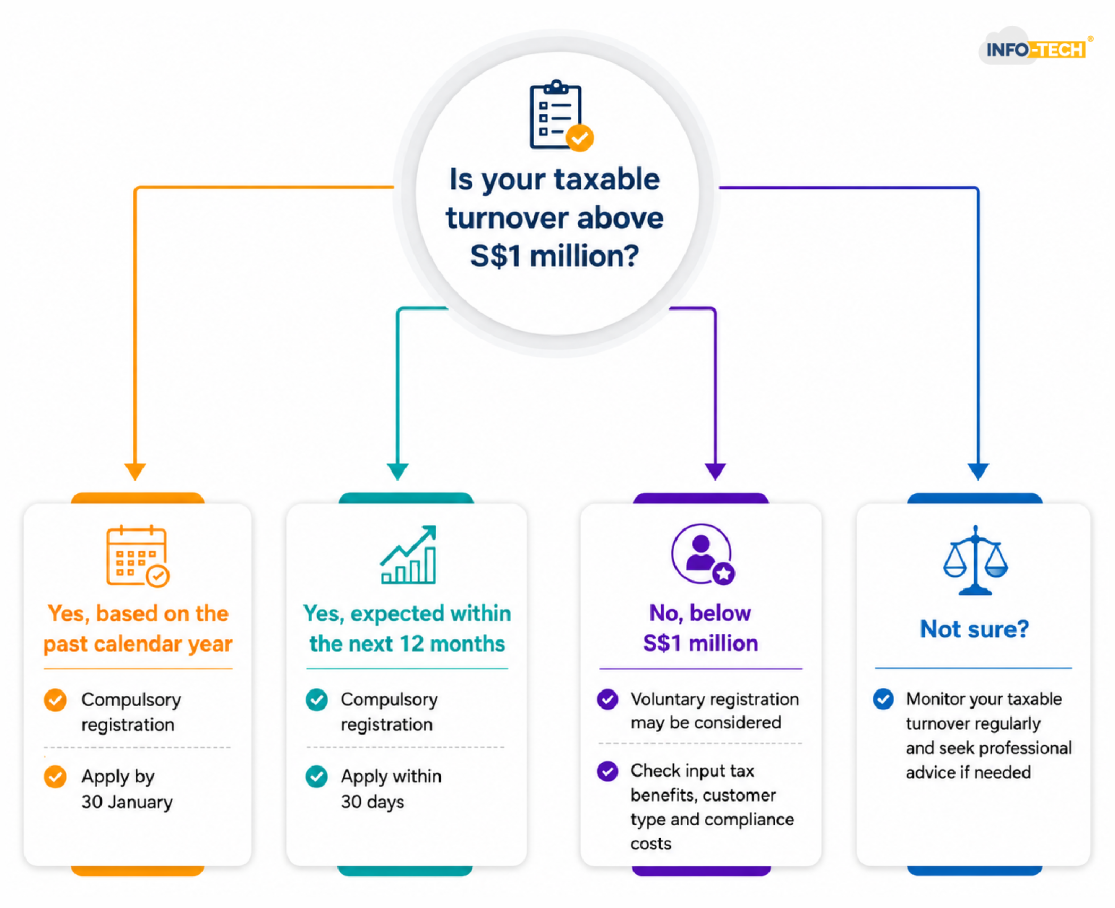
The main threshold is S$1 million in taxable turnover. IRAS applies it by looking both backwards and forwards.
| Test used by IRAS | When it applies | When to register |
| Retrospective test | Taxable turnover was more than S$1 million in the previous calendar year | Apply by 30 January |
| Prospective test | The business reasonably expects taxable turnover to exceed S$1 million in the coming 12 months | Apply within 30 days of the forecast |
The prospective test is where businesses are sometimes caught out. A signed contract or accepted quotation may show that turnover will cross the limit even though the money has not yet been received. For forecasts made from 1 July 2025, the business is generally given two months from the forecast date before it has to begin charging GST.
Read also: Turnover Meaning in Business: Singapore Guide
Which Sales Count Towards the S$1 Million Limit?
The figure to watch is taxable turnover, not every dollar recorded as revenue.
Standard-rated sales made in Singapore normally count. Zero-rated supplies, including qualifying exports and international services, also form part of taxable turnover. Exempt supplies and transactions outside the scope of GST are generally left out.
A one-off sale of a capital asset may also be excluded. For example, selling an old company vehicle does not necessarily mean that the full amount should be added to the registration calculation.
This is one reason the turnover should be checked through proper accounts rather than estimated from bank deposits alone.
Read also: Estimated Chargeable Income (ECI) Guide: Singapore Businesses
Is Voluntary GST Registration Worth Considering?
A business does not have to wait until its turnover reaches S$1 million. It may apply voluntarily while still below the limit.
There can be a practical reason for doing so. A company that spends heavily on equipment, rent, software or professional services may be able to recover eligible GST paid on those costs. It may also be easier to deal with larger corporate customers that are already GST-registered.
Still, voluntary registration is not automatically a saving. The business must start charging GST, file returns and maintain the required records. It is also generally expected to remain registered for at least two years. For a company selling mainly to the public, the extra 9% may affect either its prices or its margin.
Read also: IRAS Employer Tax Filing Deadline 2026: Submit by 1 March
How to Register for GST?
The application is made through the IRAS myTax Portal. The person submitting it will need the correct Corppass authorisation.
Before completing the form, the company should first confirm whether it is registering because it has crossed the threshold or because it has chosen to register voluntarily. That distinction matters because voluntary applicants may have extra conditions to meet.
Once the application and supporting papers are submitted, IRAS may ask for more information about the company’s activities, customers or expected sales. GST should only be charged from the effective date given in the registration notice, not from the day the application was sent.
Read also: IR8A, IR8S and IR21 – How to File with Ease This Tax Season
What Should Be Prepared Before Applying for GST?
IRAS does not ask every applicant for the same set of papers. An established company registering late may need to prove past turnover, while a new company applying voluntarily may need to show that it genuinely intends to carry on a taxable business.
Documents commonly prepared include:
- The latest ACRA Business Profile
- Recent sales and purchase invoices
- Financial statements or management accounts
- Signed contracts, quotations or purchase orders
- Information about the company’s products or services
- Details of major suppliers and customers
- Rental agreements, licences or other evidence of operations
- GIRO or eGIRO details where required
The figures should agree across the application, accounts and invoices. Differences do not always mean the application will fail, but they can lead to more questions and a longer review.
Read also: Withholding Tax Singapore: A Guide For Businesses
What Changed With InvoiceNow in 2026?
From 1 April 2026, every business applying for new voluntary GST registration must meet the GST InvoiceNow requirement, regardless of when it was incorporated or how it is structured.
In practice, the business needs an InvoiceNow-ready solution and must transmit the required invoice data to IRAS through the InvoiceNow network. A company that still prepares invoices separately in Word or Excel should check its setup before starting a voluntary application.
InvoiceNow does not remove the need to maintain records. It changes how invoice data is created and submitted.
Read also: Income Tax Filing Guidelines for Singapore Businesses
How Can Accounting Software Make GST Registration Easier?
Accounting software doesn’t do GST registration for you, but it makes the whole process much smoother and less error-prone. Think of it as getting your numbers and documents “IRAS-ready” without scrambling at the last minute.
They can make GST registration easier by keeping sales, purchases, invoices and expenses in one place. It helps businesses track taxable turnover, see when they are approaching the S$1 million threshold and prepare accurate financial records or reports for the IRAS application.
After registration, the software can calculate GST on sales, record input tax on purchases and generate the figures needed for GST returns. InvoiceNow-ready accounting software like Info-Tech’s can also help businesses meet Singapore’s e-invoicing requirements and reduce errors caused by manual data entry. Get a free demo today.
Read also: Ways to Reduce Income Tax for Singapore Tax Residents
What Happens After Registration or When a Business Is Late?
Once registration takes effect, GST needs to be charged on standard-rated sales. The business must issue proper tax invoices, file its GST returns and keep the relevant records. Filing and payment are generally due within one month after the end of the accounting period, even when the return is a NIL return.
Late registration is more serious. IRAS may backdate the effective date and ask the company to pay GST on earlier sales, including sales where no GST was collected from customers.
The business may also face a fine of up to S$10,000 and a penalty equal to 10% of the GST due. IRAS generally waives the late-notification fine and penalty when a business comes forward voluntarily, although the unpaid GST itself still has to be settled.
GST Registration FAQs
Who is required to register for GST in Singapore?
A business must register for GST in Singapore if its taxable turnover exceeded S$1 million in the previous calendar year or is reasonably expected to exceed S$1 million within the next 12 months. Businesses below this threshold may still apply for voluntary GST registration if they meet IRAS requirements.
How to qualify for GST registration?
You qualify for compulsory GST registration if your taxable turnover exceeded S$1 million in the past calendar year or is expected to exceed S$1 million within the next 12 months. Businesses below the threshold may register voluntarily if they make or intend to make taxable supplies and meet IRAS conditions.
Who is exempt from paying GST?
GST is not charged on exempt supplies such as most financial services, the sale or lease of residential property, digital payment tokens and qualifying investment precious metals. Businesses that mainly make zero-rated supplies may also apply to IRAS for exemption from GST registration.
What is the minimum income for GST registration?
The minimum threshold for compulsory GST registration in Singapore is more than S$1 million in taxable turnover for the past calendar year or the next 12 months. Businesses below this amount may still register voluntarily.
What happens if I don’t apply for GST?
If you are required to register but do not apply on time, IRAS may backdate your GST registration and require you to pay GST on past sales, even when you did not collect it from customers. You may also face a fine of up to S$10,000 and a penalty equal to 10% of the GST due.
