

In this article
- 1. What is Compassionate Leave?
- 2. Does MOM Require Employers to Provide Compassionate Leave?
- 3. How Many Days of Compassionate Leave Do Employees Get?
- 4. Which Family Members Are Normally Covered?
- 5. Is Compassionate Leave Paid?
- 6. What is the Difference Between Compassionate Leave and Annual Leave?
- 7. What Happens When Someone Applies for Compassionate Leave?
- 8. Can Employers Ask Employees for Proof?
- 9. Can A Company Reject Compassionate Leave?
- 10. Compassionate Leave FAQs
Most HR policies only become important when something urgent comes up or something goes wrong. Compassionate leave is one of them.
Nobody usually gives much thought about this leave during onboarding or while signing an employment contract. But when someone suddenly loses a parent, spouse, sibling, or child, everything changes very quickly. At that point, they are not worried about KPIs or work-related deadlines. They somehow try to make funeral arrangements, answer relatives’ calls, deal with emotions, and still update their workplace.
In Singapore, compassionate leave has become fairly common across workplaces, even though it is not legally mandated under MOM regulations. Some companies handle it with empathy and flexibility. Others just rely on vague policies that leave employees confused and tensed during already difficult situations.
If you are an employer, HR manager, startup founder, or an employee trying to understand how compassionate leave actually works in Singapore, this guide breaks it down in a practical, simple and realistic way.
What is Compassionate Leave?
Compassionate leave is time off given to employees after the death of a close family member or during a serious family emergency.
Some companies use the term “bereavement leave” instead, although in Singapore, both terms usually mean the same thing. The idea behind compassionate leave is simple: when somebody experiences a personal loss, they may need time away from work to:
- Attend funeral arrangements
- Travel urgently
- Support family members
- Handle legal or financial matters
- Process grief before returning to work
Read Also: What is Family Care Leave in Singapore and How to Avail It?
Does MOM Require Employers to Provide Compassionate Leave?
No, the Ministry of Manpower (MOM) does not make compassionate leave compulsory under Singapore’s Employment Act. Though this might surprise many employees, compassionate leave has become so common that people assume that it is legally entitled.
But companies are allowed to decide:
- Whether compassionate leave is offered
- How many days are given
- Whether it is paid or unpaid
- Which family members qualify
- What documentation is needed
Very few established employers in Singapore would completely refuse compassionate leave altogether. Even businesses without formal HR structures usually try to accommodate employees during bereavement situations.
Partly because it is the humane thing to do, and also because handling these situations badly can damage the company morale very quickly.
Read Also: Can You Take Sabbatical Leave Without Quitting Your Job?
How Many Days of Compassionate Leave Do Employees Get?
There is no fixed number across Singapore. Still, if you look at common company practice, most employers tend to provide somewhere between two and five days.
The actual number often depends on the relationship involved.
| Relationship | Typical Practice |
| Parent, spouse, child | 3–5 days |
| Sibling | 2–3 days |
| Grandparent | 1–2 days |
| Parent-in-law | 1–3 days |
| Extended family | Usually discretionary |
Definitely, policies on paper and what happens in reality are not always identical.
For example, an employee attending an overseas funeral will need more flexibility because of travel arrangements. Another employee may only require one or two days depending on family circumstances, travel distance and their relationship with the bereaved. So it is practically impossible to predict the number of leaves actually required.
Read Also: Does MOM Require Compensatory Leave?
Which Family Members Are Normally Covered?
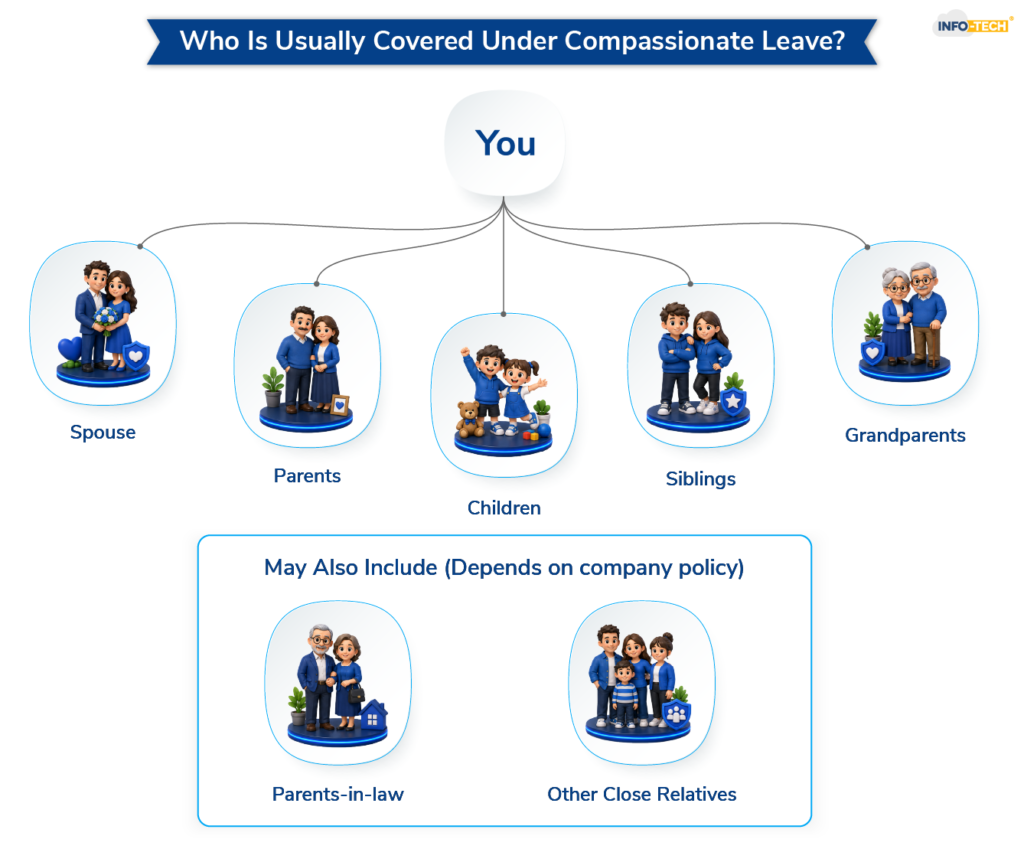
This is where company policies can vary quite a bit. Most Singapore employers define immediate family to be:
- Spouse
- Parents
- Children
- Siblings
- Grandparents
Some organizations also include:
- Parents-in-law
- Step-parents
- Adoptive family members
- Grandparents-in-law
And honestly, this part sometimes becomes sensitive. Not every close relationship fits official HR definitions. Someone may have been raised by a guardian, aunt, or older relative who technically falls outside company policy.
Experienced and understanding HR professionals usually get that compassionate situations need some level of judgment and flexibility instead of purely rigid interpretation.
Is Compassionate Leave Paid?
In Singapore, yes, in many cases it is.
Although MOM does not require paid compassionate leave, many employers still provide it as part of employee benefits, especially for permanent staff.
Some companies offer fully paid leave for a fixed number of days, while others may allow employees to combine compassionate leave with annual leave if additional time is required.
SMEs sometimes tend to manage these situations more informally, especially if they do not have detailed HR policies in place yet. The issue with such informal handling is inconsistency. One employee may receive flexibility because their manager is understanding and another one may not get the same treatment under a different supervisor.
Read Also: Paternity Leave in Singapore: Rules and Eligibility
What is the Difference Between Compassionate Leave and Annual Leave?
In smaller companies especially, employees are occasionally told to “just use annual leave instead.”, so there exists a confusion between these leaves. But the two are not really meant for the same purpose.
Annual leave is planned personal time. Compassionate leave exists because certain situations are sudden, emotional, and unavoidable.
| Leave Type | Purpose |
| Annual Leave | Holidays or personal time |
| Sick Leave | Employee’s medical condition |
| Compassionate Leave | Bereavement or family emergencies |
Unlike annual leave, compassionate leave is not something employees gradually accumulate over time. It is usually situation-based.
What Happens When Someone Applies for Compassionate Leave?
In real life, most employees contact their direct manager regarding this first, Not HR.
A typical process looks something like this:
- Employee informs manager or HR
- Leave duration is discussed
- Work handover is arranged if necessary
- Supporting documents may be submitted later
Many companies today also allow compassionate leave applications through HRMS or leave management software, which helps reduce unnecessary admin during stressful situations. The smoother the process feels, the less additional pressure employees experience.
Can Employers Ask Employees for Proof?
Yes, the employers can ask for proof from the employees. Employers may ask for:
- Death certificates
- Funeral notices
- Obituaries
- Supporting medical documents
While most employees understand why documentation is required, how HR asks for it matters too. There is a big difference between politely requesting supporting records and making someone feel distrusted while they are grieving.
Read Also: Childcare Leave Singapore: Your Entitlements Explained
Can A Company Reject Compassionate Leave?
Technically, yes. Since compassionate leave is not protected under the Employment Act, employers can reject requests, simply stating that they fall outside company guidelines. Still, outright rejection is relatively uncommon. Most companies at least try to offer alternatives such as:
- Unpaid leave
- Annual leave
- Flexible work arrangement
- Temporary remote work
From a management perspective, handling bereavement situations too harshly rarely helps anyone. Employees would remember these moments for years. And honestly, so do their colleagues.
Read Also: National Service Leave (NSL) in Singapore
Why Are Singapore Employers Paying Attention to Compassionate Leave?
Workplace expectations have changed. A decade ago, compassionate leave was often treated as a small “extra benefit.” Today, employees increasingly see it as part of basic workplace empathy. Especially younger employees.
People now pay attention to how companies respond during personal emergencies, not just salary packages or bonuses. In many Singapore workplaces, there is also growing awareness around:
- Mental health
- Emotional well-being
- Caregiver responsibilities
- Burnout
- Psychological safety at work
That shift is largely influencing HR policies too.
Some companies also provide counselling access, flexible return-to-work arrangements, or additional support during bereavement periods. The overall direction is clear: workplaces and policies are becoming more people-centric than they used to be.
Read Also: What Is Garden Leave In Singapore and How It Works?
What Makes A Compassionate Leave Policy Actually Work?
The strongest policies are usually the simplest. Employees should not have to decode complicated HR language during stressful and difficult situations.
A practical compassionate leave policy should clearly explain the following.
Who qualifies: Employees should know which family relationships are covered.
How many days are provided: Avoid vague wording where possible.
Whether the leave is paid: This removes unnecessary confusion later.
How to apply: Simple processes work best during emergencies.
What flexibility is available: Not every situation will fit perfectly into policy wording.
Read Also: Block Leave Entitlement, Eligibility and Difference
Conclusion
Compassionate leave is not just another HR present in an employee handbook.
For employees, it often becomes relevant during some of the hardest moments in their personal lives. And the way a company responds during those moments can shape trust, loyalty, and workplace culture more than employers could realize.
In Singapore, while MOM does not legally mandate compassionate leave, many organizations understand that supporting employees during bereavement is simply part of responsible people management and humane culture.
At the same time, HR teams still need proper structure behind the scenes, especially when managing leave approvals, payroll adjustments, employee records, and policy consistency across departments.
This is where modern HRMS and Leave Management Software can quietly make things easier. Instead of relying on manual spreadsheets, scattered approvals, or inconsistent tracking, companies can manage compassionate leave requests in a smoother, more organized, and more confidential way. Because during difficult situations, employees should be focusing on their family not chasing paperwork.
Read Also: Paid Time Off (PTO): What HR Teams Need to Know
Compassionate Leave Singapore FAQs:
How many days is compassionate leave in Singapore?
Most employers in Singapore commonly provide between two and five days.
What are the rules around compassionate leave?
In Singapore, compassionate leave is not legally required under the Employment Act, so the rules are usually based on individual company policies or employment contracts. Most employers provide 2 to 5 days of leave for the death of an immediate family member, and employees may be asked to provide supporting documents such as a death certificate or funeral notice.
Do I need to submit a death certificate for compassionate leave?
Yes. Employers may request documents like death certificates or funeral notices.
What is an example of compassionate leave?
An example of compassionate leave is when an employee takes a few days off after the death of a parent to attend the funeral, support family members, and manage personal matters. Some companies may also grant compassionate leave if an employee’s close family member is critically ill or facing a medical emergency.
