

In this article
- 1. What Does PTO Mean In Singapore?
- 2. Who Gets Paid Annual Leave In Singapore?
- 3. When Can Employees Start Using Annual Leave?
- 4. How Does Sick Leave Work In Singapore?
- 5. Are Public Holidays Part Of PTO?
- 6. What Happens If Annual Leave Is Not Used?
- 7. Do Part-Time Employees Get PTO?
- 8. Is Personal Time Off The Same As PTO?
- 9. Can An Employer Reject A PTO Request?
- 10. How Should Employers Manage PTO?
- 11. Paid Time Off (PTO) FAQs
Paid time off is something every employee looks at sooner or later. Some people check it when they are planning a holiday. Some check it only when they fall sick or need a day away from work. For employers in Singapore, though, PTO is not just a nice benefit to mention in an offer letter. There are rules behind it.
In Singapore, PTO usually means paid time away from work. This can include annual leave, sick leave, hospitalisation leave and public holidays. Some companies also give personal days, birthday leave or family care leave. Those extras are good to have, but the basic leave entitlements still need to follow the Employment Act.
What Does PTO Mean In Singapore?
PTO simply means that an employee is away from work but still gets paid for that time.
Different companies use different names. One company may call it annual leave. Another may call it vacation leave. A global company may use the term PTO because that is what their main HR policy says. The wording can change, but the idea is the same.
In Singapore, it is better to be clear. Annual leave, sick leave and public holidays are not just company perks. They come with minimum legal requirements. Extra leave, such as wellness days or personal days, depends on what the employer chooses to offer.
Read more: What is Family Care Leave in Singapore and How to Avail It?
Who Gets Paid Annual Leave In Singapore?
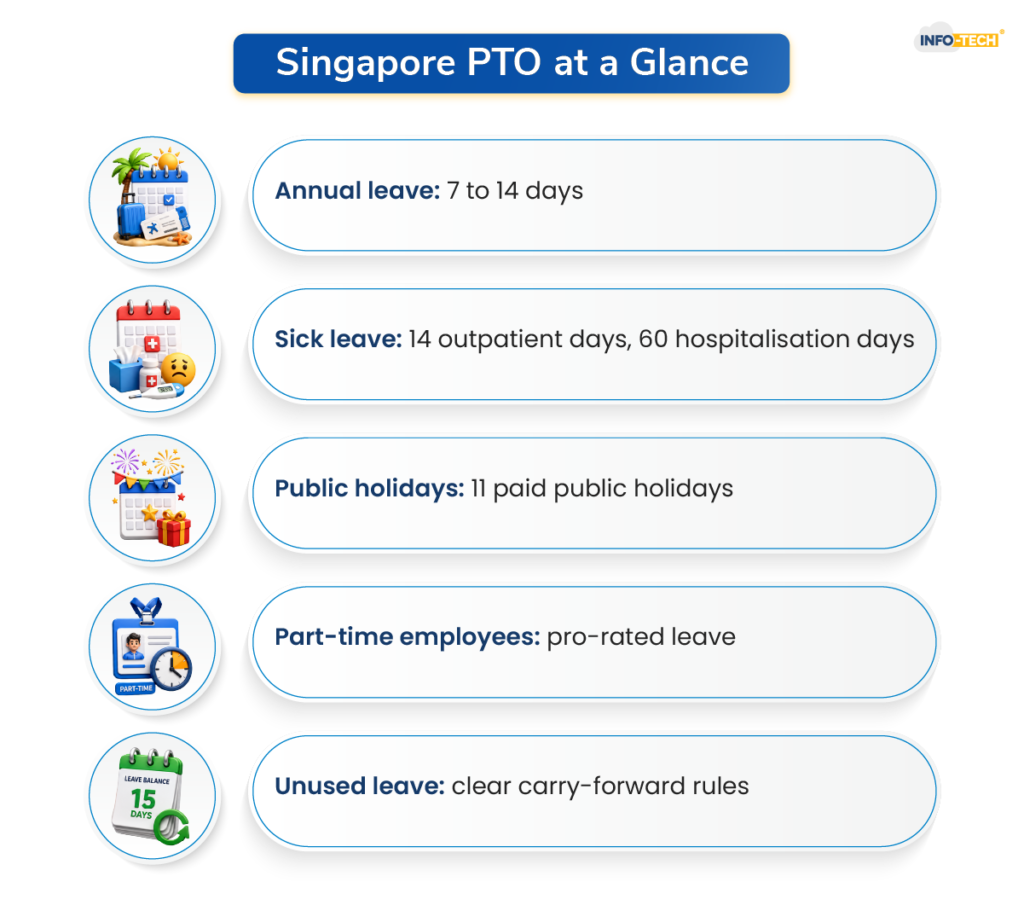
Employees covered by the Employment Act can get paid annual leave after working for the same employer for at least 3 months.
The minimum starts at 7 days in the first year of service. It increases by 1 day each year until it reaches 14 days from the eighth year onwards.
| Year of service | Minimum annual leave |
| 1st year | 7 days |
| 2nd year | 8 days |
| 3rd year | 9 days |
| 4th year | 10 days |
| 5th year | 11 days |
| 6th year | 12 days |
| 7th year | 13 days |
| 8th year onwards | 14 days |
Many employers give more than this, especially if they want to stay competitive. That is completely fine. The law only gives the minimum amount.
When Can Employees Start Using Annual Leave?
Annual leave usually starts to matter once the employee has completed at least 3 months of service.
If the employee has not worked a full year, the leave is normally pro-rated. So, a new employee should not assume they already have the full year’s leave balance. This often comes up during probation, resignation or when someone joins halfway through the year.
This is why the leave policy should be written in a way people can actually understand. If employees have to keep asking HR how many days they have, the policy is probably not clear enough.
How Does Sick Leave Work In Singapore?
Sick leave is different from annual leave. It is meant for times when the employee is not fit to work.
An employee can qualify for paid sick leave after working for the employer for at least 3 months. After 6 months of service, the full entitlement is up to 14 days of paid outpatient sick leave and up to 60 days of paid hospitalisation leave in a year.
The 60 days already includes the 14 days of outpatient sick leave. It is not 14 days plus another 60 days.
Most employers will ask for a valid medical certificate. Employees should also inform the company as soon as possible if they cannot report to work. The process should be simple. When someone is sick, they should not have to struggle with a confusing HR rule.
Are Public Holidays Part Of PTO?
Yes, public holidays are also paid time off.
Singapore has 11 paid public holidays each year. If the employee is off on that day, they should still be paid. If the employee has to work on a public holiday, the employer must compensate them properly. This could mean extra pay or another day off, depending on the situation.
This is especially important for businesses that operate during holidays. Retail stores, restaurants, hotels, clinics, logistics teams and security companies cannot treat public holiday work casually. It should be planned and recorded properly.
Read also: June Holidays 2026: Smart Planning Tips, Dates & Leave Guide
What Happens If Annual Leave Is Not Used?
Unused leave should never be left unclear. Some employees may be allowed to carry forward unused statutory annual leave for a certain period. In many cases, it has to be used within the next 12 months. If it is still not used, it may expire. For leave given above the legal minimum, the company policy or employment contract should explain what happens.
The policy should answer simple questions. Can the leave be carried forward? Can it be paid out? Will it be forfeited? Employees should not have to guess.
Do Part-Time Employees Get PTO?
Yes, part-time employees can also get paid leave.
Their leave is usually calculated based on their working hours and schedule. They may not get the same number of days as a full-time employee, but they should still receive a fair pro-rated amount.
This is one area where mistakes happen easily. If the employee works different hours each week, the calculation can become confusing. Employers should keep proper records instead of doing rough estimates.
Is Personal Time Off The Same As PTO?
Not exactly. Personal time off is usually just one type of PTO.
PTO is the broader term. It can include annual leave, sick leave, public holidays and personal days. Personal time off is normally used for private matters, such as appointments, errands, family needs or a short break.
In Singapore, personal days are usually a company benefit. If the employer offers them, the policy should say how many days are given, whether approval is needed and whether unused days can be carried forward.
Can An Employer Reject A PTO Request?
For annual leave, employers can usually approve or reject requests based on business needs. If too many people want the same dates off, the company may not be able to approve everyone’s request.
But the process should still be fair. Employees should know how requests are reviewed. They should not feel that approval depends on mood, favouritism or last-minute decisions.
Sick leave is different. If an employee is medically unfit for work and has a valid medical certificate, the employer should follow the sick leave rules. Public holiday pay should also be handled according to the law.
How Should Employers Manage PTO?
A good PTO policy does not need to sound complicated. In fact, the simpler it is, the better.
It should explain annual leave, sick leave, hospitalisation leave, public holidays, carry-forward rules, part-time leave, approvals and medical certificate requirements. It should also say what happens when someone resigns or serves notice.
Small teams may manage leave with spreadsheets for a while. But once the company grows, it becomes harder to track balances, approvals and payroll changes manually. A leave management software can make this much easier and reduce mistakes.
At the end of the day, PTO is not only about rules. Employees need time to rest, recover and handle personal matters. Employers need proper planning so work does not suffer. When the policy is clear and fair, both sides benefit.
Read also: Singapore Public Holidays 2026
Paid Time Off (PTO) FAQs
What is the meaning of PTO paid time off?
PTO, or paid time off, means approved time away from work where an employee still receives their regular pay.
Do you get paid on a PTO?
Yes, PTO means you are paid for the approved time you take off from work, usually at your regular rate of pay.
How is PTO calculated?
PTO is usually calculated based on your annual leave entitlement and how long you’ve worked; in Singapore, pro-rated annual leave is calculated as completed months of service ÷ 12 × annual leave entitlement, with fractions below half a day rounded down and half a day or more rounded up. For example, 6 completed months ÷ 12 × 10 days = 5 days of PTO.
Is it better to have more PTO or higher pay?
It depends on your priorities: higher pay is usually better if you need more income for expenses, savings, or financial goals, while more PTO is better if you value rest, travel, family time, or better work-life balance. A good way to compare is to calculate what the extra PTO is worth in daily pay, but also check whether unused PTO can be carried forward or paid out. For many people, the best choice is not one or the other, but a balance of fair pay and enough paid time off to actually recharge.
