

In this article
- 1. What Is the Average Salary in Singapore in 2026?
- 2. How CPF Changes Your Actual Take-Home Pay?
- 3. Which Industries Pay the Highest Salaries in Singapore?
- 4. Singapore Salary by Age
- 5. What Are The Trends In Salary For Fresh Graduates?
- 6. What Is The Reality, Local vs Expat Salary Singapore?
- 7. Are Singapore Salaries Actually High Globally?
- 8. Average Salary in Singapore FAQ
Singapore has a reputation for high salaries, polished skyscrapers, and a workforce that seems permanently switched on. From the outside, it looks like a place where everyone earns well and lives comfortably.
Then you actually speak to people living here.
The marketing executive earning S$4,00 but sharing a condo with strangers. The young couple bringing home a combined five-figure income while stressing over childcare costs. The fresh graduate discovering that “competitive salary” disappears fast after CPF deductions, rent, transport, and daily expenses.
That’s the thing about the average salary in Singapore — the number alone tells only half the story.
On paper, Singapore remains one of Asia’s strongest economies with some of the region’s highest wages. But average income statistics can be deeply misleading if you don’t understand what sits behind them: income inequality, housing inflation, CPF deductions, industry gaps, and the growing divide between high-income professionals and everyone else trying to keep up with the cost of living.
This isn’t another generic salary roundup.
This is a realistic look at what people in Singapore actually earn, what they really take home, and why even “good salaries” don’t always feel enough anymore.
What Is the Average Salary in Singapore in 2026?
The average salary in Singapore currently ranges between S$5,500 and S$6,500 per month before CPF contributions, depending on the source and whether bonuses are included.
At first glance, that sounds impressive.
But averages can distort reality.
Singapore has a large concentration of high earners in industries like investment banking, technology, private equity, and multinational corporate leadership. These salaries pull the national average upward.
A more realistic figure is the median salary Singapore workers earn, which sits closer to S$5,200 monthly including employer CPF contributions.
That distinction matters more than most people realise.
Average Salary vs Median Salary Singapore
| Type | Estimated Monthly Income |
| Average Salary | S$5,500 – S$6,500 |
| Median Salary | ~S$5,200 |
| Entry-Level Salary | S$2,800 – S$4,500 |
| Senior Professional Salary | S$8,000 – S$20,000+ |
The median reflects the midpoint of all earners. Half the workforce earns below it.
And once CPF enters the equation, actual disposable income becomes very different.
Read: https://www.info-tech.com.sg/blog/cpf-guide/
How CPF Changes Your Actual Take-Home Pay?
Many foreigners researching Singapore salaries miss this completely.
CPF contributions significantly reduce monthly take-home income for Singapore citizens and permanent residents.
For employees under 55:
- Employee CPF contribution: 20%
- Employer CPF contribution: 17%
That means a worker earning S$6,000 monthly doesn’t actually receive S$6,000 in cash.
Example of CPF Impact
| Salary Breakdown | Amount |
| Gross Salary | S$6,000 |
| Employee CPF Deduction (20%) | -S$1,200 |
| Actual Take-Home Pay | ~S$4,800 |
For fresh graduates entering the workforce, this often comes as a shock.
A salary that sounded comfortable during job interviews suddenly feels much tighter after deductions and rising living costs.
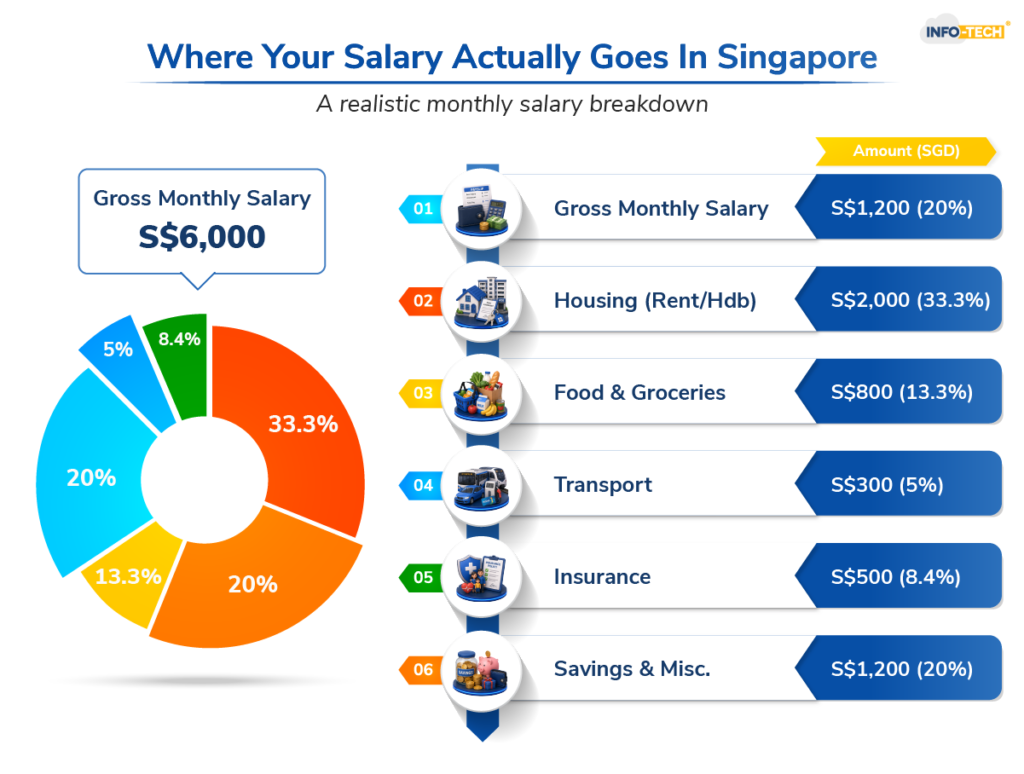
Why Some Singaporeans Earning Above Average Still Feel Financially Stressed
This is where salary discussions become emotional instead of mathematical.
Singapore salaries are high compared to many countries. But so are Singapore’s living costs.
A single person earning S$5,000 may survive reasonably well. A family with children faces a completely different reality.
Typical Monthly Costs in Singapore
| Expense | Estimated Cost |
| HDB Mortgage / Rent | S$1,500 – S$4,500 |
| Childcare | S$800 – S$2,000 |
| Transport | S$150 – S$1,500 |
| Groceries & Dining | S$600 – S$1,500 |
| Insurance | S$300 – S$1,000 |
The cost of living Singapore residents face today has climbed sharply over the last few years, especially after inflation and rising housing prices.
This explains why many middle-income households still feel financially squeezed despite earning technically “good” salaries.
Singapore Salary by Age
Income progression in Singapore is still strongly tied to experience and seniority, though the relationship is changing.
Workers in fast-growing industries now sometimes out-earn older employees in traditional sectors.
Singapore Salary by Age
| Age Group | Average Salary Range |
| 20–24 | S$2,800 – S$4,000 |
| 25–34 | S$4,500 – S$7,500 |
| 35–44 | S$6,000 – S$10,000 |
| 45–54 | S$7,000 – S$12,000 |
| 55+ | Often declines depending on role |
Interestingly, younger tech professionals are increasingly reaching salary levels that previously took decades to achieve.
That shift is quietly reshaping Singapore’s workforce dynamics.
Fresh Graduate Salary Singapore Trends
Fresh graduates entering the workforce today face a strange contradiction.
Starting salaries have improved in many industries. But so have living costs.
Fresh Graduate Salary Singapore
| Degree | Estimated Starting Salary |
| Computer Science | S$5,500 – S$7,000 |
| Finance & Business | S$4,000 – S$5,500 |
| Engineering | S$4,200 – S$5,500 |
| Communications | S$3,500 – S$4,500 |
| Arts & Humanities | S$3,200 – S$4,200 |
Graduates in AI, machine learning, and cybersecurity are seeing particularly strong salary growth due to labour shortages.
At the same time, many younger workers are delaying home ownership and family planning because salary growth no longer stretches as far as it once did.
Local vs Expat Salary Singapore Reality
One uncomfortable truth often left out of salary reports is the difference between local and expat compensation packages.
Senior expatriates working in multinational firms may receive:
- Housing allowances
- International school support
- Relocation packages
- Tax equalisation benefits
- Private healthcare coverage
Locals with identical job titles may not receive the same benefits.
At the executive level, the gap can become substantial.
That said, foreign professionals entering Singapore without expatriate packages are increasingly facing similar cost pressures as locals, especially in rental housing.
Are Singapore Salaries Actually High Globally?
Yes — and no.
Singapore salaries remain among the highest in Asia and are globally competitive after taxes.
Compared to cities like London, Sydney, or Hong Kong, Singapore offers:
- Lower income tax rates
- Strong currency stability
- Strong employment demand
- Regional career opportunities
But income alone does not determine quality of life.
Housing prices, childcare, transportation, and lifestyle expectations significantly reduce disposable income.
A S$9,000 monthly salary may sound wealthy internationally. In Singapore, it can still feel middle-class depending on family responsibilities.
Conclusion
The average salary in Singapore looks impressive on paper. But real financial comfort depends on far more than a headline income figure.
CPF deductions, housing costs, inflation, childcare expenses, and career stability all shape whether someone actually feels financially secure.
That’s why businesses today are under increasing pressure to manage salaries transparently, accurately, and efficiently — especially in a workforce where employees are paying closer attention to compensation than ever before.
For companies handling payroll, CPF calculations, leave management, employee records, and workforce administration in Singapore, having a reliable HRMS and payroll system is no longer optional. It helps reduce compliance risks, improves payroll accuracy, and gives both employers and employees clearer visibility into compensation management without the administrative chaos.
Because in Singapore’s evolving workforce, salary conversations are no longer just about numbers. They’re about trust, sustainability, and quality of life.
Average Salary in Singapore FAQ
What is considered a good salary in Singapore?
For a single person, S$5,000–S$7,000 is generally considered comfortable. Families often require significantly more due to housing and childcare costs.
What is the average salary in Singapore after CPF?
After CPF deductions, take-home pay is usually around 80% of gross salary for employees under 55.
What is the median salary in Singapore?
The median monthly income for full-time employed residents is around S$5,200 including employer CPF contributions.
Which industry pays the highest salary in Singapore?
Investment banking, AI, technology leadership, private equity, and specialised healthcare roles are among the highest-paying sectors.
