

In this article
Why PWCS?
If you’ve ever had to decide whether to increase salaries, you’ll know it’s rarely a clean decision.
On one hand, you want to keep your team motivated. You know the market is moving, and good people don’t stay where they feel undervalued. On the other hand, every increment adds pressure—especially when you’re already dealing with rising costs in everything else.
So most businesses end up somewhere in the middle. They delay. They adjust slowly. Or they increase just enough to get by.
That’s exactly the gap Singapore’s wage support schemes are trying to close.
They’re not there to completely remove the cost. But they do something more realistic—they make the decision less heavy.
And if you’ve been running a business long enough, you’ll know that sometimes that’s all you need.
What Are Wage Support Schemes?
Forget the formal definitions for a moment.
In practice, these schemes are the government saying:
“If you’re willing to raise wages responsibly, we’ll help you carry part of it.”
They’re not complicated in concept. The complexity only shows up when you don’t track things properly or misunderstand how eligibility works.
For most employers, especially SMEs, these schemes quietly reduce the risk behind salary decisions. You’re still investing in your team—but you’re not doing it entirely alone.
How PWCS Changes Decisions?
Out of all the support measures out there, the Progressive Wage Credit Scheme (PWCS) is probably the one you’ll feel most directly.
Not because it’s flashy. But because it affects something very real—your payroll.
Here’s how it works in plain terms.
You increase someone’s salary. Instead of absorbing the full increase, the government co-funds part of it. The support is stronger in the earlier years and gradually reduces over time.
That’s the structure.
But the real impact is psychological.
Because once you know the increase isn’t entirely on you, the decision becomes easier to make.
How PWCS Works in Real Life
Let’s say you’re considering a $200 increment for an employee.
Normally, you’d think:
- Can we sustain this?
- What happens when others expect the same?
- Are we locking ourselves into higher long-term costs?
Now add PWCS into the picture.
Suddenly, that $200 doesn’t fully come out of your pocket—at least not immediately. Part of it is supported. The pressure softens.
You’re still responsible. But you’re not alone.
And that small shift is often enough to move a “maybe later” decision into a “let’s do it now.”
Where PWCS May Be Risky
Here’s the part most articles don’t mention.
The scheme itself isn’t the problem. The way businesses handle it is.
Some companies assume everything will just work automatically. Others don’t really track which employees qualify. And quite a few don’t realise that the increase has to be sustained, not just a one-off adjustment.
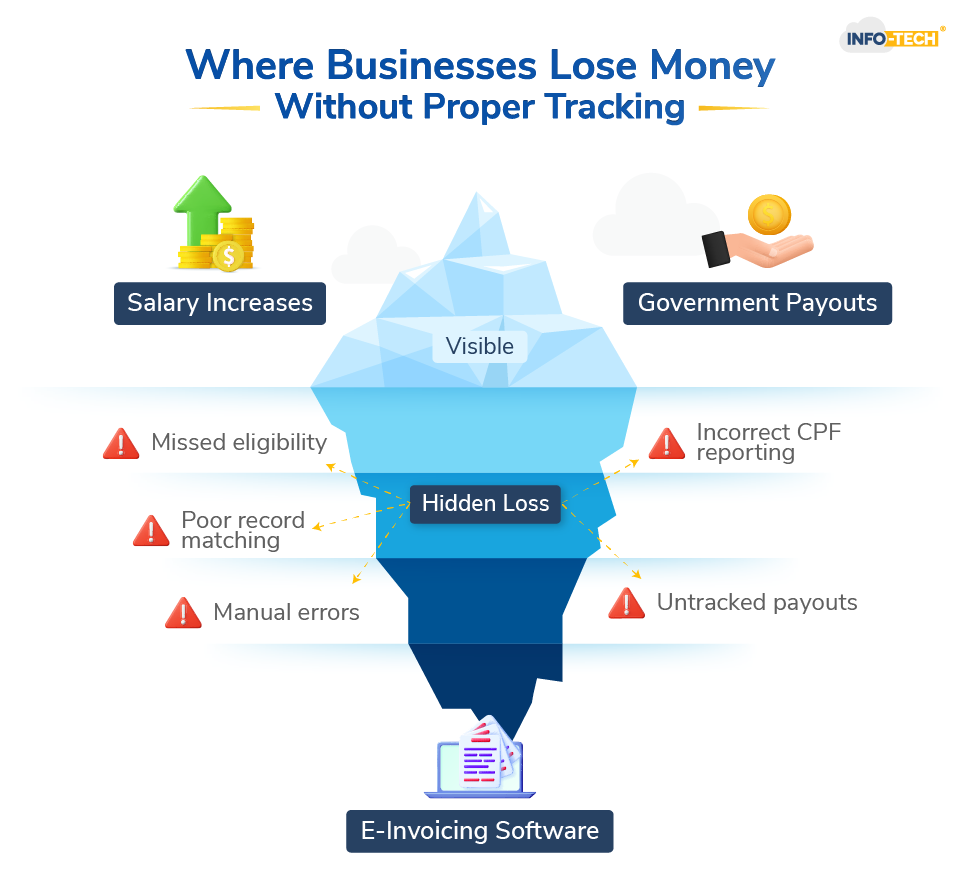
Then there’s the backend side of things—CPF records, payroll timing, reporting accuracy. These sound like small details, but they’re exactly where things slip.
And when they do, it’s not always obvious immediately. You only realise later that you didn’t get the full benefit you could have.
What Are the Disadvantages of PWCS?
Most businesses don’t struggle with understanding PWCS. They struggle with keeping everything aligned.
Think about it.
You’ve got:
- Payroll sitting in one system
- Finance records somewhere else
- Government payouts coming in separately
- And reports that don’t always match up cleanly
At first, it’s manageable. Then it slowly becomes confusing.
You start asking:
- Did we receive the correct payout?
- Which salary changes were actually supported?
- Are we tracking this properly for audits?
And that’s when things feel unnecessarily complicated.
Why Systems Matter for PWCS
Not in a “tech solves everything” way. But in a very practical sense.
When your financial records are clean and connected, everything becomes easier to understand.
A good e-invoicing software helps bring that clarity.
It doesn’t just handle invoices. It helps you:
- Keep track of incoming government payouts
- Match them against payroll changes
- Maintain proper records without digging through spreadsheets
- And avoid those end-of-year headaches where nothing quite lines up
It’s one of those things you don’t think about much—until you realise how much time and uncertainty it removes.
What PWCS Means for Employers
At the end of the day, wage support schemes like the Progressive Wage Credit Scheme (PWCS) aren’t just about saving money.
They’re about making better decisions easier.
Without support, salary increases feel like a risk.
With support, they feel like a step forward.
And in a place like Singapore, where talent moves quickly and expectations are only going up, that difference matters more than most people admit.
Conclusion
If you look at it purely from a numbers perspective, PWCS reduces your cost. That’s true.
But if you look at it from a business perspective, it gives you something more valuable—breathing room.
Room to reward your employees without overthinking every dollar.
Opportunity for planning ahead instead of reacting late.
Room to stay competitive without stretching too far.
And when you combine that with the right tools—like reliable e-invoicing software to keep everything clear and organised—you’re not just managing wages better.
You’re running your business with a bit more confidence.
And honestly, that’s something every employer could use.
Learn More: What Is Annual Wage Supplement (AWS) in Singapore?
PWCS Frequently Asked Questions
What is the Progressive Wage Credit Scheme (PWCS) in Singapore?
The Progressive Wage Credit Scheme (PWCS) helps employers in Singapore manage salary increases by co-funding part of the wage increment. It’s designed to support sustainable wage growth, especially for lower- and middle-income employees, while easing the financial burden on businesses.
Who is eligible for PWCS in Singapore?
Singapore-registered employers may qualify for PWCS when they raise the wages of Singapore Citizen or Permanent Resident employees who receive CPF contributions. For 2026, the employee must earn no more than S$4,000 monthly after the increase, receive at least a S$100 wage increase, and have CPF contributions for at least three months in both the preceding and qualifying years.
How much does PwC pay per month in Singapore?
There is no fixed monthly payout; in 2026, the Government co-funds 30% of the qualifying monthly wage increase, up to the S$3,000 wage ceiling—for example, a S$200 increase receives S$60 per month in support.
Do I need to apply for PWCS?
In most cases, no manual application is required. The payouts are typically processed automatically based on CPF and payroll data. However, accuracy in reporting is important—if your records are off, you may not receive the full benefit.
Why didn’t I receive the expected payout?
This usually comes down to eligibility issues—such as salary thresholds, non-sustained increments, or reporting inconsistencies. It’s worth reviewing your payroll and CPF submissions carefully to ensure everything aligns.
Is PWCS only for large companies?
Not at all. In fact, SMEs often benefit more because the cost relief makes a bigger difference to their overall financial position.
