

In this article
- 1. What is Expense Reimbursement?
- 2. Which Expenses can Employees Claim in Singapore?
- 3. Is Expense Reimbursement Taxable in Singapore?
- 4. Do Employees Need Receipts for Every Claim?
- 5. Can an Employer Reject a Reimbursement Claim?
- 6. What Should a Reimbursement Policy Include?
- 7. How does the Reimbursement Process Work?
- 8. Why Reimbursements Get Delayed?
- 9. How Can Expense Reimbursement Be Made Easier?
- 10. Expense Reimbursement FAQs
Most employees don’t mind paying for a client lunch or for a quick ride to a site visit. What they mind is waiting three weeks to get that money back. Finance teams feel it too, with missing receipts, wrong categories and hours spent keying claims into spreadsheets.
This guide covers what you can reimburse in Singapore, how IRAS treats these payments, and practical ways to speed things up for everyone.
What is Expense Reimbursement?
Expense reimbursement is when a company pays an employee back for business costs they covered with their own money. It’s a repayment, not extra pay, so it is generally covered outside the employee’s salary.
It often gets mixed up with two other payments:
- Reimbursement: repays an actual cost after it happens, backed by a receipt.
- Allowance: a fixed amount paid regularly, like a monthly transport allowance, whether or not the employee spends it.
- Advance: money given before the expense, with any unused balance returned afterwards.
Which Expenses can Employees Claim in Singapore?
Each company sets its own list, but these categories show up in almost every policy.
| Category | Common examples | What policies specify |
|---|---|---|
| Local transport | Taxi, Grab, MRT fares, parking, ERP for client visits | Whether private car use is paid per km or on actual costs |
| Overseas travel | Flights, hotels, visa fees, travel insurance | Cabin class and nightly hotel caps |
| Meals | Meals on business trips, overtime meals | Per-meal or daily limits |
| Client entertainment | Client lunches, event tickets | Spending caps and attendee names |
| Training | Courses, workshops, conference fees | Must be job-related, often needs pre-approval |
| Equipment and supplies | Stationery, peripherals, software subscriptions | Pre-approval above a set amount |
| Phone and internet | Work share of a personal mobile bill | A fixed monthly cap |
| Medical | GP consultation fees | Annual cap, panel vs non-panel clinics |
Is Expense Reimbursement Taxable in Singapore?
Usually, no. If the employee spent the money on company business and can prove it, IRAS doesn’t treat the repayment as income. Fixed allowances are a different story.
| Payment type | Taxable? | Reason |
|---|---|---|
| Actual business expenses with receipts | No | It only repays a work cost |
| Mileage for business use of a private car | No | It covers actual business travel |
| Per diem on overseas business trips | Only the amount above IRAS’s daily rates | IRAS publishes a rate per country |
| Medical reimbursements | Generally, no | Covered under IRAS rules on medical benefits |
| Fixed monthly transport or phone allowance | Yes | Paid regardless of actual spend |
| Personal costs, like gym fees | Yes | Not a business expense |
Any taxable amount goes into the employee’s Form IR8A.
If your company’s GST registration is done, you can usually claim input tax on employee business expenses when you hold a valid tax invoice or receipt. A few items are blocked though, including club memberships, costs of S-plated cars, and medical expenses unless required by law or a collective agreement. IRAS updates these rules from time to time, so it is best to check the latest guidance before finalizing the company’s policy.
Read also: IR8A, IR8S and IR21 – How to File with Ease This Tax Season
Do Employees Need Receipts for Every Claim?
Yes, for almost everything. A receipt shows the amount, date, vendor and what was bought, which is exactly what approvers and auditors look for. Some companies let very small claims like a bus fare go through without one, but employees should still log them properly.
IRAS expects businesses to keep records for five years. So receipts should live somewhere safe and searchable, not buried in someone’s inbox or a drawer.
Can an Employer Reject a Reimbursement Claim?
Yes, if the claim falls outside the company’s policy. The main exception is medical consultation fees. Under MOM rules, if an employee is entitled to paid sick leave and gets an MC from a company-appointed doctor or a public medical institution, the employer has to pay the consultation fee.
But, when an employer turns down a claim, it is required to tell the employee why.
What Should a Reimbursement Policy Include?
A short, clear policy prevents most disputes before anyone spends a cent. Cover the following points:
- Claimable categories and limits, split by role where it makes sense. A field technician’s transport needs look nothing like an office admin’s.
- The proof needed for each type, such as a receipt photo, a tax invoice or attendee names for entertainment.
- A submission deadline, for example within 30 days of the expense.
- Who approves what, and the amount that needs a second approver.
- Anything that needs pre-approval, like overseas trips or equipment above $500.
- How foreign currency claims are converted.
- When employees get paid, ideally with the next payroll run.
How does the Reimbursement Process Work?
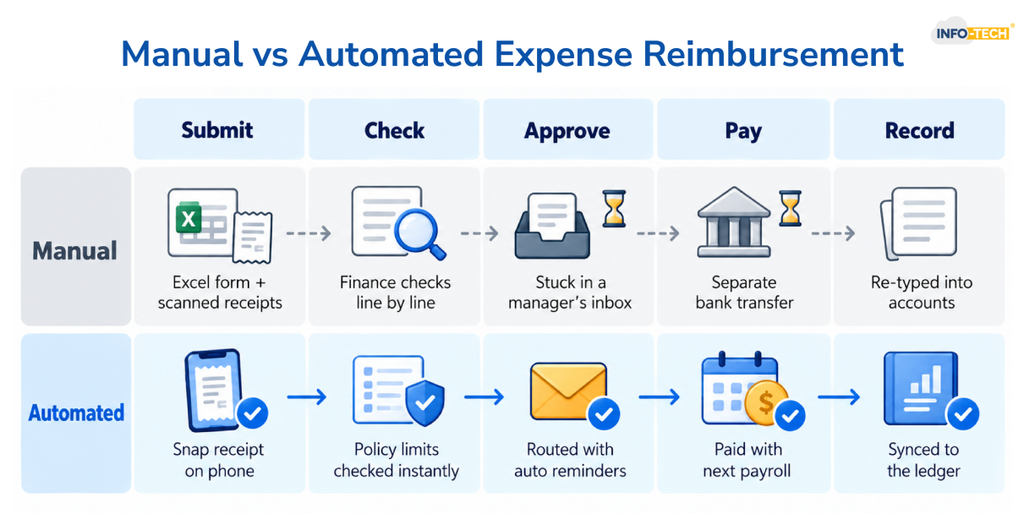
The steps are the same everywhere. What changes is how much of it happens by hand.
| Step | Manual process | Automated process |
|---|---|---|
| Submit | Excel form emailed with scanned receipts | Employee snaps the receipt on their phone and details fill in |
| Check | Finance checks each line against the policy | System flags over-limit or duplicate claims |
| Approve | Claim waits in a manager’s inbox | Routed to the right approver with reminders |
| Pay | Separate bank transfer or manual payroll entry | Added to the next payroll run automatically |
| Record | Typed into the accounting system | Posted to the general ledger automatically |
Why Reimbursements Get Delayed?
Slow payouts chip away at trust quickly, and the causes are usually easy to fix.
| What slows things down | Simple fix |
|---|---|
| Employees save up claims and submit months later | Set a deadline and send automatic reminders |
| Receipts go missing or print fade | Capture them on the spot with a mobile app |
| Approvers are travelling or swamped | Allow mobile approvals and name a backup approver |
| Vague rules lead to endless back and forth | Publish clear limits for every category |
| Finance re-keys data across systems | Connect claims, payroll and accounting |
How Can Expense Reimbursement Be Made Easier?
The biggest time saver is getting rid of paper and re-keying. With Info-Tech’s Claims Management Software, employees submit claims from their phone, approvers sign off wherever they are, and your policy limits are checked before a claim ever reaches finance.
Approved claims then flow into Payroll Software, so staff get reimbursed with their salary and taxable items land in the right place for IR8A. Pair it with Accounting Software and every claim is recorded in your books without anyone typing it in again.
If you’d rather not run payroll in-house at all, our Payroll Outsourcing Service can handle claims payouts alongside monthly salaries.
A clear policy and the right tools mean employees get their money back faster, and your finance team spends its time on work that matters.
Expense Reimbursement FAQs
How to record an expense that will be reimbursed?
Record the expense when the claim is approved, then clear it when you pay the employee back. That way the cost shows up in the month it was incurred, even if the payout happens later.
What are some examples of reimbursable expenses?
Common reimbursable expenses in Singapore include local transport like Grab rides and parking, overseas travel costs, business meals, client entertainment, training fees, work equipment, the work share of phone bills, and GP consultation fees. Personal meals, daily commutes, traffic fines and upgrades beyond policy are usually not covered, though each company’s expense policy has the final say.
How to account for reimbursed expenses?
Record the reimbursed expense in two steps. When the claim is approved, debit the relevant expense account (and GST input tax if you’re GST-registered and hold a valid tax invoice), and credit Employee claims payable. When you pay the employee, debit Employee claims payable and credit Bank, or credit payroll clearing if the payout goes through payroll.
How to fill up a reimbursement expense receipt?
Fill in your details, the expense date, vendor, category, a short business purpose (with attendee names for entertainment), and the amount with GST shown separately. Attach a clear receipt, sign the declaration, and submit it to your approver, or use a signed declaration with backup such as a bank statement if the receipt is lost.
