

In this article
- 1. What Does Human Capital Management Mean?
- 2. Why Does HCM Matter In a Business?
- 3. What Is Included In HCM?
- 4. How Does HCM Help With Hiring?
- 5. How Does HCM Improve Onboarding?
- 6. How Does HCM Support Payroll, Attendance and Benefits?
- 7. What Are The Benefits Of HCM Software?
- 8. Is HCM Different From HRMS And HRIS?
- 9. Where is HCM heading next?
- 10. HCM Frequently Asked Questions
What Does Human Capital Management Mean?
Human Capital Management, or HCM, is basically about how a business looks after its people and gets the best from them. It is close to human resources, but it goes a little further than the usual HR admin work.
When people hear HR, they often think of payroll, leave forms, attendance, employee records and contracts. Those things are part of Human Capital Management too. But Human Capital Management also looks at hiring, onboarding, training, performance, career growth, employee engagement and long-term workforce planning.
The thinking behind HCM is simple. Employees are not just names in a payroll file. Their skills, experience, attitude and development all affect how well the company performs.
Read also: Why Singapore Businesses Prefer Unified HRMS + ERP Platforms
Why Does HCM Matter In a Business?
Most business problems do not always look like people problems at first. A project gets delayed. Customers complain. A good employee resigns. Payroll mistakes happen. A manager cannot find the right person for a role. Behind many of these issues, there is usually something connected to people management.
That is why Human Capital Management matters. It helps a company manage employees in a more practical and planned way instead of only reacting when something goes wrong.
It also gives HR teams a bigger role. HR is no longer only expected to process forms and salaries. In many companies, HR now helps with workforce planning, compliance, employee experience and management reporting. Human Capital Management gives them the structure and data to do that properly.
Read also: Best HR & Payroll Software in Singapore: How to Choose
What Is Included In HCM?
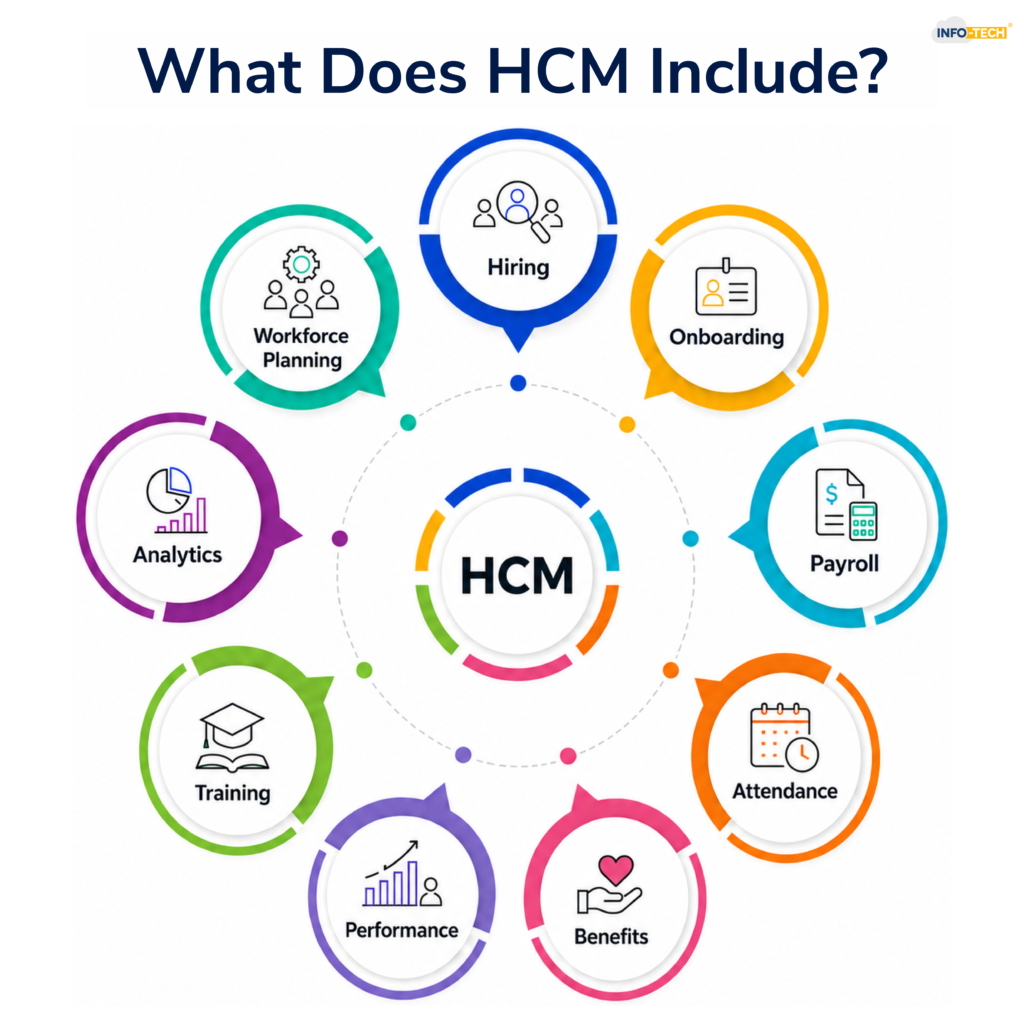
HCM can include almost every stage of an employee’s time with the company. It may start with recruitment, then continue with onboarding, payroll, attendance, benefits, performance reviews, training and development.
For some companies, Human Capital Management is mainly about keeping payroll, leave and employee records under control. For bigger companies, it may also include workforce planning, compensation planning, succession planning, learning programs, analytics and employee self-service.
The point is not to make HR sound more complicated. The point is to bring all the important people-related work into one clearer system, so things do not sit separately in emails, spreadsheets and paper files.
Read also: What to Know Before Changing HR Software
How Does HCM Help With Hiring?
Hiring is one of the areas where poor planning can become expensive. If a company hires too quickly, it may bring in the wrong person. If it hires too slowly, the existing team may become overloaded.
HCM helps businesses understand what kind of people they actually need. It can show where skill gaps exist, which teams need support and what roles are becoming harder to fill.
It also helps HR manage the hiring process better. Candidate details, interview progress, hiring notes and approvals can be tracked properly. This makes recruitment less messy and helps managers make decisions with more information in front of them.
Read also: How HRMS Software Helps Eliminate Payroll Errors
How Does HCM Improve Onboarding?
A new employee does not become ready just because they have joined the company. The first few days and weeks matter a lot. If onboarding is poor, the person may feel confused, unsupported or unsure about what is expected.
Human Capital Management helps make onboarding more organized. It can guide new employees through documents, company policies, training steps, introductions and role expectations.
Good onboarding also helps the company. New hires settle in faster, managers spend less time repeating the same information, and employees are more likely to feel connected from the beginning.
Read also: Top Recruitment Challenges Faced by HR Professionals
How Does HCM Support Payroll, Attendance and Benefits?
Payroll and attendance may sound like routine HR work, but they are areas where small mistakes can create big frustration. If salary, leave, overtime or deductions are wrong, employees will notice immediately.
HCM connects employee data, working hours, leave, overtime, benefits and payroll information. This reduces repeated manual entry and helps HR teams work with cleaner records.
For example, when attendance data is connected to payroll, salary calculations become easier to manage. When leave records are updated properly, managers can see who is available and who is away. Benefits information can also be handled more clearly, instead of being managed through scattered files.
Read also: HR Timesheet Software: Boosting Resource Planning
What Are The Benefits Of HCM Software?
HCM software is useful because it gives HR, managers and employees one place to handle many daily tasks. Without it, companies often end up using a mix of spreadsheets, email threads, paper forms and separate systems.
With Human Capital Management software, employees can usually apply for leave, check payslips, update details and submit requests on their own. Managers can approve requests, view attendance and check team information without asking HR for every small update.
It also helps with reporting. A company can look at headcount, payroll cost, absenteeism, turnover, training and performance data more easily. This makes it easier to see what is happening inside the workforce instead of guessing.
Another important benefit is compliance. Proper records, approvals and workflows help reduce the risk of missing important HR or payroll requirements.
Read also: How HR Software Helps Small Businesses
Is HCM Different From HRMS And HRIS?
These terms are easy to mix up because they overlap.
HRIS usually means a system that stores employee information and handles basic HR records. This can include personal details, job information, leave balances, payroll data and benefits records.
HRMS is normally wider. It may include HRIS features, plus payroll, attendance, recruitment, training and performance tools.
HCM is the broader idea. It is not only the software. It is the way a company manages and develops its workforce. Human Capital Management software may include HRIS and HRMS features, but the purpose is wider than admin. It is also about skills, productivity, engagement and long-term people planning.
Where is HCM Heading Next?
HCM is becoming more connected because the workplace itself has changed. Employees may work from the office, from home, across branches or even across countries. HR teams need faster access to information, and managers need clearer workforce data.
Many companies already use cloud tools for payroll, attendance or recruitment. The problem starts when all these tools work separately. HR still has to move information from one place to another, and managers still do not get a full picture.
Modern HCM is moving towards unified systems where payroll, time attendance, performance, learning and employee records work together. AI and automation are also starting to play a bigger role by reducing routine tasks and helping HR spot trends earlier.
In the end, HCM is not just about managing HR paperwork. It is about helping a company understand its people better, support them properly and build a workforce that can keep up with change.
HCM Frequently Asked Questions
What is HCM software?
HCM software is a system that helps businesses manage HR tasks such as hiring, onboarding, payroll, attendance, benefits, performance, training, and employee records in one place.
Is HCM the same as ERP?
No, HCM is not the same as ERP. HCM focuses on managing people-related functions like payroll, attendance, hiring, training, benefits, and performance, while ERP manages wider business operations such as accounting, finance, inventory, procurement, sales, and supply chain. HCM can be part of, or integrated with, an ERP system.
Is HCM a CRM?
No, HCM is not a CRM. HCM manages people inside the company, such as employees, payroll, attendance, hiring, training, benefits, and performance. CRM manages customers and sales, such as leads, enquiries, follow-ups, quotations, deals, and customer relationships.
What is the main purpose of HCM?
The main purpose of HCM is to help businesses manage their workforce better, improve productivity, reduce HR errors, and support employee growth.
