
In this article
- 1. What is Employee Self-Service (ESS)
- 2. Why ESS Matters in Practice
- 3. What Are the Functions of ESS Platforms
- 4. What Improvements Can Be Seen With ESS
- 5. How ESS Simplifies Onboarding Process
- 6. How ESS Manages Documents Without Duplication
- 7. How ESS Supports Compliance and Records Accuracy
- 8. How ESS Impacts Employee Development
- 9. Conclusion
- 10. ESS Frequently Asked Questions
As organisations grow, the amount of routine HR work also increases. Most of this work is not difficult, but it happens again and again—requests for payslips, leave balances, policy documents, and small updates.
Over time, these small tasks start taking up a large part of HR’s time.
Employee self-service portals serve the purpose of solving this problem. Instead of adding more work to HR, they reduce the need for HR to handle everyday requests.
What is Employee Self-Service (ESS)?
An employee self-service portal is usually part of a larger HRMS system. It allows employees to access and manage their own information without depending on HR for every task.
This includes things like:
- Updating personal and bank details
- Applying for leave
- Viewing payslips and benefits
- Accessing company policies and documents
The idea is simple: employees should be able to get basic information on their own, without waiting for someone else.
Why ESS Matters in Practice?
In many workplaces, delays do not happen because the work is difficult. They happen because of repeated small interruptions.
Each request may only take a few minutes. But when the same questions come in every day, they slow things down.
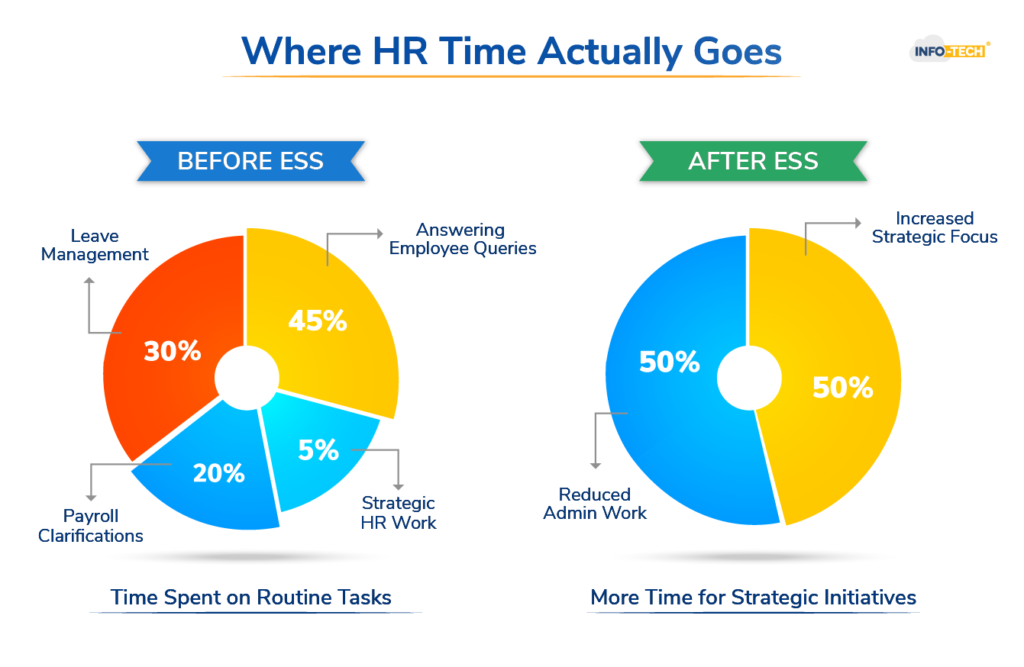
An ESS system changes this. Employees can find what they need on their own. HR teams no longer have to respond to the same queries repeatedly.
The change may not feel dramatic, but over time, work becomes smoother and more predictable.
What Are the Functions of ESS Platforms?
Most employee self-service portals are being built around a similar set of features:
- A central place for employee information
- Access to documents such as contracts and payslips
- Digital leave application and tracking
- Clear view of payroll and benefits
- A simple way to communicate with HR
These features are not new. What makes a difference is having them all in one place, easy to access and use.
What Improvements Can Be Seen With ESS?
| Traditional Approach | With ESS in Place | Practical Outcome |
| HR answers routine questions | Employees check information themselves | Less interruption for HR |
| Documents stored in different places | All documents in one system | Less confusion |
| Leave handled manually | Leave requests done digitally | Fewer mistakes |
| Payroll questions handled one by one | Payslips available anytime | Fewer queries |
| Communication spread across channels | One structured platform | Clearer communication |
How ESS Simplifies Onboarding Process?
Onboarding is often where problems start to show.
New employees may need to fill out forms, wait for documents, and follow up on missing information. This can make the process feel disorganised.
With an ESS portal, onboarding becomes more structured:
- Documents completed online
- Contracts signed digitally
- Policies are available from the start
- Information does not need to be requested again
The process may not be faster, but it becomes clearer and easier to manage.
How ESS Manages Documents Without Duplication?
Managing employee documents has always been a challenge. Even with digital systems, files can be scattered, outdated, or repeated in different places.
An ESS platform brings everything into one system. Employees know where to find documents, and HR does not need to send the same files again and again.
This reduces confusion and saves time on both sides.
How ESS Supports Compliance and Records Accuracy?
Compliance depends on keeping records accurate and up to date.
ESS systems help by creating a clear and consistent way to handle information. Employees enter their own data, and all updates follow the same process.
Attendance, leave, and employee records are stored properly, which reduces errors.
Compliance still needs attention, but it becomes easier to manage.
How ESS Impacts Employee Development?
Some platforms also include features for performance and development.
These may allow:
- Setting and tracking goals
- Giving and receiving feedback
- Recording performance reviews
When everything is stored in one place, it becomes easier to see how employees are progressing over time.
Gradual Improvements in Engagement
The effect of it on employee engagement is not immediate.
However, when employees can access information easily and do not have to wait for responses, daily frustrations reduce.
Clear processes and easy access create a more stable work environment. Over time, this helps employees feel more comfortable and connected at work.
Conclusion
Employee self-service portals are not about changing everything. They are about improving how everyday tasks are handled.
By giving employees direct access to information, organisations reduce delays, avoid repeated work, and make processes more efficient.
This allows HR teams to focus on work that requires attention and decision-making, instead of handling the same routine tasks every day.
In simple terms, ESS helps workplaces run in a more organised and consistent way.
Learn More: Why Singapore Businesses Prefer Unified HRMS + ERP Platforms
ESS Frequently Asked Questions:
What is an employee self-service portal?
An employee self-service portal is a system that allows employees to access and manage their personal, payroll, and HR-related information without depending on HR for routine requests.
How does an ESS portal help HR teams?
An ESS portal reduces repetitive queries, automates basic processes like leave requests, and allows HR teams to focus on more important tasks instead of handling routine administrative work.
What features are included in an employee self-service system?
Most ESS systems include access to payslips, leave management, document storage, employee data updates, and basic communication tools for interacting with HR.
Why is employee self-service important for businesses?
Employee self-service improves efficiency by reducing delays, minimising manual work, and making information easily accessible. This leads to smoother operations across the organisation.
