
In this article
- 1. How GST Reached 9%?
- 2. Where GST Is Used in Daily Business?
- 3. Do You Need to Register for GST?
- 4. How GST Works?
- 5. What Are the Complicated Parts of GST?
- 6. What GST Situations Can Come Unexpectedly For Businesses?
- 7. Why GST Is Not Just Tax?
- 8. What is the Role of E-Invoicing in Keeping Tax Clean?
- 9. Conclusion
- 10. GST Frequently Asked Questions
If you ask around, most people will give you the same quick answer: GST in Singapore is 9%.
That’s correct—but if you’ve ever had to deal with it in real life, you’ll know it’s not just about knowing the number. It’s about how that number fits into everything else you’re doing, especially if you run a business.
Because GST doesn’t sit in isolation. It shows up in your pricing, your invoices, your expenses, and sometimes even in conversations with customers who question why your quote suddenly looks higher than expected.
So while 9% is the official answer, it’s worth understanding what sits behind it.
How GST Reached 9%?
Singapore didn’t move to 9% overnight.
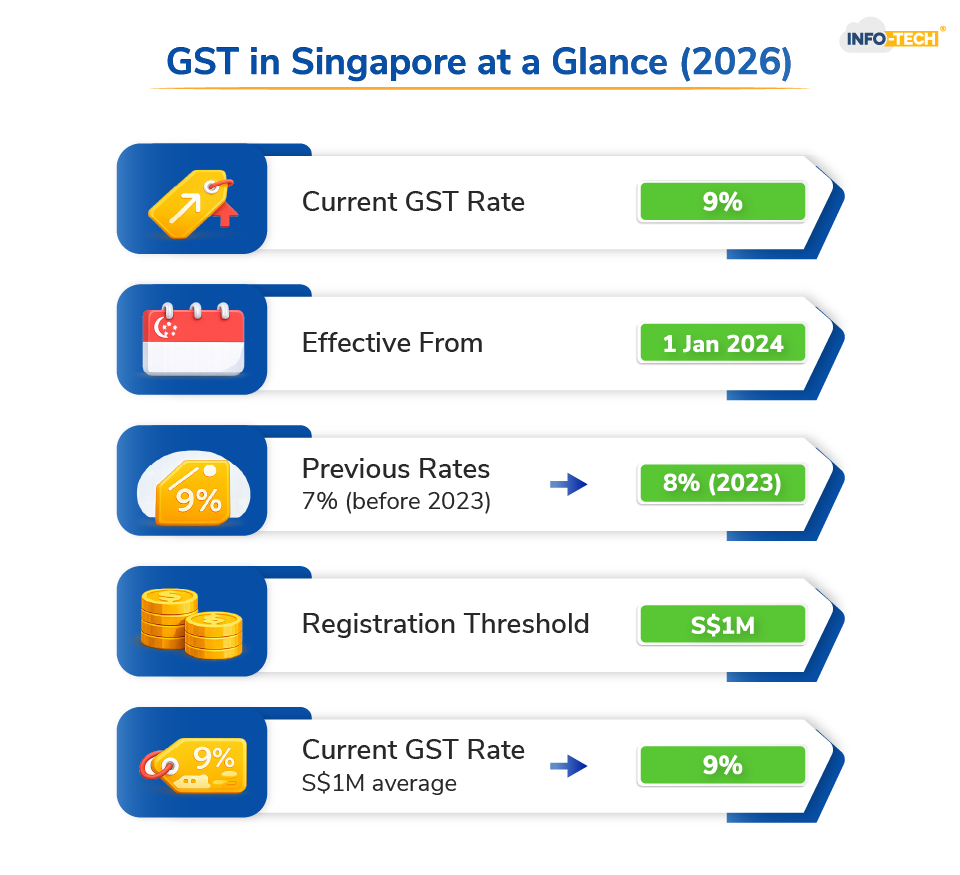
For many years, it stayed at 7%. Then it was increased in two steps—first to 8% in 2023, and then to 9% in 2024. The staggered approach wasn’t accidental. It gave businesses time to adjust without having to overhaul everything at once.
From a business standpoint, that transition period was when most companies updated their pricing, systems, and invoicing formats. By now, things have largely settled, and 9% is simply part of the baseline.
Where GST Is Used in Daily Business?
If you’re running a business, GST becomes part of your routine pretty quickly.
It appears in:
- The invoices you send out
- The payments you receive
- The expenses you incur
- The reports you file
What’s important to remember is that this tax is not your income. You’re collecting it on behalf of the government.
That sounds obvious, but it’s easy to lose sight of when you’re managing cash flow. The money comes in with your sales, but a portion of it doesn’t belong to you—and eventually, it needs to be accounted for.
Do You Need to Register for GST?
Not every business needs to deal with GST right away.
You’re only required to register when your taxable turnover exceeds S$1 million over a 12-month period, or if you expect it to exceed that amount.
Until then, you don’t charge GST.
Some businesses choose to register earlier, especially if they want to claim GST on their expenses. But once you’re in, you’re fully in—you need to charge it properly, keep accurate records, and file returns on time.
There’s no halfway version of it.
How GST Works?
At a basic level, it works like this:
You charge 9% to your customer.
Paying GST on your own business expenses.
You claim the difference.
That’s the theory.
And if you’re dealing with just a few transactions, it stays simple.
What Are the Complicated Parts of GST?
Things change once your business grows a little.
You start dealing with:
- Multiple invoices across different dates
- Clients who pay late or partially
- Refunds or credit notes
- Different types of transactions
And suddenly, what used to be a straightforward calculation becomes something you need to track carefully.
Not because GST itself is complex—but because real business activity rarely happens in a neat, linear way.
What GST Situations Can Come Unexpectedly For Businesses?
Most issues don’t come from big mistakes. They come from small oversights.
For example:
- Charging GST incorrectly on certain items
- Forgetting to update records after adjustments
- Mixing up zero-rated and exempt supplies
- Missing documentation for claims
Individually, these seem minor. But when it’s time to file returns, they start to surface—and fixing them takes more time than expected.
Why GST Is Not Just Tax?
A lot of people assume GST is something your accountant handles.
And while that’s partly true, the reality is that GST depends heavily on how your day-to-day processes are set up.
If your invoicing, expense tracking, and record-keeping are consistent, GST tends to flow smoothly.
If they’re not, GST becomes something you keep revisiting—checking, correcting, and sometimes second-guessing. So it’s less about understanding the rules, and more about how well your systems support those rules.
Accounting software can make this easier by keeping sales, purchases, invoices and GST records connected. Instead of calculating GST separately or pulling figures from different spreadsheets, businesses can maintain their transaction records in one system.
This becomes especially useful when transaction volumes grow. Having accurate records throughout the accounting period makes it easier to review GST figures and prepare the information needed for filing.
What is the Role of E-Invoicing in Keeping Tax Clean?
This is where tools start to make a difference—not in a flashy way, but in a practical one. With proper e-invoicing software, a lot of the usual friction disappears.
You don’t have to manually calculate it each time.
No worries about inconsistent invoice formats.
You don’t have to piece together records later when filing returns.
In Singapore, InvoiceNow takes this a step further by allowing businesses to send and receive structured e-invoices directly between compatible accounting and finance systems. This means invoice data can move digitally from one business to another instead of relying only on PDFs, emails and manual entry.
InvoiceNow is also becoming increasingly relevant to GST compliance. Singapore is progressively introducing the GST InvoiceNow Requirement, under which GST-registered businesses will need to transmit invoice data to IRAS through InvoiceNow according to the applicable implementation timeline.
Using InvoiceNow-Ready accounting or e-invoicing software can therefore help businesses manage everyday invoicing while preparing for Singapore’s changing GST reporting requirements.
Conclusion
GST in Singapore is designed to be straightforward, and in many ways, it is.
But like most things in business, it only stays simple if your processes are in place. Once things become manual or fragmented, even a 9% tax can start to feel more complicated than it should.
The good news is that this is something you can control.
With clear records, consistent workflows, and the right tools—like reliable e-invoicing software, it becomes just another part of your operations, not something you have to keep fixing.
And that’s really where you want to be.
Read More: Income Tax Filing Guidelines for Singapore Businesses
GST Frequently Asked Questions
What is the GST rate in Singapore now?
The GST rate in Singapore is 9% as of 2026.
When do I need to register for GST?
You must register if your taxable turnover exceeds S$1 million over 12 months, or if you expect it to.
Can I claim GST on business expenses?
Yes, if you are GST-registered, you can claim input tax on eligible expenses with proper documentation.
What’s the difference between zero-rated and exempt supplies?
Zero-rated supplies are taxed at 0% but allow input tax claims, while exempt supplies do not include GST and typically do not allow claims.
