

In this article
- 1. What is Salary Deduction in Singapore?
- 2. What the Employers Can Legally Deduct from the Salary in Singapore?
- 3. Can Employers Make Other Deductions from the Salary?
- 4. What is the Maximum Salary that can be Deducted?
- 5. What are the Deductions the Employers Cannot Do?
- 6. How Accuracy in Deductions become Important for Payroll Compliance?
- 7. Why Transparency becomes Important in Payroll?
- 8. How Payroll Platforms Helps Managing Salary Deductions?
- 9. What are the Checklists for Singapore Employers?
- 10. Salary Deduction FAQs
Deducting money from employees’ salary account becomes necessary at times. But in Singapore, the employers cannot do it just because they consider them to be reasonable. Under the employment act, the salary deductions are allowed only for specific conditions and they are subjected to limits and restrictions.
It becomes very important for the employers to know these conditions, especially when they handle with the absences, damage of company’s assets, loan payments and CPF contributions. Incorrect deduction of salaries may lead to disputes and compliance issues.
Learn what the employers can legally deduct, what are the rules they should adhere to and other limitations they should know before handling migrant workers.
What is Salary Deduction in Singapore?
Salary deduction is the money taken out the employee’s salary before the employee receives the take-home pay. These deductions can be done by the employers only at reasonable circumstances.

Also Read: How Gross Salary Works
What the Employers Can Legally Deduct from the Salary in Singapore?
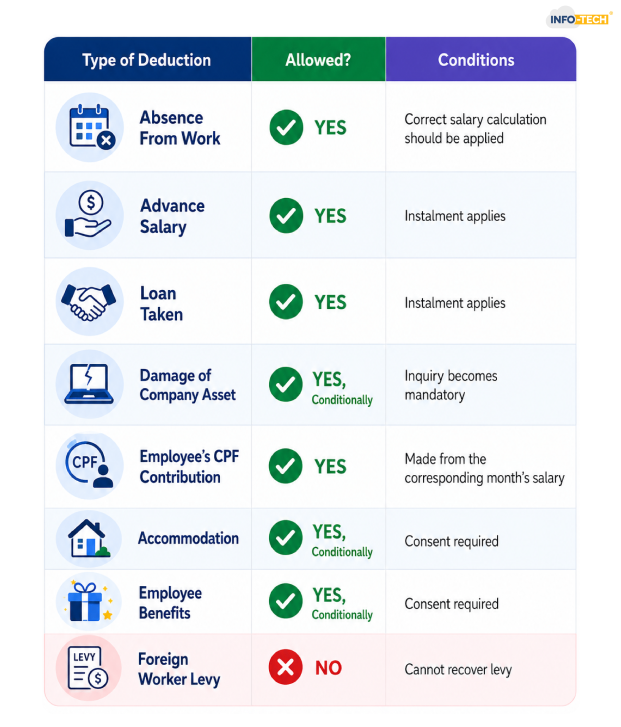
Can Employers Make Other Deductions from the Salary?
Yes, the employers can make other deductions from the salary of an employee under certain circumstances. But they can be done only with the written consent of an employee. The employee must be able to withdraw the consent anytime without any penalty levied on them. So, these deductions are generally something done to benefit the employee and the employer is in a position to collect on behalf of them. For an example, an employee may voluntarily give consent to deduct money from their salary to pay the insurance plan.
The employers cannot use the consent of the employees to deduct salary for reasons that are prohibited by law. The foreign worker levy is one such deduction which cannot be done as per the law.
What is the Maximum Salary that can be Deducted?
In general, though an employer cannot deduct more than 50% of the total salary payable in a single salary period. But this 50% cap does not include deductions for advance recovery, loan recovery, overpaid salary, absence from work and other payment to registered co-operative societies with the consent of the employees. During the completion of employment, the authorised deductions may exceed the 50% cap.
What are the Deductions the Employers Cannot Do?
In, Singapore, the employers are restricted to deduct salary from the employees for reasons that are not authorized by the employment act.
Examples include,
Liquidated damages: The employers cannot deduct the salary of the employees for the items that do not benefit the employees.
Employment costs for migrant workers: The deductions cannot be done for costs such as work-pass renewal, security bond, compulsory training or levy payments.
How Accuracy in Deductions become Important for Payroll Compliance?
Accurate salary deductions become very important for the employers to pay correct salary to the employees and to comply with the Singapore employment laws. Unauthorized deductions may result in disputes, claims and enforcement actions.
Why Transparency becomes Important in Payroll?
Transparency in Salary Deduction will reduce the misunderstandings and disputes between the employer and the employees. This will build trust among the employees and they become confident when they are well informed about the deductions being made. The error count can be reduced to a greater extent when they are kept transparent.
How Payroll Platforms Helps Managing Salary Deductions?
The payroll software helps employers by automating the calculations, ensures the deductions are done for the right salary period, reduces the manual work and clear records can be maintained with clearly displaying gross salary, each deduction and the net salary. The absence information can automatically flow into payroll as the systems are integrated.
What are the Checklists for Singapore Employers?
Before deducting the salary of an employee, the employers should ask themselves the following mandatory questions.
- Is the deduction authorized under the Singapore employment law?
- Do we have an employee consent in writing?
- Is an inquiry required?
- Does the overall deduction amount come within the 50% limit?
- Do we have accurate record of deductions in payroll?
- Is the employee a migrant worker?
- Will it appear correctly in the payslip?
Salary Deduction FAQs
Can an employer deduct salary for any loss/damage of company property?
Yes, but it can be done only under specific conditions. In Singapore, an employer may deduct salary for any damaged company property only if an employee is directly responsible for the loss or damage of the property.
What is the maximum salary deduction in Singapore?
Generally, the maximum salary deduction should not exceed 50% of an employee’s one month’s salary. But it excludes certain deductions from that cap, including loan recovery, overpaid salary recovery and absence from leave.
Can an employer recover the overpaid salary?
Yes, according to the Ministry of Manpower (MOM), an employer in Singapore can recover the overpaid salary to recover the amount that has been mistakenly paid in excess.
Does MOM allow employers to deduct salary for foreign worker levy?
No, MOM does not allow salary deduction for foreign worker levy. It states that the foreign worker levy should be paid by the employers and should not deduct any amount from the employees’ salary.
