

In this article
- 1. What Is Income Tax Rate In Singapore?
- 2. Why Do So Many People Get Singapore Income Tax Wrong?
- 3. What Income Can You Earn Before Paying Tax?
- 4. What Does Tax Look Like On A S$50,000 Salary?
- 5. What Happens When Your Salary Reaches Around S$85,000?
- 6. Does A Six-Figure Salary Mean A Huge Tax Bill?
- 7. Income Tax Rates FAQs
What Is Income Tax Rate In Singapore?
Getting a pay raise feels great until tax season comes around.
Suddenly, a question that never seemed important starts to matter: How much of that salary am I actually keeping?
It’s a question many working Singaporeans ask, especially when moving into a higher-paying role. The assumption is often the same. Higher salary means a much bigger tax bill.
The reality is usually less dramatic.
Singapore’s income tax rates remain among the lowest in the developed world. In fact, many first-time taxpayers are surprised by how little they actually pay compared to what they expected.
The confusion often comes from tax brackets. People hear that a certain salary falls into an 11.5% or 15% tax bracket and assume that percentage applies to every dollar they earn. It doesn’t.
That’s not how Singapore’s tax system works.
Instead, income is taxed progressively. Different portions of your income are taxed at different rates, and a significant portion may not be taxed at all.
Understanding that distinction can make a huge difference when planning your finances, comparing job offers, or simply trying to understand what happens to your salary after CPF and taxes are taken into account.
Why Do So Many People Get Singapore Income Tax Wrong?
One of the biggest misconceptions is that crossing into a higher tax bracket suddenly results in a huge jump in taxes.
Imagine two colleagues. One earns S$79,000 a year and the other earns S$82,000. Many people assume the second person will be heavily penalised because they have entered a higher bracket.
In reality, only a small portion of their income is taxed at the higher rate. The rest continues to enjoy the lower rates that apply to earlier brackets.
Think of Singapore’s tax system as a staircase rather than an elevator. Every step is taxed differently. Reaching a higher step doesn’t change what happened on the lower ones.
This structure is one of the reasons Singapore consistently ranks as one of the more tax-friendly places to work and do business.
What Income Can You Earn Before Paying Tax?
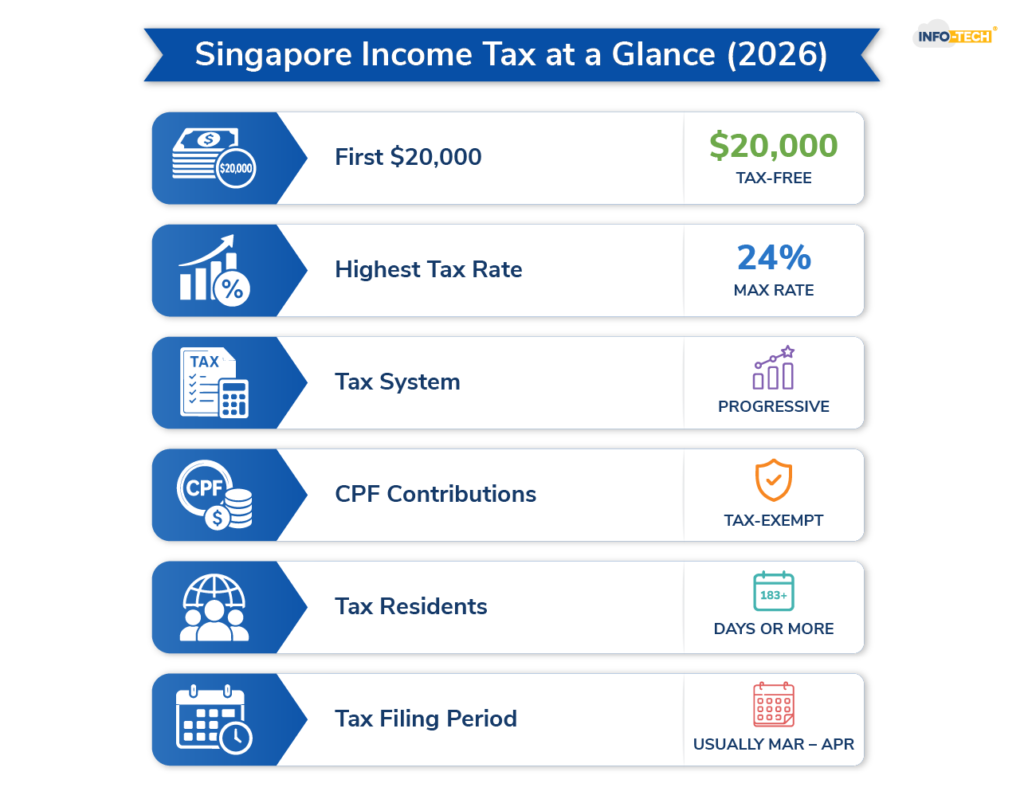
For tax residents, the first S$20,000 of chargeable income is not taxed at all.
That means many students working part-time, retirees with modest income, and some lower-income earners may not pay any personal income tax.
Even once income exceeds that threshold, the tax burden remains relatively light.
For example, someone with a chargeable income of S$30,000 pays only S$200 in tax.
To put that into perspective, that’s less than what many people spend on coffee in a month.
The tax bill starts small because Singapore’s tax system is designed to increase gradually rather than hit taxpayers with large jumps.
What Does Tax Look Like On A S$50,000 Salary?
A salary of S$50,000 places someone firmly within Singapore’s middle-income workforce.
Teachers, junior managers, marketing executives, coordinators, and many office professionals fall into this category.
At this level, tax is noticeable but rarely painful.
After taking CPF contributions and common reliefs into account, many individuals end up paying only a few hundred dollars in income tax for the year.
For someone receiving their first Notice of Assessment, the amount is often much lower than expected.
The bigger impact on take-home pay usually comes from CPF contributions rather than income tax itself.
That is something many new employees only realise after they start working.
What Happens When Your Salary Reaches Around S$85,000?
This is where taxes become more visible.
A salary around S$85,000 is common among experienced professionals, team leaders, and mid-level managers.
At this stage, portions of income start moving into the higher tax brackets. The tax bill grows, but not dramatically.
Most people earning around this amount will still find that the majority of their income has been taxed at relatively modest rates.
Depending on available reliefs and deductions, annual tax payable often falls somewhere between S$3,000 and S$5,000.
For many households, that works out to less than a monthly mortgage payment spread across an entire year.
The perception is often that taxes are becoming expensive. The numbers usually tell a different story.
Does A Six-Figure Salary Mean A Huge Tax Bill?
Crossing the S$100,000 mark is a career milestone for many professionals.
It is also the point where people start paying much closer attention to their Notice of Assessment.
A person earning around S$120,000 annually will generally pay more tax than someone earning S$80,000, but not because the entire salary is being taxed at a higher percentage.
Only the income within the relevant brackets attracts those higher rates.
That distinction matters.
Without it, many people incorrectly assume that earning more could somehow leave them worse off after taxes.
Singapore’s progressive structure ensures that this simply doesn’t happen.
Even after tax obligations increase, higher earnings still translate into higher take-home income.
Info-Tech’s Payroll Software helps businesses automate payroll calculations, generate IR8A reports, manage CPF contributions, and stay compliant with the latest IRAS requirements, reducing manual work and minimising costly errors.
Income Tax Rates FAQs
How much income tax do I pay if I earn S$50,000 a year in Singapore?
The exact amount depends on your chargeable income after CPF contributions and eligible tax reliefs are deducted. For many tax residents earning around S$50,000 annually, the income tax payable is often only a few hundred dollars. This is because Singapore’s income tax rates are progressive, and the first S$20,000 of chargeable income is tax-free.
Do higher income tax rates apply to my entire salary?
No. This is one of the most common misunderstandings about Singapore’s tax system. When your income moves into a higher tax bracket, only the portion of income within that bracket is taxed at the higher rate. The rest continues to be taxed at the lower rates that apply to earlier brackets.
Does CPF reduce the amount of income tax I need to pay?
Yes. Mandatory CPF contributions made by Singapore citizens and Permanent Residents are generally tax-exempt. Because CPF contributions reduce your chargeable income, they can lower the amount of tax you ultimately pay. This is one reason why two people with similar salaries may have different tax bills.
What is the highest personal income tax rate in Singapore?
The highest marginal income tax rate for Singapore tax residents is currently 24%. However, this rate only applies to the portion of chargeable income that falls within the highest tax bracket. Most taxpayers pay a much lower effective tax rate because different portions of their income are taxed at different rates under Singapore’s progressive tax system.
