

In this article
- 1. What is the CPF Ordinary Wage Ceiling in 2026?
- 2. How Is CPF Calculated When Salary Exceeds S$8,000?
- 3. What Is the Difference Between Ordinary and Additional Wages?
- 4. What CPF Contribution Changes Will Apply From 2027?
- 5. When Must Employers Pay CPF Contributions?
- 6. How Can Payroll Software Help With CPF Calculations?
- 7. CPF Wage Ceiling FAQs
The CPF salary ceiling determines how much of an employee’s wages is subject to CPF contributions. From 1 January 2026, the monthly Ordinary Wage ceiling increased to S$8,000. This change affects payroll calculations for employees earning above the previous ceiling. Employers should also prepare for higher CPF contribution rates for certain senior workers from 1 January 2027.
What Is the CPF Salary Ceiling?
The CPF salary ceiling is the maximum amount of an employee’s wages on which CPF contributions are payable. It does not limit how much an employee can earn.
CPF contributions generally apply to Singapore Citizens and Singapore Permanent Residents. The rate depends on the employee’s age, monthly wages and SPR status.
What is the CPF Ordinary Wage Ceiling in 2026?
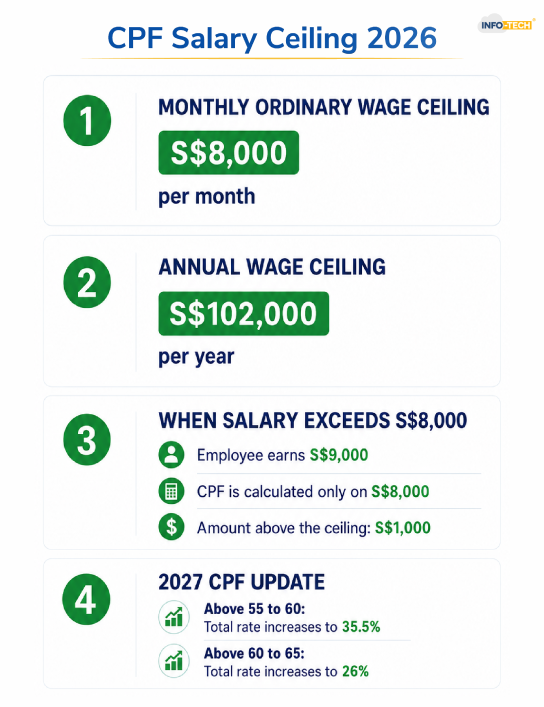
From 1 January 2026, the monthly Ordinary Wage, or OW, ceiling is S$8,000.
This means that when an employee earns more than S$8,000 in Ordinary Wages during a month, CPF is calculated only on the first S$8,000. The ceiling was gradually raised from S$6,000 to S$8,000 between 2023 and 2026.
Ordinary Wages usually include basic monthly salary and payments relating to work performed during that month.
What Are the CPF Contribution Rates in 2026?
For Singapore Citizens and SPRs from their third year onwards earning more than S$750 per month, the following rates apply from 1 January 2026:
| Employee’s Age | Employer | Employee | Total |
| 55 and below | 17% | 20% | 37% |
| Above 55 to 60 | 16% | 18% | 34% |
| Above 60 to 65 | 12.5% | 12.5% | 25% |
| Above 65 to 70 | 9% | 7.5% | 16.5% |
| Above 70 | 7.5% | 5% | 12.5% |
Different rates apply to lower-wage employees and SPRs in their first or second year.
Read also: How Central Provident Fund Works in Singapore
How Is CPF Calculated When Salary Exceeds S$8,000?
Consider an employee aged 45 who earns S$9,000 per month. CPF is calculated on S$8,000, not the full salary.
The total contribution is: S$8,000 × 37% = S$2,960
The employee contributes S$1,600, while the employer contributes S$1,360. No CPF is payable on the remaining S$1,000 of Ordinary Wages.
CPF contribution amounts should be rounded according to CPF Board rules. Total contributions are rounded to the nearest dollar, while cents are dropped when calculating the employee’s share.
Read also: CPF Contribution Rate Explained for Employers in Singapore
What Is the Difference Between Ordinary and Additional Wages?
Ordinary Wages are usually regular monthly payments such as basic salary. Additional Wages, or AW, generally include payments such as annual bonuses and certain variable payments.
The monthly S$8,000 ceiling applies to Ordinary Wages. Additional Wages are subject to a separate annual ceiling.
The Additional Wage ceiling is calculated as:
S$102,000 − total Ordinary Wages subject to CPF for the year
For example, if an employee has S$96,000 in Ordinary Wages subject to CPF, only S$6,000 of Additional Wages can attract CPF contributions.
What Happens to the CPF Annual Wage Ceiling in 2026?
The CPF annual wage ceiling remains S$102,000. It covers the total Ordinary Wages and Additional Wages that can attract CPF contributions during a calendar year.
Employers must apply both the monthly OW ceiling and the annual wage ceiling. This is especially important when processing bonuses, commissions or other Additional Wages.
What CPF Contribution Changes Will Apply From 2027?
From 1 January 2027, contribution rates will increase for employees aged above 55 to 65 who earn more than S$750 per month.
| Employee’s Age | Employer | Employee | Total |
| Above 55 to 60 | 16.5% | 19% | 35.5% |
| Above 60 to 65 | 13% | 13% | 26% |
Rates for employees aged 55 and below, above 65 to 70 and above 70 will remain unchanged.
The increase will be allocated to the employee’s Retirement Account until the Full Retirement Sum is reached. It will then be channelled to the Ordinary Account. Proportional increases will also apply to affected senior workers earning more than S$500 and up to S$750.
Read also: CPF Guide for Singaporeans and PR
When Must Employers Pay CPF Contributions?
CPF contributions become due at the end of each calendar month. Employers should pay them by the 14th of the following month.
When the 14th falls on a Saturday, Sunday or public holiday, payment can be made on the next working day. Employers who miss the deadline may face enforcement action.
Late payment interest is charged at 1.5% per month, subject to a minimum of S$5. CPF Board may also impose a composition amount of up to S$1,000 per offence. Serious or repeated non-payment may lead to prosecution, fines or imprisonment.
Read also: Top 5 Questions on Central Provident Fund Singapore
How Can Payroll Software Help With CPF Calculations?
Info-Tech’s Payroll software can apply the correct contribution rate based on an employee’s age, wages, citizenship and SPR status. It can also cap Ordinary Wages at S$8,000 and track Additional Wages against the annual ceiling.
This reduces manual calculations and lowers the risk of underpayment or overpayment. Employers can also maintain clearer CPF records, prepare submission details and update contribution rates before the 2027 changes take effect. Contact us today!
Read also: 5 CPF Withdrawal Mistakes to Avoid in 2026
CPF Wage Ceiling FAQs
What is the CPF salary ceiling for 2026?
The CPF Ordinary Wage ceiling for 2026 is S$8,000 per month, while the annual salary ceiling remains S$102,000.
What happens when I reach my CPF ceiling?
Once your monthly salary reaches the S$8,000 CPF Ordinary Wage ceiling, no CPF is contributed on the amount above S$8,000, though bonuses may still attract CPF under the annual Additional Wage ceiling.
What is the minimum wage to pay CPF?
CPF contributions are payable when an eligible employee earns more than S$50 in total wages per month; no CPF is required for monthly wages of S$50 or less.
Does a part-time worker need to contribute to CPF?
Yes. Part-time employees who are Singapore Citizens or Permanent Residents must receive CPF contributions when they earn more than S$50 in a month, just like full-time employees.
