

In this article
- 1. Does Annual Wage Supplement And Bonus Mean the Same?
- 2. How Is Annual Wage Supplement (AWS) Different from a Bonus?
- 3. Why Do Companies Pay AWS in Singapore?
- 4. Is AWS Mandatory in Singapore?
- 5. Who Is Eligible for Annual Wage Supplement?
- 6. Will I Get My 13th Month Pay If I Resign?
- 7. Does Tax Apply to Annual Wage Supplement?
- 8. What Is a Supplemental Benefits Wage?
- 9. What Are the Benefits of Annual Wage Supplement?
- 10. Key Takeaway
- 11. Frequently Asked Questions
Annual Wage Supplement (AWS) also known as the 13th-month salary, represents a yearly wage component that employers in Singapore pay out It is typically equivalent to one month of basic salary and is usually paid at the end of the year, often in November or December.
However, in Singapore’s wage structure, AWS is classified as variable pay and is not a legal entitlement. Employers are only required to pay AWS if it is stated in the employment contract, a collective agreement, or an established company policy
Does Annual Wage Supplement And Bonus Mean the Same?
This is a common question in Singapore, and the answer is no. AWS isn’t the same as a performance bonus even though lots of folks use these words to mean the same thing.
AWS is a set yearly payment often equal to one month’s basic pay, no matter how well you or the company do. A bonus, however, is often up to the company and depends on how well things go.
Also Read: How Much Is GST in Singapore (2026)?
How Is Annual Wage Supplement (AWS) Different from a Bonus?
Although many people casually refer to AWS as a “bonus” or “13th-month bonus,” the two are treated very differently in practice.
AWS is typically a pre-agreed part of an employee’s wage structure. When it is stated in a contract or company policy, employees generally know in advance that they will receive an extra month’s basic salary at the end of the year, as long as they meet the eligibility conditions.
A bonus, on the other hand, is performance-driven and discretionary. It may vary from year to year, or not be paid at all, depending on company results, individual performance, or management decisions.
In simple terms:
– AWS is predictable when it is written into employment terms
– Bonuses are variable and depend on outcomes
This distinction matters because AWS affects expectations around pay stability, while bonuses are treated as additional rewards rather than a guaranteed wage component.
Learn More: Workfare Income Supplement Payout Singapore
Why Do Companies Pay AWS in Singapore?
AWS has its roots in Singapore’s wage system, where employers were encouraged to adopt a flexible wage structure. By keeping part of employees’ pay variable, companies can better manage costs during economic downturns while still rewarding employees in stronger years.
For employees, AWS provides a financial buffer at the end of the year, a time when expenses such as school fees, holidays, and festive spending tend to increase.
Is AWS Mandatory in Singapore?
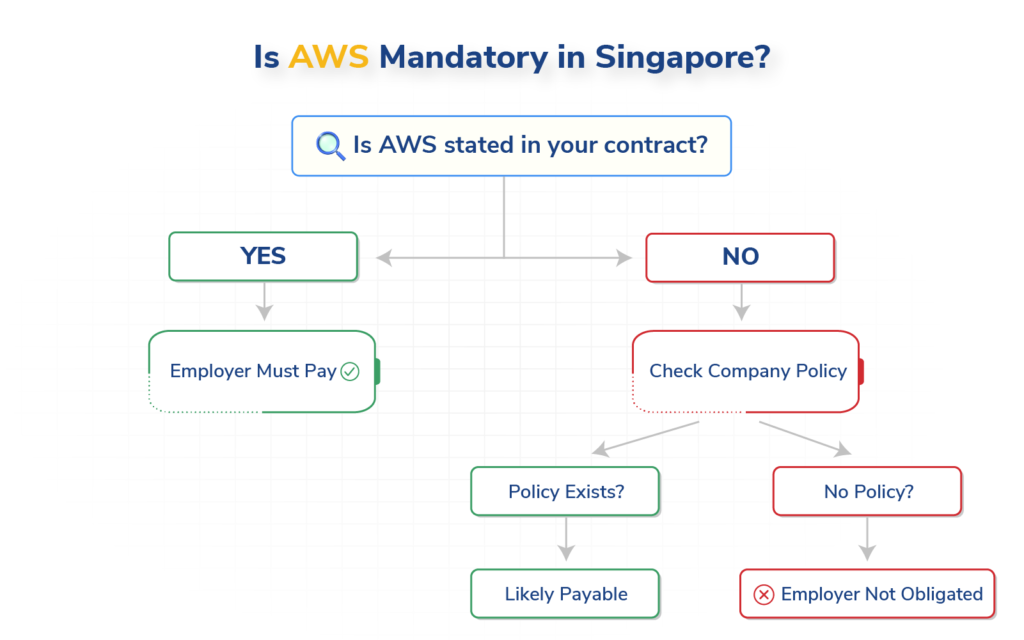
No. AWS is not mandatory under the Employment Act
An employer is required to pay AWS only if:
– It is stated in the employment contract
– It is included in a collective or union agreement
– The company has a clearly communicated and consistent policy
If none of these apply, employees are not automatically entitled to AWS, even if it was paid in previous years.
Who Is Eligible for Annual Wage Supplement?
Who gets AWS depends on what each company decides. But common rules include:
- People working full-time
- Those who’ve worked for a certain time (like 3–12 months)
- Employees still with the company when it’s time to pay
Some businesses adjust AWS for staff who start mid-year or exit before year-end.
Will I Get My 13th Month Pay If I Resign?
This question pops up a lot in Singapore.
Getting AWS after you quit depends on what your job contract says and how your company handles it.
Usual cases:
- Contract says AWS comes if you work there on payout day → You won’t get it
- Contract allows for partial AWS → You might get some money
- No clear rules → Your employer decides
You don’t have a legal right to AWS after quitting unless your contract says so.
Does Tax Apply to Annual Wage Supplement?
Yes. Singapore taxes AWS.
You must report it as part of your job income for tax purposes. Your employer will include AWS on your IR8A form.
AWS also requires CPF contributions, following current CPF rules and limits.
What Is a Supplemental Benefits Wage?
A supplemental wage means extra pay on top of your regular monthly salary, like:
- Annual Wage Supplement (AWS)
- Bonuses
- Incentives
- Commissions
These wages still count as taxable job income and might need CPF contributions, based on the type and amount.
What Are the Benefits of Annual Wage Supplement?
AWS gives employees:
- Steady income at year’s end
- Help with big yearly costs
- Money security without stress to perform
For employers AWS:
- Keeps good employees around
- Allows pay changes
- Fits with Singapore’s changing pay system
Key Takeaway
Annual Wage Supplement (AWS) is still a hot topic, but many people don’t quite get how it works in Singapore’s pay system. People often call it the 13th-month salary, but AWS isn’t a bonus, isn’t required, and isn’t guaranteed unless it’s written down. Employees should always check their contracts, and employers should be clear about their AWS rules to avoid any fights.
Knowing how AWS works helps employees and employers make smart choices about pay, what to expect, and money planning in Singapore’s changing job scene.
Annual Wage Supplement FAQs
Does AWS count as a bonus?
No. AWS is a set yearly pay part, while bonuses depend on how well you do and are up to the employers.
Do I pay tax on AWS?
Yes. You pay full tax on AWS and it counts for CPF too.
Can I get all my money if I quit?
You’ll get the pay you’ve earned and any unused time off, but AWS depends on what your contract says.
Is the 13th month extra pay?
In real life many people call it a bonus, but it’s different in legal and structural terms.
