

In this article
- 1. What is Sick Leave in Singapore?
- 2. Who is Eligible for Paid Sick Leave in Singapore?
- 3. How Many Days of Sick Leave Are Employees Entitled to in Singapore?
- 4. What are the Rules for Medical Certificates (MCs) in Singapore?
- 5. How are Sick Leave Salary and Medical Reimbursements Calculated?
- 6. What Happens if Sick Leave Falls on Weekends, Public Holidays or Annual Leave?
- 7. How Can Employers Manage Sick Leave More Efficiently?
- 8. Sick Leave – FAQs
Everyone falls ill from time to time, and when you do, the last thing you want is to worry about whether you’re allowed to take the day off. Yet many people in Singapore aren’t quite sure how sick leave works. If you’re covered under the Employment Act, you can get up to 14 days of paid outpatient leave and up to 60 days of paid hospitalisation leave each year.
In this guide, we’ll walk you through everything you need to know, from who qualifies and how many days you’re entitled to, to what counts as a valid medical certificate and how your salary is paid while you’re on sick leave, all based on the Ministry of Manpower’s (MOM) rules.
What is Sick Leave in Singapore?
Sick leave, which most people simply call medical leave or MC leave, gives you the time off you need when you’re too unwell to work.
In Singapore, if you’re eligible, there are two kinds of paid leaves you can take:
- Outpatient sick leave: For when you’re not well enough to work but don’t need to be admitted to hospital, like when you’re down with a bad flu or a stomach bug.
- Hospitalisation leave: For employees who require hospital care, day surgery or medically certified recovery, including certain situations where hospital admission is unnecessary.
Under the Employment Act, paid leave entitlement depends on an employee’s length of service.
Who is Eligible for Paid Sick Leave in Singapore?
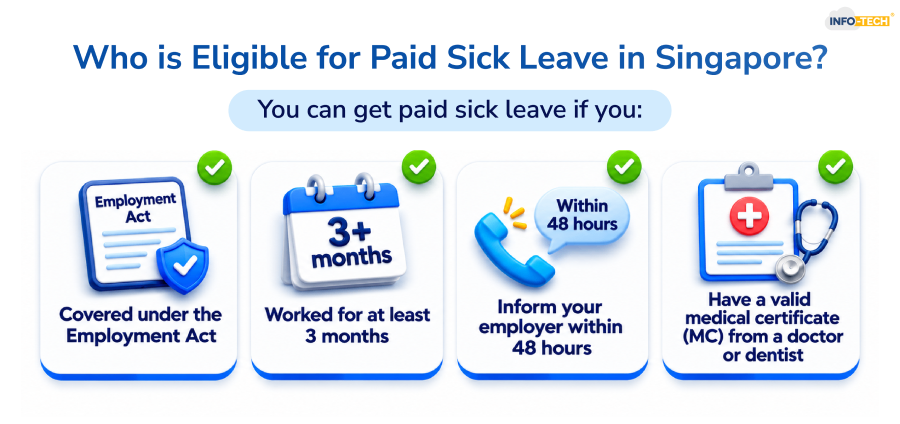
According to MOM sick leave eligibility and entitlement, employees qualify for paid sick leave when they meet these conditions:
- They are covered under the Employment Act.
- They have worked for their employer for at least three months.
- They have notified, or tried to notify, their employer within 48 hours of being absent.
- You have a valid medical certificate from a registered doctor or dentist confirming that you’re not fit to work.
- If you’ve been with your company for less than three months, you won’t qualify for statutory paid sick leave just yet. That said, some employers offer extra leave benefits as part of their company policy, so it’s worth checking your employment contract or asking HR.
- Once you’ve hit the three-month mark, you’re entitled to paid sick leave, even if you’re still on probation. Eligibility is based on how long the employee has worked, not on whether they have passed probation.
How Many Days of Sick Leave Are Employees Entitled to in Singapore?
The longer an employee has worked, the more paid leave they are entitled to, with the full statutory entitlement available once they have completed six months of service.
The table below shows MOM’s entitlement.
| Completed Months of Service | Paid Outpatient Sick Leave | Paid Hospitalisation Leave |
| Less than 3 months | 0 days | 0 days |
| 3 months | 5 days | 15 days |
| 4 months | 8 days | 30 days |
| 5 months | 11 days | 45 days |
| 6 months or more | 14 days | 60 days |
The 14 days of outpatient sick leave and 60 days of hospitalisation leave are not added together, so employees are not entitled to 74 days in total. Instead, the former counts toward the 60-day hospitalisation leave limit. For instance, an employee who has taken 8 days of the leave will have 52 days of hospitalisation leave left, provided the medical certification requirements are met.
Hospitalisation leave isn’t limited to time spent in hospital. It can also apply to recovery at home, if a hospital doctor certifies that the employee needs hospital care or bed rest.
Also check: Paid Time Off (PTO): What HR Teams Need to Know
What are the Rules for Medical Certificates (MCs) in Singapore?
To be eligible for statutory paid sick leave, employees must submit a valid medical certificate. Under Ministry of Manpower (MOM) regulations, employers are required to accept MCs issued by doctors registered under the Medical Registration Act or by dentists registered under the Dental Registration Act.
This includes MCs issued by:
- Public hospitals and polyclinics.
- Registered private clinics.
- Registered dentists.
- Registered doctors providing teleconsultations.
Employers cannot reject an otherwise valid MC simply because it comes from a non-panel clinic.
However, employers are not legally required to recognise MCs from Traditional Chinese Medicine (TCM) practitioners for paid leave, although they may choose to do so.
Employees should send a sick leave notification soon as possible, within 48 hours of their absence. The MC can be submitted when they return to work.
Read Also: What happens if I don’t submit my MC within 48 hours?
How are Sick Leave Salary and Medical Reimbursements Calculated?
Employees who qualify for paid sick leave must receive their salary according to MOM’s requirements.
The payment depends on the type of leave taken:
| Leave Type | Salary Entitlement |
| Outpatient sick leave | Gross rate of pay, excluding shift allowance |
| Hospitalisation leave | Gross rate of pay |
For monthly-rated employees, MOM calculates the daily gross rate using this formula:
Daily gross rate = (12 × Monthly gross rate of pay) ÷ (52 × Average working days per week)
The gross rate of pay includes eligible allowances but excludes items such as overtime payments and bonuses.
Read Also: MOM Leave Calculator – Guide to Accurate Leave Entitlements
Are Employers Required to Reimburse Medical Consultation Fees?
Employers must reimburse medical consultation fees when:
- The employee has completed at least three months of service.
- The consultation results in at least one day of paid sick leave.
- The MC is issued by a medical practitioner from a qualifying public medical institution or a company-appointed doctor.
For example, if you visit a private clinic that isn’t on your company’s panel, your MC can still entitle you to paid sick leave, but your employer may not have to cover the consultation fee.
That said, many employers go beyond the basics and offer more generous medical benefits in their employment contracts, so it’s a good idea to check what yours includes.
What Happens if Sick Leave Falls on Weekends, Public Holidays or Annual Leave?
In general, sick leave only counts on the days you’re scheduled to work.
You won’t receive statutory paid leave for:
- Rest days and non-working days.
- Public holidays
- Days already taken as annual leave.
- Unpaid leave days.
For example, an employee working Monday to Friday receives an MC covering Friday to Monday. If Saturday and Sunday are non-working days, only Friday and Monday count towards the sick leave entitlement.
If an employee falls ill during annual leave, they can discuss with their employer whether the annual leave can be cancelled and replaced with sick leave. This is not an automatic entitlement.
Employees who have exhausted their paid sick leave may discuss additional leave or alternative working arrangements with their employer in such special situations.
How Can Employers Manage Sick Leave More Efficiently?
Tracking leaves manually can become challenging, particularly for businesses managing multiple departments, shifts or work locations.
HR teams need to maintain accurate leave balances, review MC submissions, manage approvals and ensure that leave records are reflected correctly in payroll.
Using a leave management software can make these tasks easier. This allows employees to apply for leave online, upload medical certificates and check their leave balances. Managers can review applications and approve leave requests through the system. It can also integrate with payroll software, helping businesses keep leave and payroll information consistent while reducing manual administrative work.
Book a DemoSick Leave – FAQs
Is sick leave mandatory in Singapore?
Yes, under the employment act, the employers must provide paid sick leave to eligible employees who meet MOM requirements.
What makes an MC valid in Singapore?
An MC becomes valid if the certificate is provided by a doctor registered under the Medical Registration Act or a dentist registered under the Dental Registration Act.
Does unused sick leave carry forward to next year?
No, statutory sick leave does not carry forward. Any unused sick leave expires by the end of the year and does not carry forward, unless your company policy states otherwise.
Can an employer provide more sick leave than the law requires?
Yes, the MOM sets only the minimum entitlement. The employers are allowed to offer more sick leave benefits than the law requires.
