

In this article
- 1. What Does Quiet Firing Really Look Like Day to Day?
- 2. Is Quiet Firing Even Legal Under the Employment Act?
- 3. When Does It Become Constructive Dismissal?
- 4. Why Do So Many Employees Stay Silent About It?
- 5. How Do You Start Documenting What’s Happening?
- 6. Should You Ask Your Manager Directly About the Situation?
- 7. When Is It Time to Escalate This to HR?
- 8. How Do You Know If It Has Crossed a Legal Line?
- 9. Can You Actually File a Claim Under the Employment Act?
- 10. Employment Act FAQs
There’s a kind of workplace exit that doesn’t come with a termination letter, a formal warning, or even a proper conversation. It happens slowly. Responsibilities shrink. Conversations become shorter. Opportunities quietly disappear. You’re still employed—but something has clearly changed. This is what people now call quiet firing. And while the phrase is new, the reality behind it isn’t. What matters today is understanding how situations like this relate to the employment act, and what you can actually do when you find yourself in one.
What Does Quiet Firing Really Look Like Day to Day?
Most people expect workplace problems to be obvious. A warning letter. A poor appraisal. A direct conversation.
Quiet firing doesn’t work like that.
Instead, it shows up in ways that are easy to dismiss at first. You might notice you’re no longer invited to discussions you used to lead. Work that once came your way is reassigned without explanation. Feedback disappears—not negative, not positive, just silence.
At some point, you realise you’re no longer growing in the role. You’re simply… there.
That slow shift is what makes quiet firing so difficult to recognise early.
Is Quiet Firing Even Legal Under the Employment Act?
There’s no law that uses the term “quiet firing.” No company is going to admit to doing it.
But under the employment act, what matters is not the label—it’s the outcome.
If an employer’s actions lead to:
- Unfair treatment
- Unreasonable changes to your role
- Or conditions that make it difficult for you to continue working
then it may fall under legal concern.
Employers are expected to maintain fair working conditions. They cannot deliberately create an environment that pushes someone to leave without going through proper processes.
So while quiet firing itself isn’t defined, its effects can still be challenged.
When Does It Become Constructive Dismissal?
This is where things become more serious.
Constructive dismissal happens when the situation becomes so unreasonable that you feel you have no real choice but to resign. Even though you’re the one leaving, the responsibility may still fall on the employer.
Common situations include:
- Significant changes to your role without agreement
- Being sidelined or stripped of responsibilities
- A work environment that becomes isolating or unfair
- Decisions that directly affect your career without justification
Under the employment act, this distinction matters. If proven, constructive dismissal can be treated similarly to wrongful termination.
But it’s not automatic—you need to show that the employer’s actions crossed a clear line.
Why Do So Many Employees Stay Silent About It?
Even when something feels off, most people don’t act right away.
Not because they don’t notice—but because they’re unsure.
There’s no single incident to point to. No moment where everything clearly went wrong. It’s gradual, which makes it easy to question your own judgment.
On top of that:
- People worry about being seen as difficult
- They don’t want to escalate unnecessarily
- They assume things will improve
By the time they decide to leave, they often realise they have no record of what actually happened.
And that’s where quiet firing works best—in uncertainty.
How Do You Start Documenting What’s Happening?
Start paying attention to patterns, not just moments.
Keep track of:
- Changes in responsibilities
- Missed opportunities or removed tasks
- Communication gaps
- Anything that feels inconsistent with your role
This isn’t about building a case immediately. It’s about making sure you’re not relying on memory alone later.
Should You Ask Your Manager Directly About the Situation?
Yes—and sooner rather than later.
A simple, structured conversation can reveal more than assumptions ever will.
Ask clearly:
- What are the expectations for your role now?
- Why have responsibilities changed?
- What feedback do they have on your performance?
Sometimes, what feels like quiet firing may come down to misalignment. Other times, the response you receive will confirm your concerns.
Either way, you gain clarity—and a record of communication.
When Is It Time to Escalate This to HR?
If things don’t improve after your discussion, it’s reasonable to escalate.
Keep the conversation professional and focused:
- Explain how your role has changed
- Highlight the impact on your work
- Avoid emotional accusations
Under the employment act, employers are expected to handle workplace concerns fairly. Escalating internally shows that you’ve attempted resolution.
How Do You Know If It Has Crossed a Legal Line?
Not every uncomfortable situation is illegal. But patterns can indicate something more serious.
You should take a closer look if:
- Our role has been significantly reduced without explanation
- You are consistently excluded or ignored
- Your career progression is clearly being affected
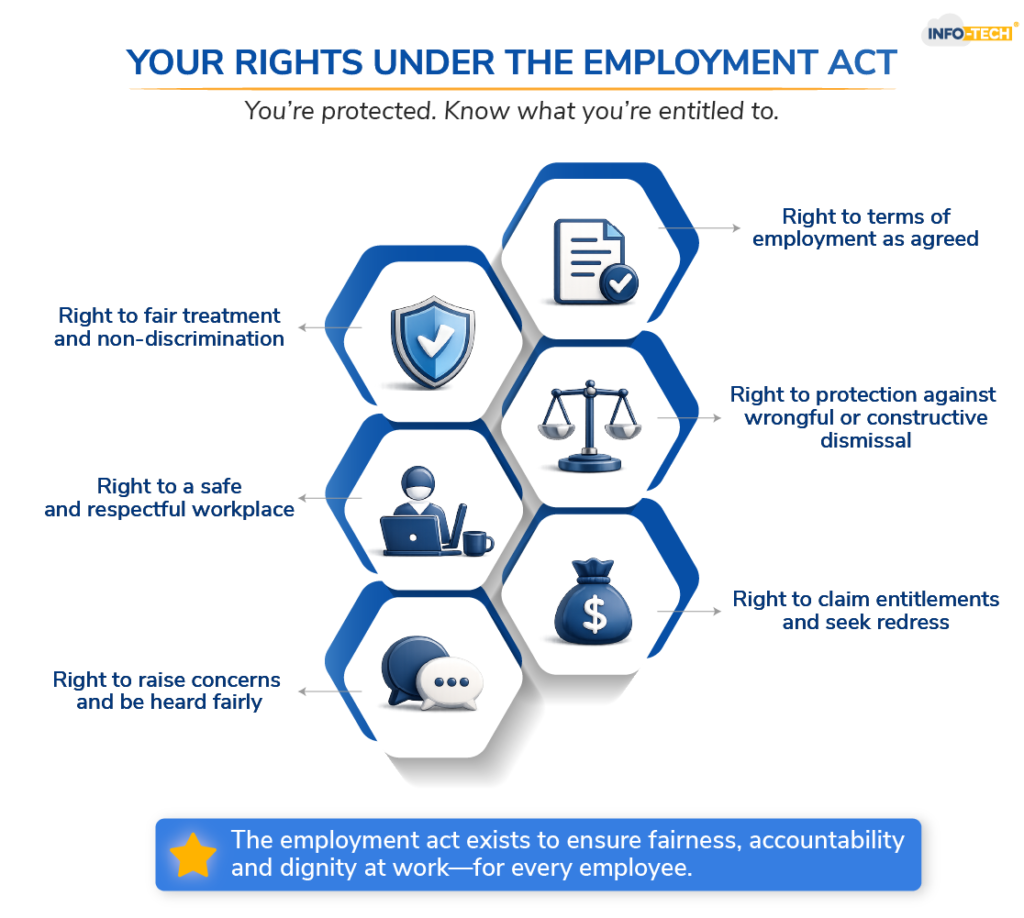
At this point, the issue may no longer be about management style—it may relate to your rights under the employment act.
Can You Actually File a Claim Under the Employment Act?
If internal efforts fail, formal options exist.
Depending on your situation, you may be able to file a claim for wrongful or constructive dismissal. In Singapore, for example, cases can be raised through dispute resolution channels like TADM.
But outcomes depend heavily on:
- Documentation
- Timing
- And whether the employer’s actions can be clearly demonstrated
This is why early action matters.
Why Is Quiet Firing Becoming More Common in Workplaces Today?
In many organisations, difficult conversations are avoided rather than handled directly.
Instead of formal terminations, some managers:
- Reduce responsibilities gradually
- Disengage from employees
- Wait for resignations to happen on their own
It may seem easier in the short term—but it creates long-term issues for both sides.
For employees, the effects are often personal:
- Loss of confidence
- Unclear career direction
- Emotional stress
And without understanding the employment act, many walk away without realising they may have had options.
What Does All This Mean for You Going Forward?
Quiet firing creates confusion. That’s what makes it effective—and damaging.
But the moment you recognise the pattern, things begin to shift.
You start asking questions, start documenting and then you begin to understand where your situation stands under the employment act.
In many workplaces today, having the right systems in place can also make a real difference. For example, organisations using structured HR software and performance management tools are far less likely to fall into unclear or inconsistent practices. Clear goal tracking, documented feedback, and transparent communication leave less room for situations like quiet firing to develop unnoticed.
And that changes everything. Because once you have clarity, you’re no longer just reacting—you’re making informed decisions about what comes next.
Explore Our Guide: Work Permit Online Singapore 2026
Employment Act FAQs
What is quiet firing in the workplace?
Quiet firing is when an employer gradually pushes an employee out without formally terminating them. This can include reducing responsibilities, excluding them from decisions, or limiting growth opportunities. While not a legal term, such actions may raise concerns under the employment act if they lead to unfair or unreasonable working conditions.
Is quiet firing illegal under the employment act?
Quiet firing itself is not specifically defined in the employment act, but its effects can be challenged. If an employer’s actions result in unfair treatment, forced resignation, or significant role changes without consent, it may fall under wrongful or constructive dismissal protections.
What is constructive dismissal and how is it related?
Constructive dismissal occurs when an employee resigns because the employer created an unreasonable or hostile work environment. Under the employment act, this can be treated similarly to termination if the employee can prove they had no real choice but to leave.
What should I do if I think I’m being quietly fired?
Start by documenting changes in your role, communication, and responsibilities. Speak to your manager for clarity, and escalate to HR if needed. If the situation continues, you may explore formal dispute channels depending on your rights under the employment act.
