
In this article
- 1. What Is Electronic Billing?
- 2. What Is An E-Bill?
- 3. How Does Electronic Billing Work?
- 4. How Are Invoices Created In E-Billing Systems?
- 5. How Are E-Bills Delivered To Customers?
- 6. How Do Payments Happen In Electronic Billing?
- 7. What Are the Benefits Of Electronic Billing?
- 8. Are There Any Challenges With E-Billing?
- 9. Who Uses Electronic Billing?
- 10. What Is the Difference Between E-Billing And E-Invoicing?
- 11. How Can E-Invoicing Help Your Business Grow?
- 12. Electronic Billing FAQs
Think about the last time you paid a bill. There’s a good chance it came to your email, and you clicked a link, paid it, and moved on. No paper, no printing, no hassle.
That’s electronic billing. It’s something most businesses use today, but not everyone really understands how it works or why it matters. Let’s go through it in a simple way.
What Is Electronic Billing?
Electronic billing (or e-billing) is billing done digitally instead of on paper.
Instead of printing invoices, sending them physically, and waiting for payments, everything happens through software. The invoice is created, sent, tracked, and paid; all online. For businesses, this mainly means less manual work and fewer things slipping through the cracks.
What Is An E-Bill?
An e-bill is basically a normal bill, in digital form.
It still has all the usual details like:
- Who it’s from
- Who it’s for
- What the charge is
- How much to pay
- When it’s due
The only real difference is how it’s used. Instead of sitting on someone’s desk, it sits in their inbox and usually comes with a “Pay Now” button.
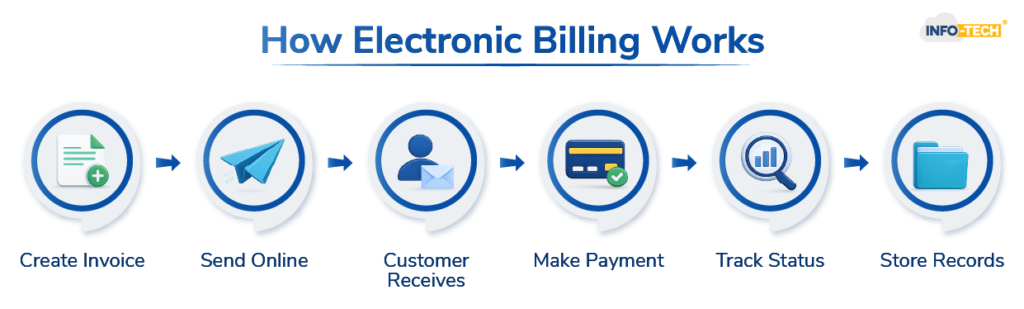
How Does Electronic Billing Work?
Even though there’s a system behind it, the process itself is pretty straightforward.
Here’s what usually happens:
| Step | What happens |
| Invoice creation | The system prepares the invoice using existing data |
| Invoice delivery | It’s sent by email or through a portal |
| Payment | The customer pays online |
| Tracking | The status gets updated automatically |
| Follow-up | Reminders go out if needed |
| Record keeping | Everything is saved digitally |
Most of this runs quietly in the background. That’s the whole point; it removes the need to manage every step manually.
How Are Invoices Created In E-Billing Systems?
In the past, someone had to sit and type out every invoice. Now, the system just pulls information from wherever it already exists like your accounting software or customer records. It fills in the details, calculates totals, adds taxes if needed, and formats the invoice. Before sending it, it usually checks for basic errors too.
So instead of creating invoices from scratch every time, it’s more like reviewing and sending.
How Are E-Bills Delivered To Customers?
Once the invoice is ready, sending it to the customer is the easy part.
It can go out:
- As a PDF in an email
- Through a login portal
- Directly into the customer’s system
Some systems even notify the customer automatically, so nothing gets missed.
How Do Payments Happen In Electronic Billing?
Instead of figuring out bank details or writing cheques, customers can just click and pay. Most systems support different payment options like cards, bank transfers, or wallets.
Once the payment is done, both sides get confirmation, and the invoice is marked as paid. No need to manually update anything.
How Does Tracking And Follow-Up Work?
One of the most useful parts of e-billing is visibility. You don’t have to guess what’s happening anymore. You can see:
- Whether the invoice was opened
- Whether it’s still pending
- Whether it’s been paid
If someone forgets, the system can send reminders automatically. So instead of chasing payments yourself, the system does the nudging.
What Are the Benefits Of Electronic Billing?
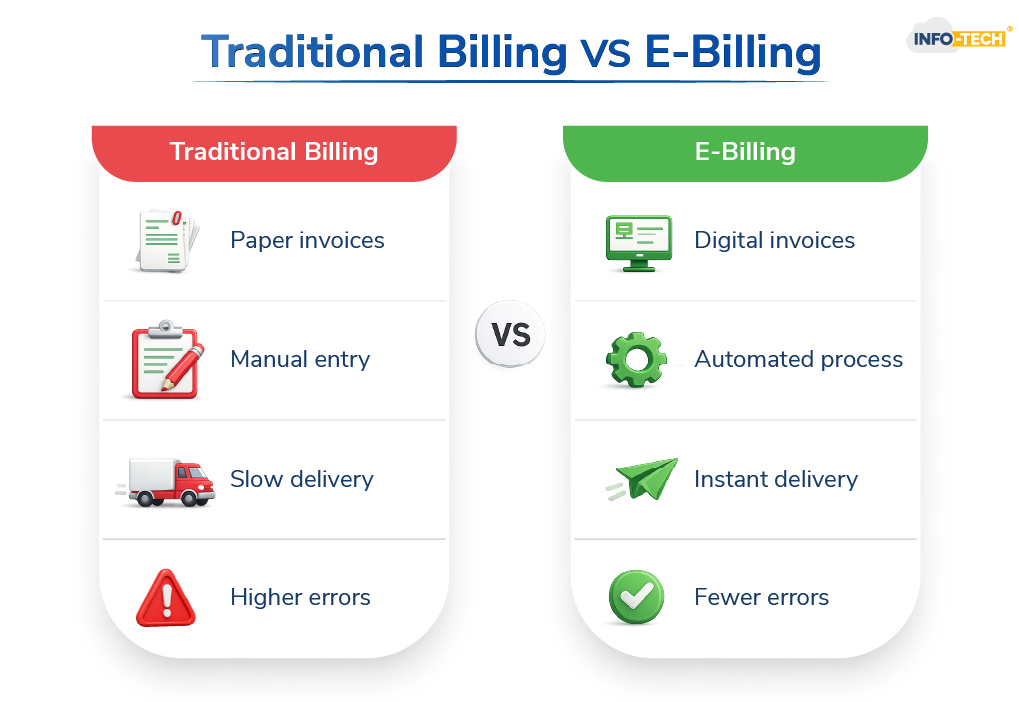
Most businesses don’t switch to e-billing just because it’s digital. They do it because it solves everyday problems.
It helps by:
- Cutting down manual mistakes
- Speeding up payments
- Keeping everything in one place
- Reducing paperwork
- Making it easier to track money
Over time, it just makes things feel more under control.
Are There Any Challenges With E-Billing?
The only real difficulty is at the beginning.
If a company has been using paper for years, switching can feel like a big change. There’s some setup involved, and people may need time to get used to the system.
But once it’s up and running, most businesses don’t go back to traditional billing methods.
Who Uses Electronic Billing?
Almost all business of various sizes and industries use e-billing now.
You’ll see it in:
- Small and large businesses
- Government offices
- Hospitals and clinics
- Service companies
If payments are involved, e-billing usually is too.
What Is the Difference Between E-Billing And E-Invoicing?
E-billing and e-invoicing are closely related, but they are not exactly the same.
E-billing covers the wider billing process, including creating bills, sending them, collecting payments, tracking payment status, and keeping records.
E-invoicing focuses on exchanging invoice information digitally between businesses. Unlike sending a PDF invoice by email, an e-invoice can contain structured data that moves directly from one accounting system to another.
In Singapore, InvoiceNow is a good example of how this works. It allows businesses to send and receive structured e-invoices through a nationwide network instead of manually handling invoice files.
How Can E-Invoicing Help Your Business Grow?
Even though it’s just one step, invoicing sets the tone for everything that follows. If invoices are delayed or full of errors, payments usually get delayed too.
With e-invoicing, that first step becomes quicker and cleaner. You’re not re-entering the same details again and again, and there’s less chance of mistakes.
It also quietly handles things like formatting and compliance, which can otherwise take time to figure out. From the customer’s side, it’s just easier. They get a clear invoice, they understand it, and they pay it. No confusion, no back-and-forth.
If you’re trying to scale or just keep things organised, having a proper system in place like Info-Tech E-Invoicing Software can make a real difference. It keeps invoicing connected with your accounts and avoids the usual mess of using multiple tools.
Read More: E-Invoicing Singapore: The 2026 Guide for Businesses
Electronic Billing FAQs
What is the meaning of electronic billing?
Electronic billing (e-billing) simply means creating and sending bills digitally instead of using paper. In this process, invoices are generated through software, sent to customers via email or online systems, and paid electronically. It covers the entire billing cycle from making the invoice to receiving and recording the payment; all in a digital format.
What are the three types of billing?
The three main types of billing are prepaid, postpaid, and recurring billing. In prepaid billing, customers pay in advance before using a service or product, which is common in subscriptions or mobile recharges. Postpaid billing works the opposite way, where customers use the service first and pay later after receiving a bill, like electricity or phone bills. Recurring billing is used for ongoing services, where payments are automatically charged at regular intervals such as monthly or yearly, making it convenient for both businesses and customers.
What are the five types of electronic payment systems?
The five common types of electronic payment systems are credit cards, debit cards, net banking, digital wallets, and mobile payment systems. Credit and debit cards are widely used for both online and offline payments, while net banking allows users to transfer money directly through their bank accounts. Digital wallets like Paytm or Google Pay store payment details for quick transactions, and mobile payment systems enable payments through smartphones using apps or technologies like UPI and QR codes.
Which is the most common form of electronic payment?
The most common form of electronic payment in Singapore today is PayNow. It’s widely used for instant bank transfers using just a mobile number or NRIC, making it very convenient for everyday payments. Along with PayNow, NETS and card payments (credit/debit cards) are also very commonly used, especially in shops and online transactions.
