
In this article
Sending an invoice by email may feel digital, but the work behind it is often still manual. A supplier creates a PDF, attaches it to an email and sends it. The customer then downloads the file and enters the same details into another accounting system. InvoiceNow is useful in removing much of this repeated work. It allows invoice information to move directly from one finance system to another in a structured digital format.
For Singapore businesses, it is also becoming more important because it is gradually being included in the country’s GST compliance process.
What Is InvoiceNow?
It is Singapore’s nationwide e-invoicing network. It allows businesses to send and receive invoices directly between compatible finance or accounting systems.
Instead of exchanging a PDF or paper document, it sends the invoice details as structured data. The receiving system can read information such as the invoice number, supplier details, GST amount, payment terms and line items without someone typing everything again.
InvoiceNow was introduced by the Infocomm Media Development Authority, or IMDA, in 2019. It operates using Peppol, an international framework that allows different finance systems to exchange business documents in a standard format.
Is InvoiceNow an Accounting Software?
No, InvoiceNow is not accounting software. It is the network that connects different accounting and finance solutions.
A simple comparison is a bank transfer. A customer using one bank can send money to someone using another bank because both banks are connected through common payment standards. In the same way, businesses using different InvoiceNow ready accounting systems can exchange invoices because the systems follow the Peppol standard.
Are you using an InvoiceNow-ready e-invoicing and accounting software? Contact us today and start using Info-Tech – be tax ready.
Read also: E-Invoicing Singapore: The 2026 Guide for Businesses
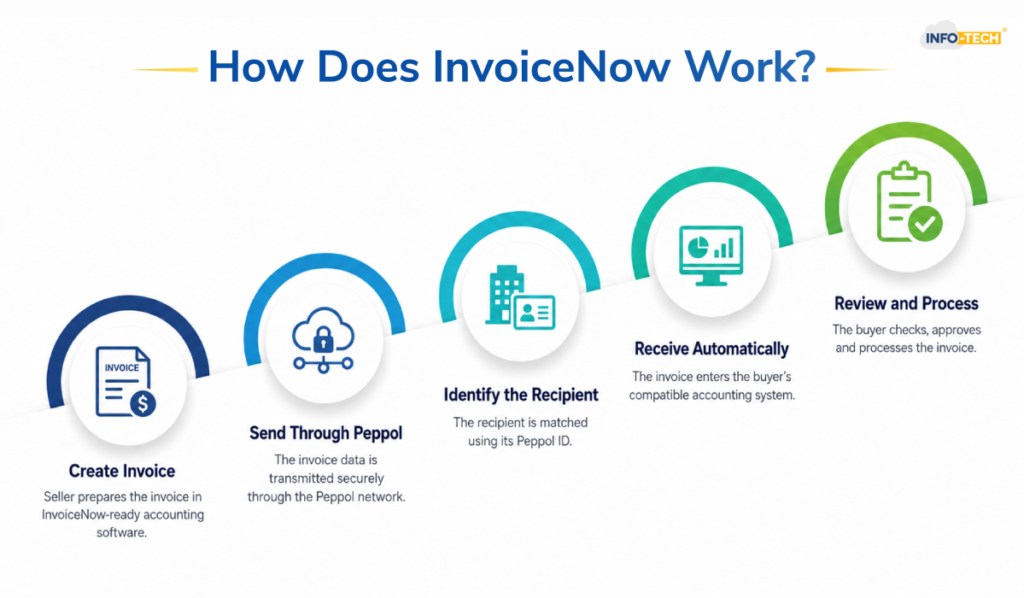
How Does InvoiceNow Work?
The process usually begins in the seller’s accounting software:
- The seller first prepares an invoice in an system.
- The invoice information is shared through the Peppol network.
- The network identifies the recipient using their Peppol ID.
- The invoice data is entered into the recipient’s finance system.
- The recipient reviews, approves and processes the submitted invoice.
The invoice does not need to be downloaded from an email and entered again. This makes it easier to automate invoice matching, approval and payment workflows, hence save time.
Businesses are registered in the SG Peppol Directory using their Unique Entity Number, or UEN. They are then issued a Peppol ID that allows other businesses on the network to identify them.
Read also: GST Registration in Singapore: 2026 Business Guide
Is InvoiceNow Different from a PDF Invoice?
A PDF invoice is a digital document, but it is not automatically a structured e-invoice.
| PDF invoice | InvoiceNow e-invoice |
| Usually sent through email | Sent through its network |
| Contains information in a document | Contains structured data that a system can read |
| May require manual data entry | Can flow directly into user’s accounting software |
| Can be missed in an inbox | Delivered securely to the recipient’s connected system |
| Details may be entered incorrectly | Reduces repeated typing and transcription errors |
| Processing depends heavily on manual work | Supports faster and more automated processing |
A business may still generate a readable version of the invoice for reference. The main difference is that it also sends the underlying data in a format the receiving system can process right away.
What Are the Benefits of InvoiceNow?
InvoiceNow can make everyday invoicing easier for both suppliers and customers.
Lesser manual entry of data
Finance employees do not have to repeatedly copy-paste invoice numbers, amounts, GST values and supplier details from the PDF documents provided.
Fewer invoicing errors
Structured data reduces mistakes caused by typing incorrect figures, selecting the wrong supplier data or entering the same invoice twice.
Faster processing
Invoices arrive directly into the recipient’s system, allowing the review and approval process to begin sooner than the manual entry.
Better cash flow
Faster invoice delivery and processing can end up in shorter payment cycles. Suppliers can also easily track invoice records, instead of searching through emails.
Lower administrative costs
Businesses can spend more time on important tasks, instead of downloading files, entering information, correcting errors and following up on missing invoices.
Easier growth
Handling invoices becomes much harder when the volume grows into hundreds or thousands. InvoiceNow allows more of the process to be automated while keeping invoice records organized and tax compliant.
Read also: How IRAS Regulations Are Changing Business Invoicing
Is There Government Support for InvoiceNow Adoption?
Financial support is available to help eligible businesses cover some of their transition costs. Applications for the GST Transition Grants opened on 1 July 2026. Businesses with annual supplies of S$4 million or below may qualify for a S$1,000 grant, while larger businesses may qualify for a S$5,000 grant, subject to the applicable terms and conditions.
The InvoiceNow Queen Bee Grant also provides support of up to S$25,000 for eligible larger businesses that help their smaller trading partners adopt it.
IRAS and IMDA are also working with solution providers to offer free-of-charge packages for it. These support arrangements are currently planned to remain available until 31 March 2031, although the participating solutions and package conditions may change.
InvoiceNow FAQs
What is InvoiceNow?
It is the e-invoicing network of Singapore that enables businesses share invoice data through Peppol network directly between accounting systems.
Is InvoiceNow mandatory in Singapore?
It is not yet mandatory for every business in Singapore. It is currently required for businesses applying for voluntary GST registration, while existing GST-registered businesses will be brought under the requirement progressively from 1 April 2028 to 1 April 2031.
How is InvoiceNow related to an accounting software?
InvoiceNow works through compatible accounting software, allowing invoice data to be sent and received directly between business systems over the Peppol network.
Who created InvoiceNow?
It was brought into force by Singapore’s Infocomm Media Development Authority (IMDA) in 2019.
