

In this article
- 1. Why Does Singapore Charge A Levy For Helpers?
- 2. Is The FDW Levy Paid By The Employer Or The Helper?
- 3. Why Are Some Families Paying Less Levy Than Others?
- 4. Could You Be Eligible For The Concessionary Levy?
- 5. When Does FDW Levy Payment Start?
- 6. What Happens To The Levy When A Helper Leaves?
- 7. What Happens If You Forget To Pay The Levy?
- 8. What Should First-Time Employers Budget For?
- 9. Final Thoughts
- 10. FDW Levy Payment FAQs
If you’ve been looking into hiring a helper in Singapore, you’ve probably spent most of your time comparing salaries.
That’s normal. Salary is usually the first number people focus on. Agency fees get attention too. Insurance often comes up somewhere along the way.
Then somebody mentions the levy.
Suddenly, you’re wondering why there is another monthly charge on top of everything else.
The reality is that many first-time employers don’t fully understand the fdw levy payment until after their helper arrives. Some assume it’s a tax. Others think it forms part of the helper’s salary. Quite a few only discover the concessionary levy after they’ve already been paying the higher rate for months.
The levy isn’t the most exciting part of hiring a helper, but it is one of the most important. If you’re planning to employ a foreign domestic worker, understanding how it works can help you budget properly and avoid paying more than necessary.
Why Does Singapore Charge A Levy For Helpers?
This is probably the first question many employers ask.
After all, if you’re already paying a salary, buying insurance and covering medical expenses, why is there another monthly charge?
The levy is part of Singapore’s foreign manpower framework. Rather than charging foreign domestic workers directly, the Government places the responsibility on employers.
For households, however, the policy explanation is often less important than the practical reality. The levy is simply part of the cost of employing a helper in Singapore.
Think of it this way. When people calculate whether they can afford a helper, the salary is only one piece of the puzzle. The levy is another recurring expense that needs to be factored into the monthly household budget from day one.
Ignoring it can lead to some unpleasant surprises later.
Is The FDW Levy Paid By The Employer Or The Helper?
The answer is straightforward: the employer pays it.
Not the helper.
This may sound obvious, but misunderstandings still happen.
Every now and then, you hear stories of employers trying to offset the levy through salary deductions or informal arrangements. Singapore’s rules are clear on this. The levy is the employer’s responsibility and should never be recovered from the helper’s wages.
A helper’s salary is payment for the work she performs. The fdw levy payment is a separate obligation tied to employing a foreign domestic worker.
Mixing the two can create problems, both legally and practically.
Why Are Some Families Paying Less Levy Than Others?
This is where things become interesting.
Two households can hire helpers under very similar circumstances yet end up paying very different levy amounts.
The reason is the concessionary levy.
Many people only hear about it through friends, family members or online discussions. In reality, it has existed for years and was designed to support households with genuine caregiving responsibilities.
If you’re caring for a young child, an elderly parent or a family member with disabilities, there’s a chance your household may qualify for a significantly lower levy rate.
What’s surprising is how many people discover this only after they’ve already started employing a helper.
They assume everyone pays the same amount.
They don’t.
Could You Be Eligible For The Concessionary Levy?
Quite possibly.
The concession is generally available to households with a Singapore citizen who falls into certain categories.
Young children are one of the most common reasons families qualify. Parents often hire helpers because balancing childcare, work commitments and daily household responsibilities can become overwhelming.
Then there are households caring for elderly parents.
Singapore’s ageing population means many families are supporting parents well into their seventies and eighties. A helper often becomes an important part of that arrangement, assisting with mobility, meals, medication reminders and day-to-day care.
The concession also extends to certain households caring for persons with disabilities.
In these situations, the lower levy recognises that the helper is providing support that goes beyond ordinary household chores.
The exact eligibility requirements can change over time, so it’s always worth checking MOM’s latest guidelines rather than relying on information shared in forums or social media groups.
When Does FDW Levy Payment Start?
This is one of those details that employers often overlook until they see money leaving their bank account.
The levy generally begins once the helper’s Work Permit is issued.
Many first-time employers assume the charges start only after the helper has settled into the household. Unfortunately, that’s not how it works.
From MOM’s perspective, the levy follows the Work Permit.
This means employers should be prepared for the levy from the beginning of the employment period, not several weeks later.
Understanding this early helps avoid budgeting mistakes, especially for households already managing agency fees and other upfront costs.
What Happens To The Levy When A Helper Leaves?
This question causes more confusion than you might expect.
A common assumption is that the levy automatically stops once the helper leaves the household.
In reality, what matters is the Work Permit.
If the permit remains active, levy obligations may continue even if the employment relationship has effectively ended.
This is why experienced employers tend to be very careful about completing cancellation procedures promptly.
It isn’t just paperwork.
Delays can sometimes result in unnecessary costs that nobody intended to pay.
What Happens If You Forget To Pay The Levy?
Life gets busy.
Bills get missed.
Most people have probably overlooked a payment at some point.
The difference is that levy payments are tied directly to your ability to employ a foreign domestic worker.
Missed payments can eventually affect Work Permit matters and create complications when employers need to renew permits or hire again in the future.
This is one reason GIRO remains the preferred payment method.
Once everything is set up properly, deductions happen automatically, reducing the chances of human error.
It’s not foolproof, of course. There still needs to be enough money in the account. But it removes the risk of simply forgetting.
What Should First-Time Employers Budget For?
One mistake many first-time employers make is focusing too heavily on the advertised salary.
The actual monthly cost is usually higher.
There is the salary itself. Then there is insurance, medical expenses, food, household necessities and the levy.
Viewed individually, each expense may seem manageable.
Viewed together, they paint a more realistic picture of what employing a helper actually costs.
This doesn’t mean hiring a helper is unaffordable. For many households, the support they provide is invaluable. But it does mean employers should go into the arrangement with their eyes open.
A little planning upfront is far easier than adjusting a household budget several months later. For employers who also run a business, keeping personal employment expenses separate from business expenses is important. Accounting software can help businesses organise financial records, track recurring expenses and maintain clearer accounts.
Final Thoughts
The fdw levy payment is one of those costs that rarely gets discussed until someone is about to hire a helper.
Yet it plays a major role in determining the true cost of employment.
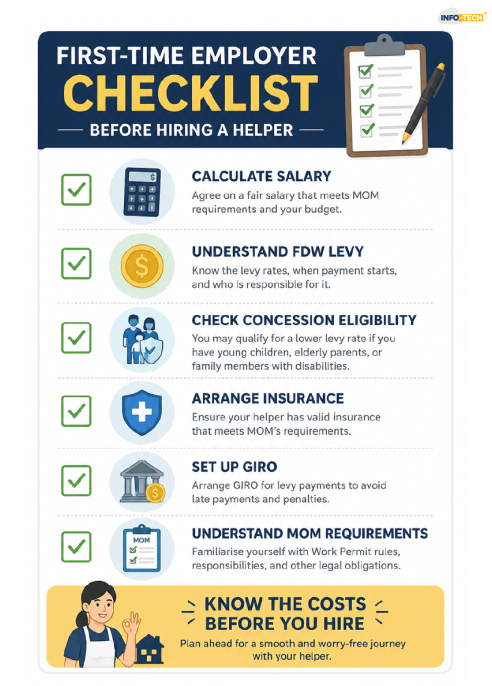
For some households, the standard levy applies. For others, the concessionary levy can result in meaningful savings every year. The key is understanding where your household stands before making assumptions.
If there’s one takeaway for prospective employers, it’s this: don’t treat the levy as an afterthought.
Check whether you’re eligible for a concession. Understand when payments begin and end. Make sure payment arrangements are set up correctly.
While FDW levy matters are administered through the Ministry of Manpower (MOM), staying organised with employment records, payroll processes, and recurring administrative tasks can make managing employees much easier. Businesses that employ both local staff and migrant workers often use an integrated HR and payroll software solutions to streamline payroll, employee records, leave management, and other workforce administration from a single platform.
A helper can make an enormous difference to a family’s daily life. Taking the time to understand the levy simply ensures there are no surprises once that journey begins. For employers who also run a business, digital tools can make other financial processes easier to manage. E-invoicing, for example, allows businesses to create, send and receive invoices digitally, reducing manual data entry and keeping transaction records more organised. When connected with accounting software, it can also make it easier to keep invoicing and financial records in one place.
In Singapore, businesses can also use InvoiceNow to send and receive structured e-invoices directly between compatible finance or accounting systems. As Singapore progressively moves towards wider InvoiceNow adoption, businesses can consider using InvoiceNow-Ready accounting or e-invoicing software to simplify invoice processing and prepare for upcoming requirements.
FDW Levy Payment FAQs
What is FDW levy payment in Singapore?
FDW levy payment is a monthly fee that employers pay to the Singapore Government when they hire a Foreign Domestic Worker (FDW), also known as a migrant domestic worker. It is separate from the helper’s salary and is the employer’s responsibility.
Who is responsible for paying the FDW levy?
The employer is fully responsible for the FDW levy payment. Employers are not allowed to deduct the levy from their helper’s salary or recover the cost in any form.
Can I qualify for a concessionary FDW levy rate?
Yes. Households may qualify for a concessionary levy if they have an eligible Singapore citizen family member, such as a young child, an elderly person aged 67 and above, or a person with disabilities who requires assistance with daily activities.
How do I pay the FDW levy in Singapore?
Most employers pay the FDW levy through GIRO. This allows the levy to be deducted automatically each month, helping employers avoid missed payments and potential penalties..
