
In this article
- 1. What Is Withholding Tax In Singapore?
- 2. Who Needs To Pay Withholding Tax In Singapore?
- 3. Who Is Considered A Non-Resident In Singapore?
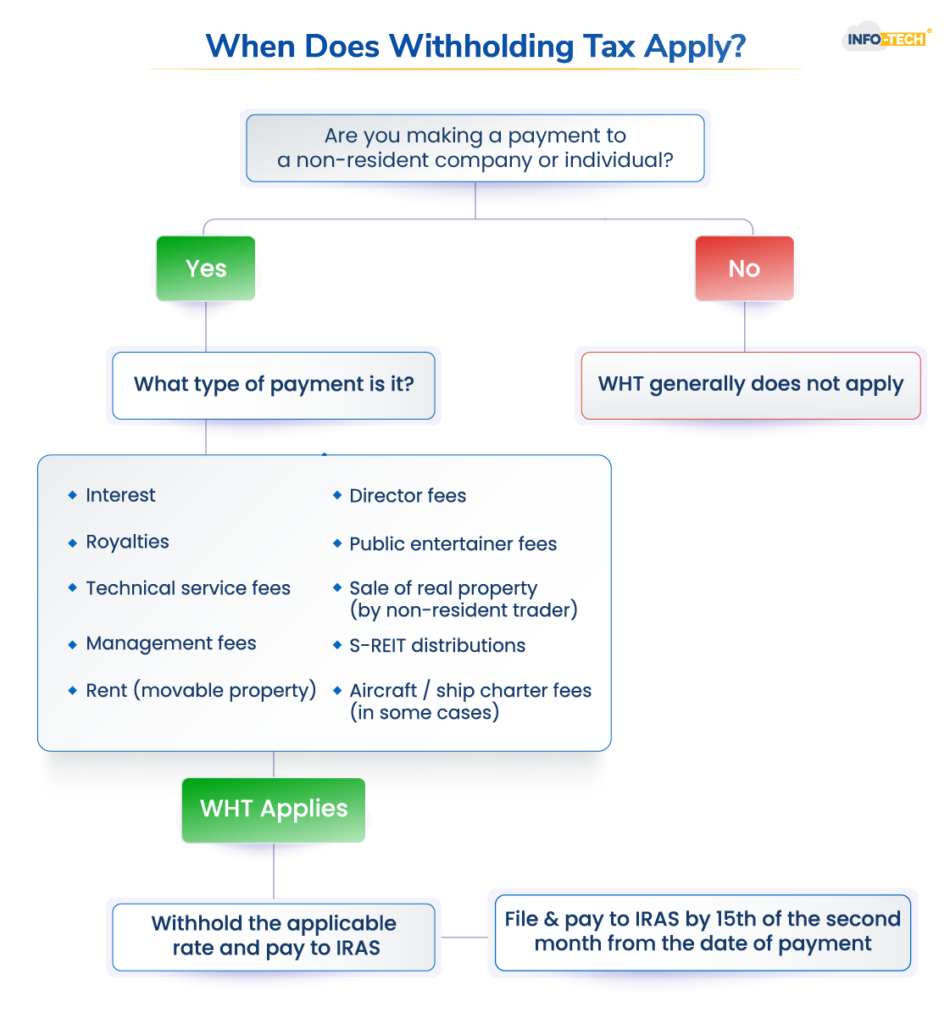
- 4. What Types Of Payments Are Subject To Withholding Tax In Singapore?
- 5. Which Payments Are Not Subject To Withholding Tax In Singapore?
- 6. What Are The Withholding Tax Rates In Singapore?
- 7. When Must Withholding Tax Be Paid To IRAS?
- 8. What Happens If Withholding Tax Is Paid Late?
- 9. How Can Businesses Avoid Withholding Tax Problems?
- 10. Withholding Tax FAQs
What Is Withholding Tax In Singapore?
Most business owners don’t really think about withholding tax until somebody from accounts asks, “Did we deduct tax on this payment?” That’s usually how it starts. In Singapore, withholding tax applies when a business pays certain kinds of income to someone based overseas. Instead of sending the full amount, part of it has to be paid to IRAS.
Simple idea, honestly. If the income comes from Singapore, IRAS wants tax collected even if the person receiving the money is not here.
Not every overseas payment falls into this category though. That’s where people get confused. This guide explains the basics of withholding tax in Singapore in a simple and practical way.
Who Needs To Pay Withholding Tax In Singapore?
Under Singapore rules, the local payer is the one responsible for checking whether withholding tax applies.
So if a Singapore company hires a consultant from another country or pays license fees to a foreign software provider, it may need to deduct tax first before paying.
Ignoring it doesn’t really help because IRAS still treats the payer as the responsible one.
Who Is Considered A Non-Resident In Singapore?
For companies, it depends on where the business is controlled and managed.
For individuals, the 183-day rule is the common benchmark. If someone spends less than 183 days in Singapore during the year, they are usually treated as a non-resident for tax purposes.
This applies to consultants, directors, entertainers, freelancers, and professionals working in Singapore for shorter periods.
What Types Of Payments Are Subject To Withholding Tax In Singapore?
Royalties are one of the biggest ones.
Say a business pays an overseas company for software usage, branding rights, or intellectual property. That can attract withholding tax.
Interest payments connected to loans can also fall under WHT.
Then there are management fees and technical service fees. These are slightly trickier because the tax treatment sometimes depends on where the work was actually carried out.
Director fees paid to non-resident directors are also taxable.
Here’s a quick breakdown of some common WHT rates:
| Payment Type | Typical WHT Rate |
|---|---|
| Interest and loan-related fees | 15% |
| Royalties and IP payments | 10% |
| Rent for movable property | 15% |
| Non-resident director fees | 24% |
| Non-resident public entertainer payments | 15% |
| S-REIT distributions | 10% |
Singapore also has tax treaties with many countries, so sometimes the actual rate can be lower.
Which Payments Are Not Subject To Withholding Tax In Singapore?
Dividends usually don’t. Singapore already taxes company profits at the corporate level, so dividends are generally exempt from withholding tax.
Some shipping-related payments are exempt too. Certain banking and finance transactions may also qualify.
There are cases where payments made to Singapore branches of overseas companies do not attract withholding tax either.
Still, businesses should not assume every overseas payment is exempt just because someone says it is.
What Are The Withholding Tax Rates In Singapore?
The rate changes depending on the payment.
- Interest payments are commonly taxed at 15 percent.
- Royalties are generally taxed at 10 percent.
- Non-resident director fees are taxed at 24 percent.
- For non-resident professionals, it is usually 15 percent on gross income or based on the prevailing non-resident tax rate on net income.
Technical service fees may be taxed at the prevailing corporate tax rate if the services are performed in Singapore.
When Must Withholding Tax Be Paid To IRAS?
The deadline catches people out quite often. Businesses need to file and pay withholding tax by the 15th day of the second month after payment is made.
So if payment happens in January, the tax is usually due by 15 March.
Everything is filed online through IRAS.
Keeping records properly matters more than people think. Agreements, invoices, payment dates, all of it should be stored properly in case questions come up later.
What Happens If Withholding Tax Is Paid Late?
Late payment can become expensive very quickly. IRAS may impose penalties and extra charges. In more serious situations, penalties can go up to three times the amount of tax owed.
Apart from the financial side, late compliance also creates unnecessary trouble during audits and reviews.
How Can Businesses Avoid Withholding Tax Problems?
Honestly, most problems happen because companies process overseas payments too quickly.
A simple review before payment usually helps. Who is receiving the money? What is the payment actually for? Was the work done in Singapore? Those questions matter.
Contracts should also be checked properly. Some agreements mention withholding tax clearly while others avoid mentioning it completely.
For businesses making regular overseas payments, keeping proper records makes life easier later. Withholding tax is not the most exciting part of running a business, but it’s one of those areas where getting things right early saves a lot of unnecessary headaches later.
This is where accounting software and payroll software can make things easier. Instead of manually tracking overseas payments, businesses can use these systems to organise invoices, monitor payment dates, maintain vendor records, and reduce the risk of missing filing deadlines. Payroll software is especially useful when handling payments to non-resident directors or overseas employees because it keeps payment records and tax calculations in one place.
Good accounting systems also help businesses maintain proper documentation for IRAS reviews, which becomes important during audits or compliance checks.
Withholding tax is one of those areas where small mistakes can become costly, so having proper systems in place early usually saves businesses a lot of unnecessary trouble later. Contact us today!
Read also: Income Tax Filing Guidelines for Singapore Businesses
Withholding Tax FAQs
What is the withholding tax in Singapore?
Withholding tax in Singapore is a tax deducted from certain payments made to non-resident individuals or companies before the payment is sent overseas.
Who pays withholding taxes?
The business or individual making certain payments to a non-resident person or company is responsible for deducting and paying withholding tax to IRAS.
How to avoid 30% withholding tax?
To avoid a 30% withholding tax, businesses or individuals usually need to claim benefits under a tax treaty by submitting the correct tax forms and proving their tax residency in their home country.
Can withholding tax be claimed back?
Yes, withholding tax can sometimes be claimed back if excess tax was deducted or if a tax treaty allows for a lower tax rate than what was initially withheld.
