

In this article
- 1. What Is the Workfare Income Supplement (WIS)?
- 2. How Much Is the Workfare Income Supplement Payout?
- 3. How Is Workfare Payment Split?
- 4. How Much is Monthly WIS Payment?
- 5. Who Qualifies for Workfare?
- 6. Why Payroll Accuracy Matters?
- 7. How HR Systems Help Employers Manage Compliance?
- 8. Final Thoughts
- 9. Workfare Income Supplement FAQs
The Workfare Income Supplement (WIS) is one of the ways the Singapore government supports lower-wage workers. Instead of just offering one-off financial aid, the scheme is designed to top up income while also growing CPF savings.
The programme is managed through agencies like the CPF Board and IRAS, and it provides payouts to Singaporean workers who fall within certain income levels.
For many people working in sectors such as cleaning, retail, logistics, food services, or general administrative work, Workfare acts like an extra income boost. Part of the payout comes as cash, which helps with everyday expenses, while the rest goes into CPF accounts, strengthening retirement savings.
For HR teams and employers, understanding how Workfare works is also important. Payroll records, CPF submissions, and salary reporting can affect whether an employee qualifies for the payout.
In this article, we’ll look at a few key things:
- How much the Workfare payout can be
- How the payment is split between cash and CPF
- Who qualifies for the scheme
- How often payments are made
- Why payroll accuracy matters when determining eligibility
What Is the Workfare Income Supplement (WIS)?
The Workfare Income Supplement scheme was created to support Singaporeans who earn lower wages but remain active in the workforce.
Workers who are 30 years old and above may qualify if their income falls within the eligibility range. The goal of the programme isn’t just to provide extra income, but also to encourage long-term employment and retirement savings.
Instead of paying everything in cash, the government divides the support into two parts:
• Cash payments that workers receive directly
• CPF contributions that go into their retirement savings
This way, workers benefit both now and later. They get some extra money to help with daily expenses, while their CPF balances slowly grow in the background.
Depending on employment type, the payout may be given monthly or once a year.
How Much Is the Workfare Income Supplement Payout?
The exact payout varies. Two factors mainly affect the amount:
- The worker’s age
- The worker’s income level
Generally speaking, older workers receive higher payouts because the policy aims to help strengthen their retirement savings.
Here is the maximum yearly Workfare payout by age group.
| Age Group | Maximum Annual WIS Payout |
| 30 – 34 | Up to $2,450 |
| 35 – 44 | Up to $3,500 |
| 45 – 54 | Up to $4,200 |
| 55 – 59 | Up to $4,900 |
| 60 and above | Up to $4,900 |
| Persons with Disabilities | Up to $4,900 |
The final amount a worker receives will still depend on things like monthly wages and CPF contributions.
Workers earning lower wages typically receive a larger portion of the maximum payout, while those closer to the income ceiling may receive less.
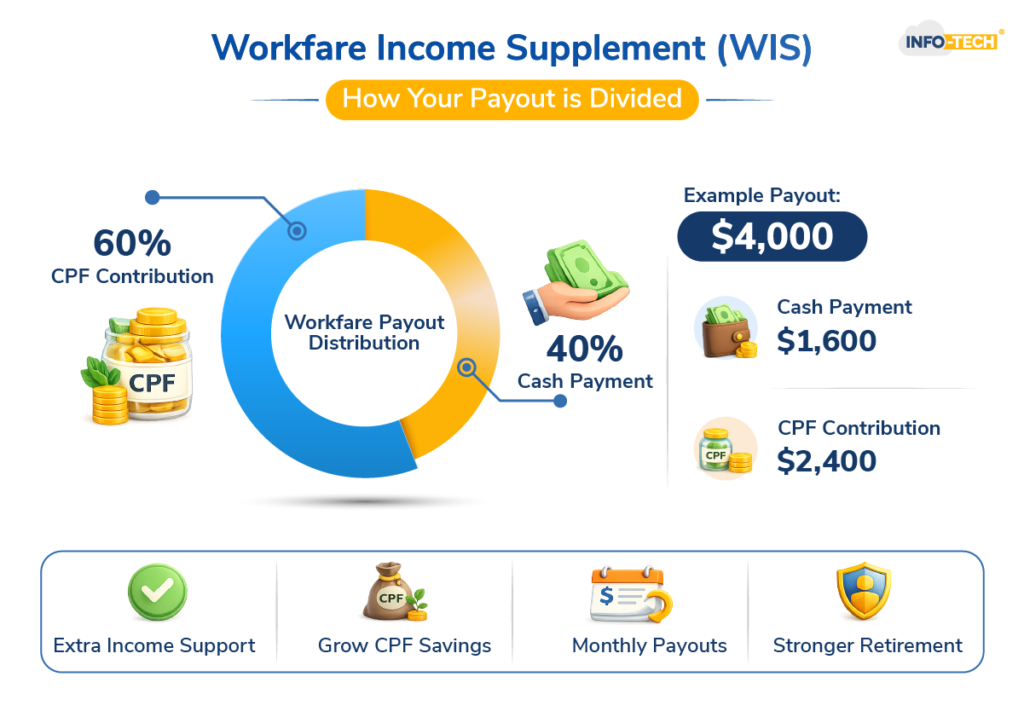
How Is Workfare Payment Split?
Another thing that sometimes surprises people is that Workfare payouts are not entirely paid in cash.
Instead, the payment is divided between cash and CPF savings.
| Payment Type | Share of Payout | Purpose |
| Cash | 40% | Immediate financial support |
| CPF | 60% | Retirement savings |
For example, if someone qualifies for a $4,000 Workfare payout, the breakdown would roughly look like this:
- $1,600 in cash
- $2,400 credited to CPF
This system encourages long-term savings without removing the immediate financial benefit.
How Much is Monthly WIS Payment?
In the past, Workfare payouts were often paid once a year. Over time, the system has been updated so that many employees now receive monthly payouts instead.
This change helps workers manage their finances more easily.
Monthly payouts usually include:
- A cash component deposited into the worker’s bank account
- CPF contributions credited into CPF accounts
For workers with tighter budgets, receiving smaller amounts regularly can sometimes be more helpful than waiting for a single yearly payout.
Who Qualifies for Workfare?
Not everyone qualifies for Workfare. There are a few basic conditions that workers need to meet.
Basic requirements
Workers must:
- Be a Singapore citizen
- Be 30 years old or older (unless disabled)
- Earn within the eligible income range
- Be working and contributing to CPF
- Live in a property below the annual value threshold
- Not own multiple properties
Employment conditions
Workers must also have:
- Active employment or self-employment
- CPF contributions being made
- Recorded income over a period of time
These conditions help ensure that the support goes to workers who are earning lower wages but are still participating in the workforce.
Why Payroll Accuracy Matters?
Many people don’t realise that Workfare eligibility often depends heavily on payroll data and CPF submissions.
If salary information is incorrect or CPF contributions are delayed, it could affect whether a worker qualifies for the scheme.
Because of this, employers need to ensure:
- Salaries are reported correctly
- CPF contributions are submitted on time
- Employee records are kept up to date
For HR teams managing many employees, this can become quite complicated if payroll is handled manually.
How HR Systems Help Employers Manage Compliance?
As employment regulations and reporting requirements become more digital, many companies now rely on HRMS and payroll software to manage their workforce data.
Platforms like those offered by Info-Tech help businesses manage several key HR processes in one place.
These typically include:
- Payroll processing
- CPF contribution calculations
- Employee information management
- Leave and attendance tracking
- Compliance reporting
By centralising payroll and HR data, companies reduce the risk of reporting errors while making it easier to stay compliant with Singapore regulations.
Final Thoughts
The Workfare Income Supplement scheme plays an important role in Singapore’s workforce support system. It helps lower-wage workers increase their income while continuing to build CPF savings for the future.
For employees, it provides useful financial support. For employers, it highlights the importance of accurate payroll reporting and CPF contribution submissions.
With reliable HR and payroll systems in place, companies can manage these requirements more smoothly while helping employees receive the government benefits they are entitled to.
Learn More: Singapore Median Income: What HR Leaders Should Know
Workfare Income Supplement FAQs:
How much cash do workers receive from Workfare payouts?
Workers receive approximately 40% of their total Workfare payout as cash, with the remaining 60% credited to CPF accounts. The exact amount depends on age, income level, and CPF contributions made by the employer.
What is the maximum Workfare Income Supplement payout?
The maximum annual payout can reach up to $4,900, depending on the worker’s age group and employment income. Older workers generally receive higher payouts to strengthen retirement support.
When are Workfare payments made?
Most employees now receive monthly Workfare payouts, which include both cash payments and CPF contributions. This change helps provide more stable financial support throughout the year.
Do employers need to apply for Workfare for employees?
No. Employees generally do not need to apply for Workfare, as eligibility is assessed automatically based on payroll income records and CPF contributions submitted by employers.
