
What Is Block Leave
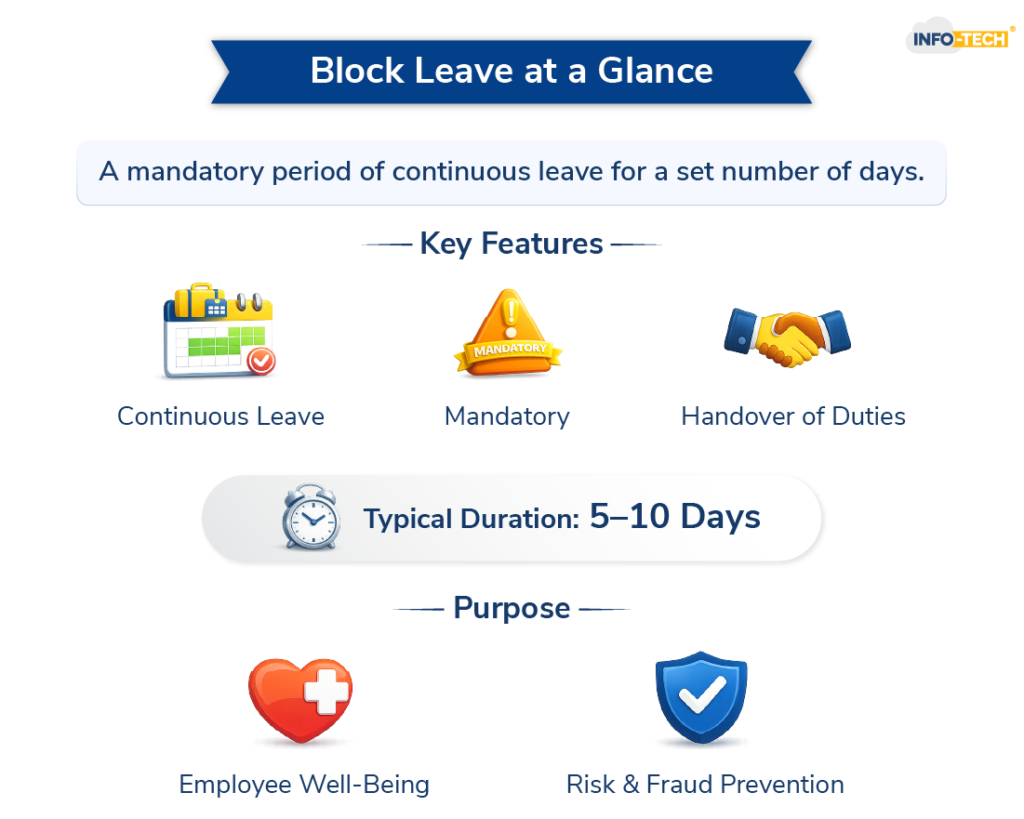
Block leave is a mandatory continuous leave provided by the employer for the employee to take rest consecutively for specific number of days. It is implemented to ensure that the employees get proper breaks from their routine work, thereby maintaining their productivity and morale. It supports work-life balance, especially for professionals working in certain high-risk sectors. During this leave, employees should not contact their organization regarding any official work.
For example, if the company policy provides 5 days of block leave, the employee must take 5 days of uninterrupted leave at once, instead of splitting them.
Purpose and Benefits of Block Leave in Organizations
Though there is no statutory requirement for the implementation of it in Singapore (except in certain regulated industries such as financial services), many companies offer this as a part of their policy for the well-being of their employees.
For employee well-being: Stepping away from work for a longer period can help employees recharge physically and mentally. The feeling of monotonous work can be abolished, and it will increase individual productivity after getting back to work. Spending dedicated time without any professional intervention can give much peace and better performance.
Reducing fraud and operational risks: In certain sensitive roles like finance, it can serve as a preventive control and reduce the chances of continuous fraud activities that are hidden.
Knowledge sharing and cross training: When an employee goes for the leave, they hand over all their duties to someone else. This will help other teams learn new work and decrease the dependency on a single employee.
Decreasing employee dependency: Depending on a single employee for certain important tasks can result dangerously when they resign or leave due to emergency. This leave allows other teams to manage the work when a person is absent.
Healthier leave culture: Some employees do not take leave just because they have work commitments and pressure on them. This leave encourages employees to take their entitled leaves, ensuring work-life balance.
How Block Leave Actually Works
During this leave, the employee is expected to be fully away from any kind of professional work, while their duties are handed over to some other person or managed by backup arrangements.
- Set minimum continuous leave period: The number of days is allocated based on the policies of the company but is usually taken from employees’ annual leave entitlement in a fixed manner.
- Plan leaves in advance: Planning it in advance is necessary for getting proper approval and business management arrangements.
- Handover work responsibilities: On the day before leaving for the leave, the employee hands over the tasks, pending work, and updates to a colleague or supervisor.
- Stay fully away from work: Employee is not expected to respond to work matters, perform any duties or even access systems. This genuinely gives a break to the employee from their work life.
- Temporary coverage: Another employee takes up the tasks and works on it. This ensures that the work is continued without disruption.
- Employee resumes duty: After the leave period ends, the employee returns and hand back process takes place.
Block Leave Policy Guidelines
The policy must clearly state certain details such as
- Duration of continuous leave
- Eligibility criteria
- Approval process
It should also include information such as mandatory handover of duties, ensuring employees do not work during the leave period, and assigning backup coverage to maintain operations
Challenges of Block Leave
While advantageous, it can also be challenging in certain ways for the employers.
- Temporary work disruption
- Difficulty in finding backup
- Increased workload on other employees
- Scheduling conflicts
Block Leave vs Annual Leave
Although both leaves involve employees taking time away from work, they differ in purpose, duration, and how they are applied within an organization. Block leave is usually a structured requirement set by the employer, while annual leave is a general entitlement that employees can use more flexibly.
| Aspect | Block Leave | Annual Leave |
| Purpose | Mandated by the employer for regulatory compliance, risk management, or employee well-being | Voluntary leave taken by employees for personal reasons, vacations, or rest |
| Duration | Usually a continuous period, often 5 days to one week or more | Can be taken in shorter increments |
| Implementation | Scheduled by the employer and aligned with company policies | Requested by the employee and approved based on operational needs |
Closing Thoughts
Block leave policy is more than just a leave; it’s an approach that benefits the employees as well as the employers. While there may be challenges for employers in planning and executing these, it can be effectively managed with the help of clear policies, proper communication, and the right tools. Overall, this leave plays a vital role in building a resilient, efficient, and employee-friendly workplace.
To streamline leave planning and ensure seamless implementation of policies like leaves, businesses can leverage HR Software or Leave Management Software for better tracking, scheduling, and compliance. Contact us today to streamline your leave management.
Block Leave Frequently Asked Questions
What is block leave in Singapore?
Block leave is Singapore is the continuous leave period provided by the employer, for the employee to take complete time off work.
How many days is block leave?
The number of block days is not fixed and depends on the policy of the company. It generally ranges from 5 to 10 consecutive days.
What is the difference between block leave and annual leave?
While block leave is mandated by the company over a specific continuous period, annual leave is employee–specific and can be used as per their wish (even for a single day).
What is a holiday block leave?
A holiday block leave refers to a scheduled period of continuous leave that is taken around public holidays or festive periods, allowing employees to extend their time off by combining block leave with official holidays.
