

In this article
- 1. What is Retrenchment in Singapore?
- 2. Why Do Companies Retrench Employees?
- 3. How Should Employers Choose Who to Retrench?
- 4. What Notice Should Be Given During Retrenchment?
- 5. Are Retrenchment Benefits Compulsory In Singapore?
- 6. What Should Be Included in a Retrenchment Package?
- 7. When Must Employers Notify MOM About Retrenchment?
- 8. How Can Employers Support Retrenched Employees?
- 9. How Can Businesses Manage Retrenchment More Responsibly?
- 10. Retrenchment FAQs
Retrenchment is never an easy thing. For employees, it may feel sudden and worrying and for employers, it is one of the hardest decisions to make. In Singapore, retrenchment is not just about ending employment. It must be handled fairly, clearly and responsibly. Especially when people’s income and future plans are going to be affected because of it.
What is Retrenchment in Singapore?
Retrenchment is when an employee is told to leave the company because their role is no longer needed for them. This may be the result of restructuring, business slowdown, automation, closure of a department, cost cutting strategy or changes in company direction.
It is in no way related to termination due to poor performance or misconduct. In retrenchment, the issue is usually not the employee’s behavior. The job itself has become redundant, or the business cannot continue keeping the same manpower structure.
Why Do Companies Retrench Employees?
Companies usually retrench employees when they need to reduce costs, merge job roles, close business units or adjust to market changes. Some businesses also retrench when technology replaces certain manual tasks and their manual support is no longer needed to them.
Still, retrenchment should not be the first option. Employers in Singapore are encouraged to consider alternatives first, such as redeployment, shorter work arrangements, training, cost-saving measures or temporary adjustments. It should come only when other practical options cannot work out.
How Should Employers Choose Who to Retrench?
The selection should be fair and based on objective reasons. Employers should fairly look at factors such as skills, experience, job relevance, work performance, future business needs and ability to support the company’s operations.
Responsible retrenchment should never be based on age, race, nationality, gender, personal dislike or convenience. A responsible employer must be able to explain clearly why certain roles or employees were affected and why retrenchment is their only option to move forward with.
What Notice Should Be Given During Retrenchment?
Employees should be informed as early as possible. The notice period usually follows the employment contract. If the contract does not state a notice period, the Employment Act notice period may apply, depending on the employee’s length of service.
Some companies may ask employees to serve the notice period. Others may give salary in lieu of notice, meaning the employee leaves earlier but is paid for the notice period. Either way, the arrangement should be clearly stated in writing.
Are Retrenchment Benefits Compulsory In Singapore?
Retrenchment benefits are not automatically fixed by law for every case. However, employees who have worked for at least two years are generally eligible for retrenchment benefits, unless the employment contract or collective agreement says otherwise.
The usual market practice is between two weeks and one month of salary for each year of service, depending on the company’s financial position and industry practice. For unionized companies, the amount may be stated in the collective agreement.
What Should Be Included in a Retrenchment Package?
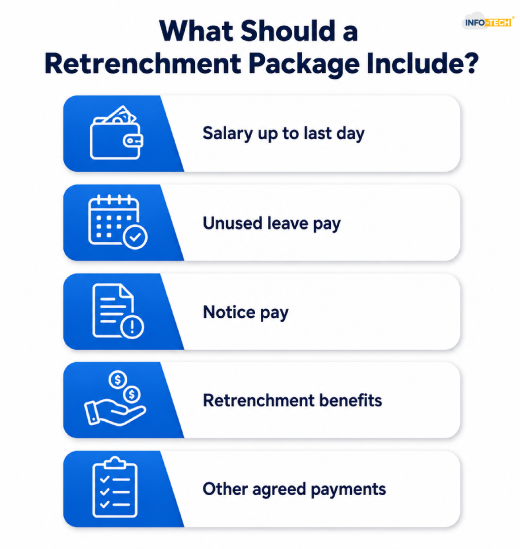
A retrenchment package may include the employee’s salary up to the last day of work, unused annual leave payment, salary in lieu of notice if applicable, retrenchment benefits and any contractual payments such as AWS or bonuses.
Employers should provide a clear breakdown so employees understand how the final amount was calculated. This reduces confusion and helps both sides avoid disputes later.
When Must Employers Notify MOM About Retrenchment?
Singapore-registered employers with at least 10 employees must notify the Ministry of Manpower when they retrench any employee. This must be done within five working days after the affected employee has been informed.
This notification helps the authorities and tripartite partners support affected employees through job matching, training and employment assistance. It is not just an administrative step; it is part of responsible manpower management.
How Can Employers Support Retrenched Employees?
A responsible retrenchment process should be handled with respect. Employers should explain the business reason clearly, give employees proper documentation, answer questions patiently and avoid making the employee feel blamed.
Where possible, employers can also offer career support, referrals, job search resources, counselling, training information or help from agencies such as Workforce Singapore and NTUC’s e2i. Small gestures matter during a difficult transition.
How Can Businesses Manage Retrenchment More Responsibly?
The best approach is to plan early and communicate honestly with the employees. Employers should keep proper employee records, leave balances, attendance data, payroll details and contract information before any retrenchment exercise starts.
This is where good HR systems can quietly make a difference. payroll software, leave management and time attendance software helps businesses keep employee information accurate, calculate final payments properly and avoid unnecessary mistakes during sensitive situations.
Retrenchment will never be a pleasant process, but it can still be handled with fairness and dignity to take it in a lighter note. When employers follow proper guidelines, communicate clearly and support affected workers, they protect not only their employees but also their company’s overall reputation.
Retrenchment FAQs:
What is employee retrenchment?
Employee retrenchment means ending an employee’s job because the role is no longer needed due to business reasons like restructuring, cost-cutting, closure, or reduced work.
Is retrenchment the same as layoff?
Not exactly. Retrenchment usually means the employee’s role is made redundant because of business reasons like restructuring or cost-cutting. Layoff is a broader term. In some countries, it can mean temporary or permanent job loss, but in Singapore, people often use “layoff” casually to mean retrenchment.
What are the three types of retrenchment?
The three types of retrenchment are voluntary retrenchment, compulsory retrenchment, and temporary layoff or short work arrangement.
Do you get paid for retrenchment?
Yes, you can get paid for retrenchment in Singapore if you have served the company for at least 2 years; the usual practice is 2 weeks to 1 month of salary per year of service, depending on the contract, company situation and industry practice.
