

In this article
- 1. What is Skills Development Levy (SDL)?
- 2. Who Needs To Pay SDL In Singapore?
- 3. How Is SDL Calculated For Each Employee?
- 4. How Do You Calculate Total SDL For Your Company?
- 5. What Is the Use of SDL?
- 6. How Do Employers Pay SDL?
- 7. What Happens If You Don’t Pay SDL On Time?
- 8. Can You Get A Refund If You Overpay SDL?
- 9. Are There Any Exemptions To SDL?
- 10. What Does The Future Of SDL Look Like?
- 11. How Can Payroll Software Help Manage SDL More Easily?
- 12. Skills Development Levy (SDL) FAQs
If you’re running a business in Singapore, you’ll eventually come across the Skills Development Levy (SDL). Most people first notice it when handling payroll, and honestly, it can feel like just another thing to tick off.
But it’s not random. There’s a clear reason behind it, and once you understand it, it’s pretty straightforward to manage. Let’s go through it step by step in this article.
What is Skills Development Levy (SDL)?
The Skills Development Levy, or SDL, is something employers in Singapore have to pay every month for their employees.
It doesn’t matter if your employees are local or foreign, full-time or part-time; it applies across the board.
This levy is collected by the CPF Board, but it doesn’t go into CPF. Instead, it goes to SkillsFuture Singapore (SSG), which uses the funds to support training and skills development across the workforce.
So while it feels like a small deduction on your end, it’s actually part of a bigger system that helps companies train and upgrade their teams.
Who Needs To Pay SDL In Singapore?
If you have employees working in Singapore, you’ll need to pay SDL for them. It’s as simple as that.
This includes:
- Full-time employees
- Part-time staff
- Temporary or contract workers
- Foreign employees on work passes
There are a couple of exceptions, though. For example, if someone is hired purely for personal work like a domestic helper, gardener, or chauffeur, you don’t need to pay SDL for them. Also, if an employee didn’t work in Singapore at all for a particular month, SDL isn’t required for that period.
Other than these situations, most employers will need to include SDL as part of their regular payroll process.
How Is SDL Calculated For Each Employee?
The calculation itself is not complicated, but there are a few limits to keep in mind.
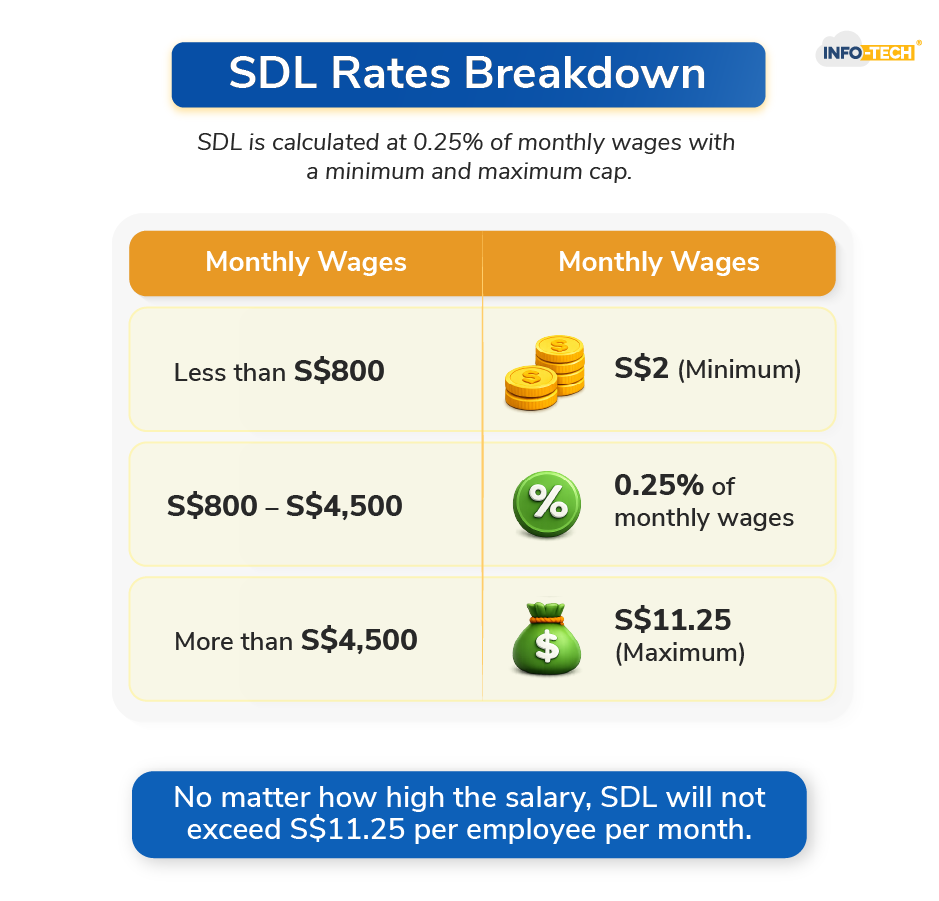
You calculate SDL as 0.25% of the employee’s monthly wages.
But:
- If the amount comes out to less than S$2, you still pay S$2
- If it goes above S$11.25, you cap it at S$11.25
So in practice, every employee will fall somewhere within that range.
Here’s a quick way to think about it:
| Monthly Salary | SDL Payable |
| Below S$800 | S$2 |
| S$800 to S$4,500 | 0.25% |
| Above S$4,500 | S$11.25 |
Once you’ve done it a few times, it becomes routine.
How Do You Calculate Total SDL For Your Company?
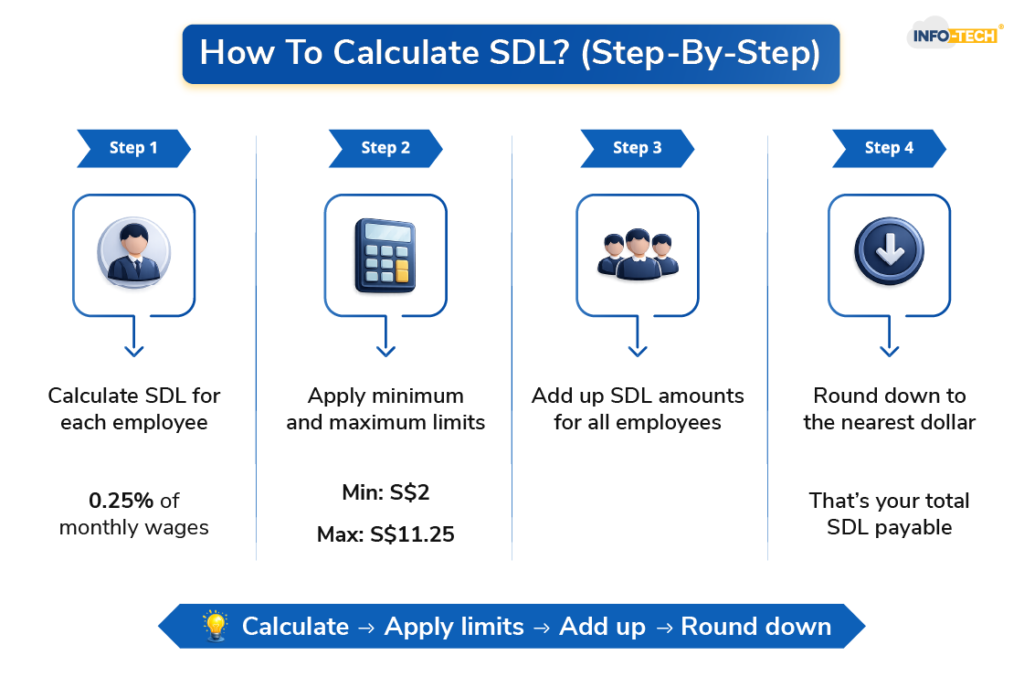
You don’t calculate SDL as one big number right away. You do it per employee first.
Here’s how it usually goes:
First, calculate SDL for each employee individually.
Then, add everything together.
At the end, you round the total amount down to the nearest dollar.
That’s your final SDL payable for the month.
What Is the Use of SDL?
SDL isn’t just a fee for the sake of it. The money collected goes into training and development programmes that businesses can actually benefit from.
It helps fund:
- Skills upgrading courses
- Workforce training programmes
- Grants for companies that invest in employee development
So while you’re paying into the system, you can also benefit from it when you train your team.
How Do Employers Pay SDL?
For most companies, SDL is paid together with CPF contributions.
If you’re using CPF EZPay, part of the work is already done for you. The system calculates SDL for local employees automatically, and you just need to key in the figures for foreign employees.
If your company only hires foreign workers, then you’ll need to pay SDL directly to SkillsFuture Singapore, usually through the GoBusiness platform.
Either way, once it’s set up, it becomes part of your monthly routine.
What Happens If You Don’t Pay SDL On Time?
Like most statutory payments, delays on paying SDL can cost you.
If you miss the deadline, there’s a 10% yearly penalty on whatever amount is still unpaid. On top of that, it might affect your ability to access certain government grants or support schemes.
SDL is generally due within 14 days after the end of each month, so it’s worth staying consistent with it.
Can You Get A Refund If You Overpay SDL?
Short answer: Yes, you can.
If you realise you’ve paid more than you should have, you can apply for a refund from SkillsFuture Singapore.
It’s not uncommon, especially if payroll figures change or adjustments are made late. As long as your records are in order, the process is manageable.
Are There Any Exemptions To SDL?
There aren’t many exemptions, and that’s intentional.
You don’t need to pay SDL for:
- Domestic workers or personal staff
- Employees who didn’t work in Singapore for that month
Apart from that, SDL applies to most employment situations.
What Does The Future Of SDL Look Like?
If anything, SDL is becoming more relevant, not less. With how quickly industries are changing, there’s a bigger push towards continuous learning of things like digital skills, automation, and adapting to new roles.
SDL plays a part in supporting that shift, so it’s likely to remain a key part of how workforce development is funded in Singapore.
How Can Payroll Software Help Manage SDL More Easily?
When your team is small, handling SDL manually is doable. But as you grow, it can get messy with more employees, more calculations, more chances for mistakes.
That’s where payroll software helps. Instead of calculating everything yourself each month, the system does it for you. It applies the correct rates, handles the limits, and keeps everything aligned with current rules.
It also helps with:
- Keeping calculations consistent
- Making sure payments are submitted on time
- Tracking any overpayments or adjustments
- Reducing the amount of manual work involved
So rather than spending time double-checking numbers every month, you can rely on the system to handle it in the background. Contact us today!
Skills Development Levy (SDL) FAQs
What is the SDL rate in Singapore?
The SDL rate in Singapore is 0.25% of each employee’s monthly wages, with a minimum of $2 and a maximum of $11.25 per month.
How to calculate skill development levy?
To calculate the Skills Development Levy (SDL), you simply take 0.25% of each employee’s monthly wages, apply a minimum of $2 and a maximum of $11.25, then add up all employees’ SDL amounts and round the total down to the nearest dollar.
Who should pay for SDL?
All employers in Singapore must pay SDL for their employees, including full-time, part-time, temporary, and foreign workers, as long as they are rendering services in Singapore.
What kind of projects use SDL?
SDL funds workforce training and development initiatives in Singapore, including employee upskilling and reskilling programmes, professional courses, industry-specific training under the Continuing Education and Training (CET) system, and government-supported initiatives that help businesses improve their workforce capabilities.
