
In this article
- 1. How IRAS Regulations Are Changing the Way Businesses Handle Invoices?
- 2. Why is invoicing getting more attention from IRAS?
- 3. Where businesses tend to run into issues?
- 4. Why older invoicing habits are starting to fall short?
- 5. What E Invoicing changes in practical terms
- 6. The role of InvoiceNow in all this
- 7. Is this just about compliance?
- 8. What happens if businesses hold off on changing?
- 9. What a more stable approach looks like now?
- 10.Final thought
- 11.E-Invoicing FAQs
How IRAS Regulations Are Changing the Way Businesses Handle Invoices?
For years, invoicing sat in the background of most businesses. It was necessary, of course, but rarely something that demanded attention unless payments were delayed or numbers didn’t match at the end of the quarter.
That quiet role is changing.
IRAS hasn’t made a loud announcement saying, “fix your invoicing process.” Instead, it has steadily raised expectations around accuracy, documentation, and traceability. The effect is the same businesses are being pushed to take invoicing more seriously than before.
At the centre of this shift is E Invoicing. Not as a buzzword, but as a practical response to how the rules are tightening.
Why is Invoicing Getting More Attention From IRAS?
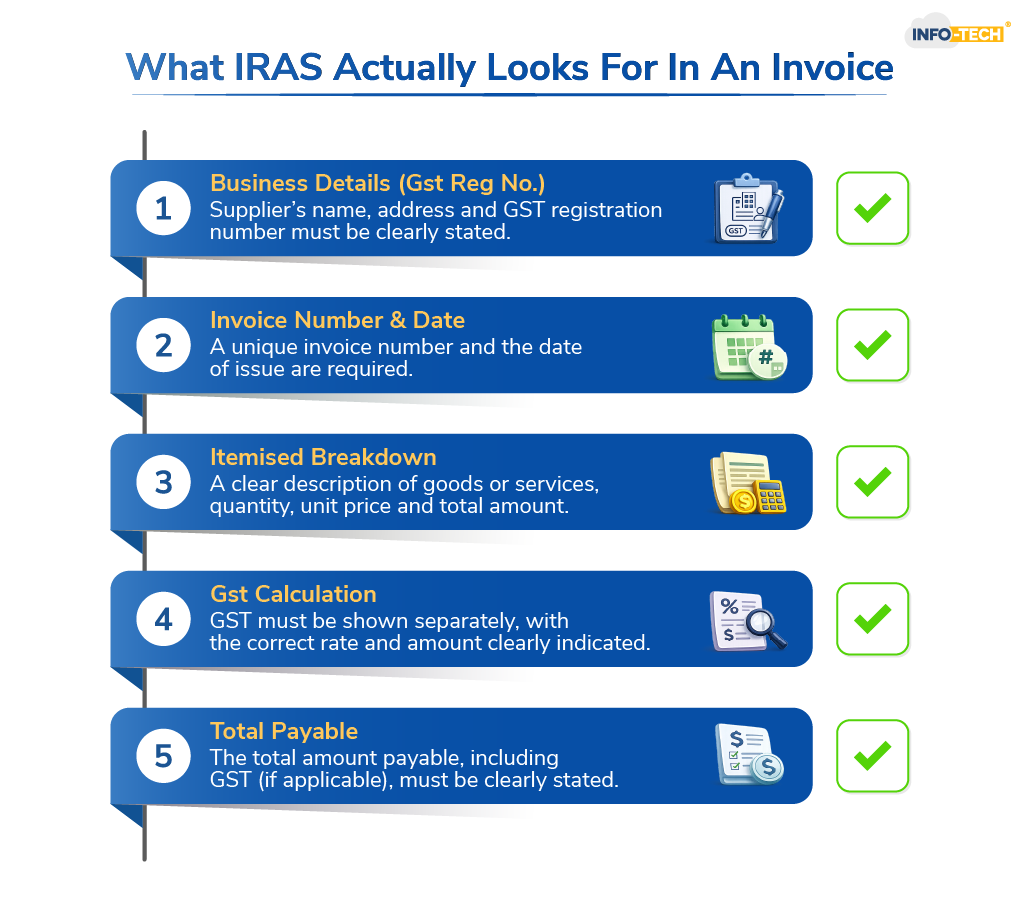
Invoicing is where financial records begin. Every GST figure reported, every revenue number declared—it all traces back to what was captured at this stage.
What IRAS is doing now is looking beyond the final figures. There is more emphasis on whether the numbers can be supported by clean, consistent records. If something doesn’t line up, it’s no longer brushed aside as a minor issue.
That’s why details matter more than they used to:
- GST must be calculated correctly and consistently
- Business and customer details need to be complete
- Records should be easy to retrieve and verify
None of this is new on paper. What has changed is how strictly it’s being applied.
Where Businesses Tend to Run Into Issues?
Most businesses don’t set out to create messy processes. It usually happens gradually.
A system is added here, a spreadsheet there, and before long, invoicing looks something like this:
- Created in one platform
- Edited or tracked elsewhere
- Sent manually
- Recorded again in accounting software
Each step works on its own. Together, they introduce small gaps.
An updated invoice might not fully replace the original.
A figure might be corrected in one place but missed in another.
A document might take longer than expected to locate when needed.
Individually, these are manageable. Under closer review, they become harder to explain clearly.
Why Older Invoicing Habits Are Starting To Fall Short?
Traditional methods were built around flexibility. Today’s expectations are built around consistency.
That difference matters.
Manual invoicing depends heavily on people getting things right every time. In smaller volumes, that’s realistic. As transactions grow and reporting becomes stricter, it becomes harder to maintain.
Even something as simple as emailing invoices has its limits. Once the document leaves your system, there’s no control over how it’s handled or recorded on the other side.
These are the kinds of gaps that start to show up when standards tighten.
What E Invoicing Changes in Practical Terms
E Invoicing doesn’t change the purpose of an invoice. It changes how reliably it is handled.
Instead of relying on manual steps, it introduces a structured process:
- Invoice formats are standardised
- Calculations follow predefined rules
- Data is stored in a consistent, searchable way
- Each step leaves a trace
The result is not perfection, but predictability. There’s less variation from one invoice to the next, and fewer surprises when records are reviewed later.
From a compliance standpoint, that consistency makes a real difference.
The Role of InvoiceNow in All This
InvoiceNow is a good example of where things are heading. Rather than sending invoices as attachments, it allows them to move directly between systems. No manual entry on the receiving side, no re-keying of data.
That shift removes several common points of failure:
- Information doesn’t get altered along the way
- The correct data reaches the right system immediately
- There is a clear record of when it was sent and received
For businesses, it reduces back-and-forth. For IRAS, it creates a more reliable flow of information.
Is This Just About Compliance?
It often starts that way. But once processes are tightened, other benefits tend to follow.
- Finance teams spend less time checking and correcting entries.
- Reconciliation becomes less of a monthly headache.
- Invoices are clearer, which means fewer disputes and faster payments.
None of this is dramatic. It’s simply a smoother way of working.
What Happens If Businesses Hold Off On Changing?
In the short term, existing processes can still function. But they usually require more effort over time.
As expectations increase, more checks are needed. More time goes into making sure everything lines up. What used to be straightforward starts to feel heavier.
At some point, the effort required to maintain the old process outweighs the effort needed to improve it.
What A More Stable Approach Looks Like Now?
Most businesses moving in this direction end up with a similar setup:
- Invoices generated within a system that handles GST correctly
- Records stored in one place rather than spread across files
- Clear tracking from issuance through to payment
- Compatibility with frameworks like InvoiceNow
Solutions like Info-Tech’s E Invoicing software are built around this idea. The aim isn’t to complicate things, but to remove the small inconsistencies that tend to cause larger problems later on.
Final Thoughts:
IRAS hasn’t made invoicing more complicated. It has made it less forgiving.
The expectation now is simple—records should be clear, consistent, and easy to verify. Anything less takes more time and effort to defend.
E Invoicing fits naturally into that direction. Not because it’s new, but because it deals with the exact areas where traditional processes tend to struggle.
For most businesses, the shift is not about doing more work. It’s about reducing the number of things that can go wrong.
E-Invoicing FAQs
Is E Invoicing mandatory in Singapore?
Not for every business yet, but IRAS strongly encourages it through InvoiceNow. Adoption is increasing, and expectations are gradually moving in that direction.
How does E Invoicing reduce errors?
It standardises formats and automates calculations, which removes many of the small inconsistencies that happen with manual handling.
What is InvoiceNow in simple terms?
It’s a system that allows invoices to be sent directly from one business system to another without manual intervention.
Will switching disrupt existing processes?
In most cases, it’s an adjustment rather than a disruption. Many systems are designed to fit into existing workflows.
