

In this article
Many businesses don’t realise they have a CRM problem until they start losing customers they thought were “loyal,” deals that seemed “almost closed,” and time that quietly disappears into spreadsheets, emails, and follow-ups that never happen.
On the surface, operations may appear manageable. Sales teams track leads in Excel, customer conversations live in inboxes, and notes that sit in their colleague’s notebook or, worse, in their head. But underneath that, there’s a silent cost building up every single day.
In a competitive business environment, these hidden costs eventually become visible often in the form of lost revenue, inconsistent service, and operational bottlenecks.
What Happens When You Do Not Use a CRM?
Not using a CRM doesn’t always mean you have no system at all. Most businesses do have something in place — it just isn’t organised.
It usually looks like this:
- Spreadsheets shared across teams
- Emails used to track customer conversations
- Sales updates discussed but never written down
- Customer details scattered across different tools
- No single place to see everything clearly
And honestly, it works… till a certain extent
As your business grows the volume of customers, interactions, and processes increases, making manual coordination difficult to sustain.
Also Read: Customer Relationship Management Software For Retention
What Is the Real Cost Of Not Using CRM?
Businesses often delay implementing a CRM system because of the cost involved. In reality, it’s more costly when it comes from inefficiencies and missed opportunities that are harder to quantify.
Let’s break it down.
1. Lost Sales Opportunities
When everything is tracked manually, it’s easy to miss follow-ups, delay responses, or overlook potential deals.
A delayed reply or missed reminder can result in a lost opportunity, especially in competitive markets where customers have multiple options.
Why this happens:
- No reminders for follow-ups
- Leads aren’t clearly assigned
- Conversations aren’t tracked properly
- No clear view of your sales pipeline
| Scenario | Without CRM | With CRM |
| Lead follow-up | Missed or delayed | Automated reminders |
| Sales visibility | Unclear | Easy to track |
| Conversions | Lower | Higher |
💡 The truth is, you’re not losing just one deal, you’re losing many small opportunities over time.
2. Too Much Time Spent on Manual Work
Without a CRM, teams often spend a large portion of their time on administrative tasks instead of revenue-generating activities.
Think about it:
- Updating spreadsheets
- Searching through email threads
- Re-entering the same data across systems
- Creating reports manually
It feels normal because it’s routine. But it takes up a lot of time.
Where time gets wasted:
- A big chunk of the day goes into admin work
- The same data is entered in multiple places
- Reports take hours to prepare
| Task | Without CRM | With CRM |
| Lead tracking | Manual | Automatic |
| Reports | Time-consuming | Instant |
| Customer info | Hard to find | Easy access |
💡 Over time, these inefficiencies accumulate, reducing overall productivity.
3. Poor Customer Experience
Customers don’t always complain. Most of the time, they just leave.
Here’s what it can feel like for them:
- They have to convey the same issue repeatedly
- Inconsistent communication relayed
- Follow-ups don’t happen
It’s frustrating. And in a competitive market, that’s enough for them to move on.
Without a CRM:
- No full view of the customer
- No record of past interactions
- Don’t quite understand this
With a CRM:
- Everything about the customer is in one place
- Conversations are tracked
- Follow-ups happen on time
💡 Today, customer experience matters just as much as price or product.
4. Poor Data Leads to Weak Decision-Making
When your data is scattered, it becomes hard to keep track.
Different departments may operate on inconsistent data sets, leading to confusion and delays.
| Area | Without CRM | With CRM |
| Forecasting | Guesswork | Clear insights |
| Team alignment | Confusing | Everyone on same page |
| Planning | Reactive | Planned |
💡 Without clear data, decisions become slower and less reliable.
5. Spending More to Acquire New Customers
If you’re always chasing new customers, something is off.
It might not be marketing — it could be retention.
Without a CRM:
- You don’t track your customers properly
- You miss chances to follow up
- You don’t spot upsell opportunities
So, you keep spending more to bring in new people, while existing customers slowly drop off.
| To understand this better, you can read about How Customer Relationship Management Software Improves Client Retention |
💡 Keeping a customer is always cheaper than finding a new one.
6. Lack of Accountability Across Teams
When customer data and activities are not properly tracked, it becomes difficult to assign responsibility.
Common challenges include:
- Unclear ownership of leads
- No visibility into follow-up actions
- Difficulty measuring individual or team performance
Clear visibility improves accountability and team performance.
What happens:
- No clear ownership
- Confusion between teams
- Hard to measure performance
| Factor | Without CRM | With CRM |
| Ownership | Unclear | Clearly assigned |
| Activity Tracking | Limited | Fully visible |
| Performance Measurement | Difficult | Measurable |
💡 When work is visible, accountability improves naturally.
7. Difficulty Scaling Operations
Processes that work for a small customer base often break down as the business grows.
Without a CRM:
- Teams rely on memory instead of systems
- Processes become inconsistent
- Customer experience varies across interactions
| Stage | Without CRM | With CRM |
| Small | Manageable | Smooth |
| Growing | Messy | Organised |
| Large | Difficult | Scalable |
💡 Growth needs structure. Without it, things fall apart.
Learn More: A Comprehensive Guide To Sales Management Software
Why Businesses Delay CRM Adoption?
Many businesses recognise the need for a CRM but delay implementation due to common concerns:
- “We are still a small business”
- “Our current system works”
- “Implementation may be complex”
But here’s the catch:
👉 By the time you realise you need it, you’ve already lost time, money, and opportunities.
Dive Deeper: How AI Is Transforming Sales Communication Today
How To Move From Reactive to Proactive Operations?
A CRM doesn’t just organise your work — it changes how your business runs.
Instead of:
- Fixing problems after they happen
- Searching for information
- Missing opportunities
You start:
- Acting early
- Using real data
- Building better relationships
Conclusion
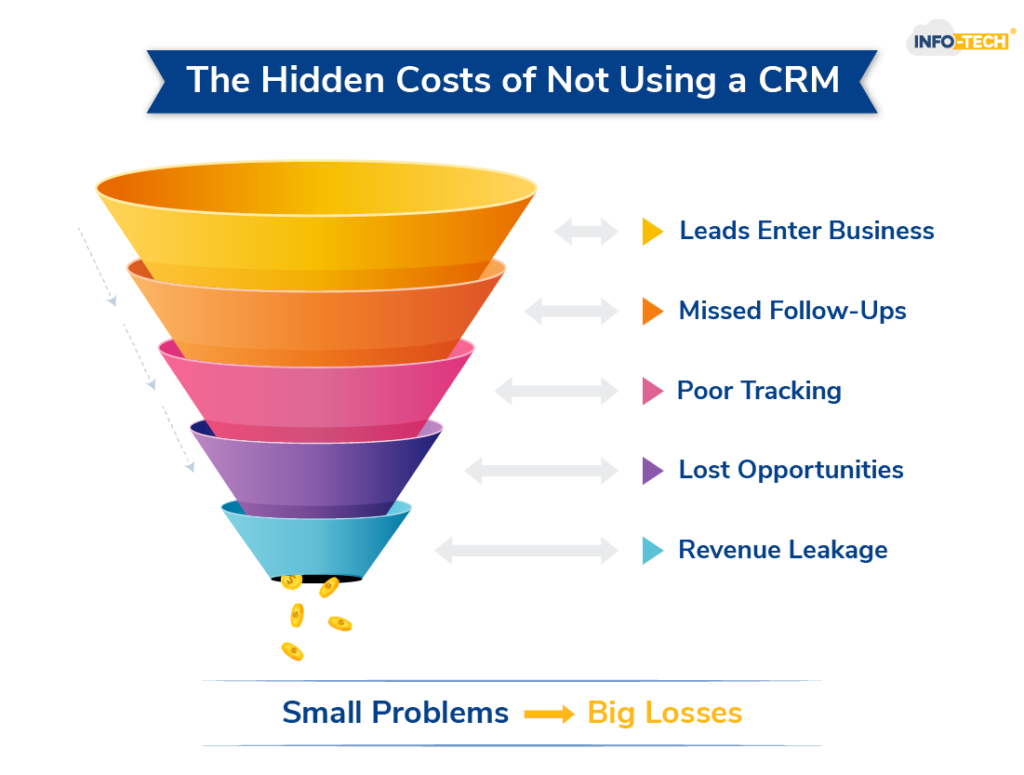
The cost of not using a CRM does not appear immediately. It builds gradually through missed opportunities, operational inefficiencies, and inconsistent customer experiences.
Over time, these issues affect revenue, productivity, and long-term growth.
As businesses scale, having a centralised system to manage customer relationships becomes less of an option and more of an operational requirement.
At Info-Tech Singapore, businesses can connect CRM Software with HRMS, Payroll, and workforce systems — all in one place. This creates a smoother, more organised way to run operations and grow without chaos.
CRM Software FAQs
What are the hidden costs of not using a CRM?
The main costs include missed sales, wasted time, poor customer experience, and lack of clear data. These may not be obvious at first but can affect business growth over time.
How does a CRM help a business?
A CRM keeps all customer information in one place, helps track interactions, and automates tasks. This makes it easier to manage sales, improve customer relationships, and make better decisions.
Do small businesses really need a CRM?
Yes. Even small businesses benefit because it helps them stay organised, avoid missed opportunities, and grow more smoothly as they expand.
How does a CRM improve customer retention?
A CRM helps businesses track customer interactions and follow up on time. This leads to better communication and a stronger relationship, which keeps customers coming back.
