Singapore’s business ecosystem is one of the most digitally advanced and competitive markets in Southeast Asia. Today’s customers quickly compare brands, expect instant responses across many different platforms, and are less tolerant with bad service. In this setting, customer loyalty doesn’t just come from low prices — it comes from great experiences, quick responses, and relationship management.
This is where CRM (Customer Relationship Management) Software play a key role. A modern CRM does more than store sales data. It provides a framework for Singapore companies to handle all customer interactions, ensure consistent service, tailor engagement, and proactively stops customers from leaving. In 2026, CRM systems have a direct link to how well companies retain their customers and their long-term profits.
Why Customer Retention Is So Important in Singapore
Getting new customers in Singapore now costs more due to digital advertising saturation, tougher competition, and highly informed consumers. But retaining current customers costs less and leads to better profits. Regular customers often spend more, refer others about the business, and need less marketing.
What’s more, Singapore customers now expect:
- Seamless digital communication
- Quick replies
- Personalized service
- Transparent Follow-ups
- Professional after-sales support
Without a CRM system, businesses find it hard to meet these operational expectations. Spreadsheets, scattered emails, and disconnected systems create problems that impact customer happiness.
CRM systems fix this by putting all information in one place, setting up standard ways of working, and letting businesses see the whole customer journey.
The Core Role of CRM in Improving Customer Retention
At its core, CRM helps keep customers by organizing relationships. Instead of relying on memory or manual tracking, businesses use systems based on data to maintain engagement and provide good service.
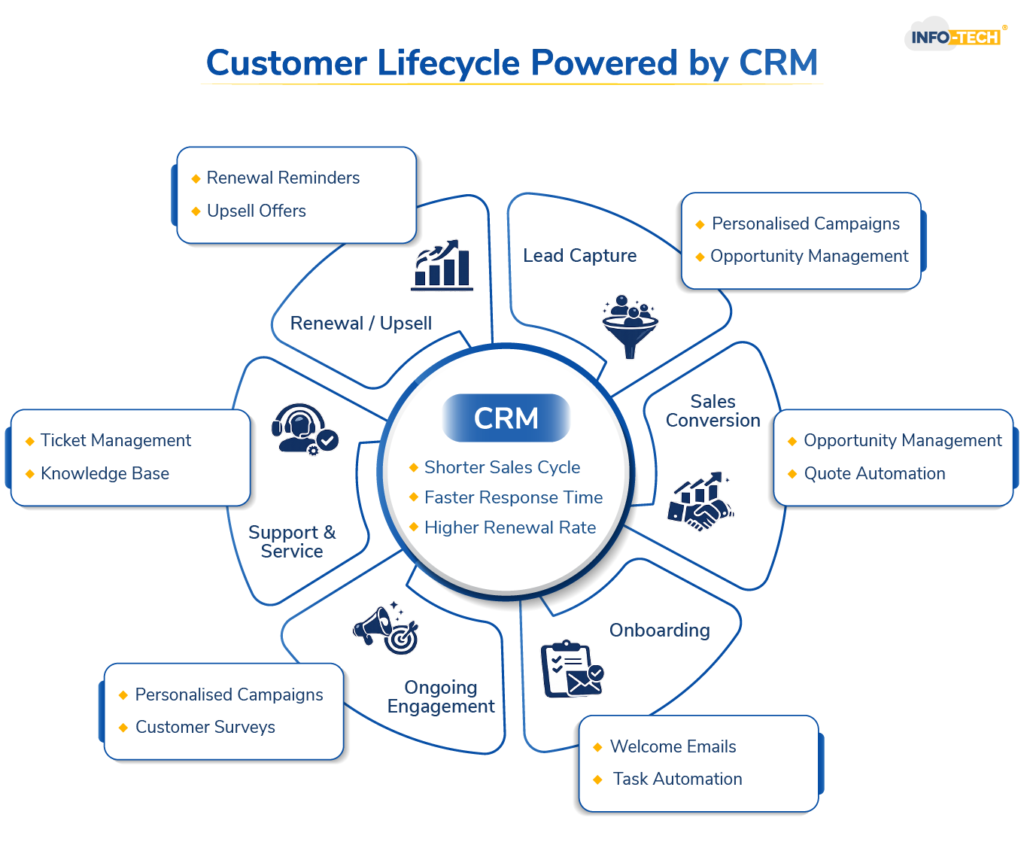
A CRM gives you a 360-degree customer view. It stores every contact- from the first question to after-sales support- in one main system. Sales teams can look at what purchase history, support teams can see past complaints, and management can study how people interact with the company. When customers feel like you know them, they’re more likely to stick around.
CRM systems don’t just hold data; they also help keep customers by:
- Sending automatic messages after sales
- Reminding about renewals before contracts end
- Running special offers based on what people buy
- Planning regular talks with big clients
- Using step-by-step plans to fix complaints
This organized way of doing things reduces risk forgotten follow-ups, inconsistent messages, or delayed responses — all things that often make customers leave.
How Customer Relationship Management Software Affects Customer Loyalty
| CRM Capability | How It Improves Retention | Business Outcome |
| Centralised customer data | Eliminates fragmented information | Faster, more personalised service |
| Automated workflows | Prevents missed follow-ups | Higher repeat purchase rate |
| Customer segmentation | Enables targeted engagement | Stronger customer loyalty |
| Case management system | Tracks and resolves complaints | Increased trust and satisfaction |
| Analytics dashboards | Identifies churn risks early | Proactive retention strategy |
How CRM Systems Give Companies an Edge
In Singapore’s quick-changing market, speed and precision matter. Businesses that act first — and get it right — often earn lasting loyalty. CRM systems create this edge in operations.
To start with, CRM systems help teams respond faster. When one system captures questions from email, website forms, WhatsApp, or calls, teams don’t waste time looking for information. Quick access to past interactions leads to smart and professional communication.
Next, CRM platforms help make choices based on facts. Instead of guessing which customers bring in money or which accounts are losing ground, management can look at clear numbers like:
- Customer lifetime value
- Retention rate trends
- Average sales cycle duration
- Service resolution time
- Revenue per customer segment
This clear view lets businesses change their strategies ahead of time, not just react to problems.
Third, CRM has an impact on cross-selling and upselling efforts. When businesses track customer preferences and buying patterns, they can introduce relevant products or services at the right time. In Singapore’s competitive scene personalized recommendations often set one company apart from another.
How Customer Relationship Management Software Improve Customer Service in Singapore
Customer service consistency predicts retention. In Singapore where customers often share reviews online, service failures can damage brand reputation.
CRM systems improve service quality by putting structured case management into action. Each customer issue gets logged, assigned, tracked, and resolved within set timelines. This ensures accountability and stops complaints from slipping through the cracks.
Also, CRM systems support automated service processes like:
- Instant acknowledgment emails
- Escalation alerts for unresolved cases
- Scheduled follow-up surveys
- Service performance monitoring
This builds a polished well-run, and open experience — which boosts customer trust a lot.
Traditional Customer Management vs CRM-Driven Management
| Aspect | Without CRM | With CRM |
| Customer records | Stored in multiple files | Unified database |
| Follow-ups | Manual reminders | Automated scheduling |
| Complaint tracking | Email chains | Structured ticket system |
| Performance visibility | Limited | Real-time reporting |
| Retention strategy | Reactive | Predictive and proactive |
CRM as a Retention Engine for SMEs and Growing Enterprises
For small firms or SMEs in Singapore, CRM systems cut down on relying too much on individual employees. When sales team members go, customer info stays safe and in order. This keeps business ties strong.
For businesses that are growing, CRM has a role in enabling growth. When customer bases increase, doing things manually becomes hard to keep up. CRM systems create standard ways to interact with customers, make sure service stays good, and let management keep an eye on all departments of the company.
In both cases, CRM changes how companies retain customers. Instead of depending on people’s personality, it uses a system. This change is key in markets where companies compete hard.
Long-Term Business Benefits of CRM in Singapore’s 2026 Digital Economy
As Singapore pushes ahead with its Smart Nation plans and moves more things online, people judge businesses on how well they run and how they treat customers. CRM systems align right in with these national digitalisation goals.
Over time, companies that use CRM systems often see:
- Better customer lifetime value
- Fewer customers leaving
- Enhanced brand reputation
- More referrals
- Steady income growth
Retaining customers doesn’t happen by chance. It’s planned through organized interaction, forward-looking insights, and consistent service delivery — all made possible by CRM tools.
Wrapping Up
Retaining customers isn’t just a metric, it’s how businesses survive. CRM Software help companies shift from reacting to problems to managing relationships. By combining data, automation, and personalization, businesses can build stronger ties with customers and ensure long-term growth in the future.
Customer Relationship Management Software Frequently Asked Questions
What is the role of CRM in improving customer retention?
CRM systems help keep customers by centralizing all customer data in one place sending automatic follow-ups, keeping track of service interactions, and spotting risks of customers leaving. By allowing personalized interactions and quicker problem-solving, CRM tools build stronger customer relationships and cut down on customer loss.
How do CRM systems help firms gain a competitive advantage?
CRM systems give companies an edge by cutting down response times showing performance insights right away and letting them make choices based on data. Businesses can tailor customer interactions, make their sales plans better, and fix service problems before they happen — doing better than rivals in busy markets like Singapore.
What CRM does your company use for sales and customer retention?
Businesses often pick CRM solutions that can grow with them. These systems bring together sales pipeline management, marketing automation, and customer service tracking on one platform. In Singapore, CRM systems are now being customized to help SMEs and growing companies create solid strategies to keep their customers.
How can CRM systems boost customer service?
CRM systems enhance customer service by recording every interaction, streamlining case management, and giving quick access to customer histories. This lets service teams answer questions, which makes customers happier and builds long-term loyalty.
