

In this article
- 1. What is IRAS Tax Bracket?
- 2. What is Chargeable Income?
- 3. Who is a Singapore Tax Resident?
- 4. Who are Non-Residents?
- 5. What is the Difference Between Gross Income and Chargeable Income?
- 6. What is the Connectivity Between Tax Relief and Tax Bracket?
- 7. Which Income is Taxed for the YA 2026?
- 8. What is the Difference Between IRAS Tax Bracket and Corporate Tax Rate?
- 9. IRAS Tax Bracket FAQs
Understanding the IRAS tax bracket becomes important for anyone who earns an income in Singapore. Whether you are an employee, freelancer or business owner, you should know how the personal income tax system works in Singapore. This can help you estimate your tax liability and plan your finances better.
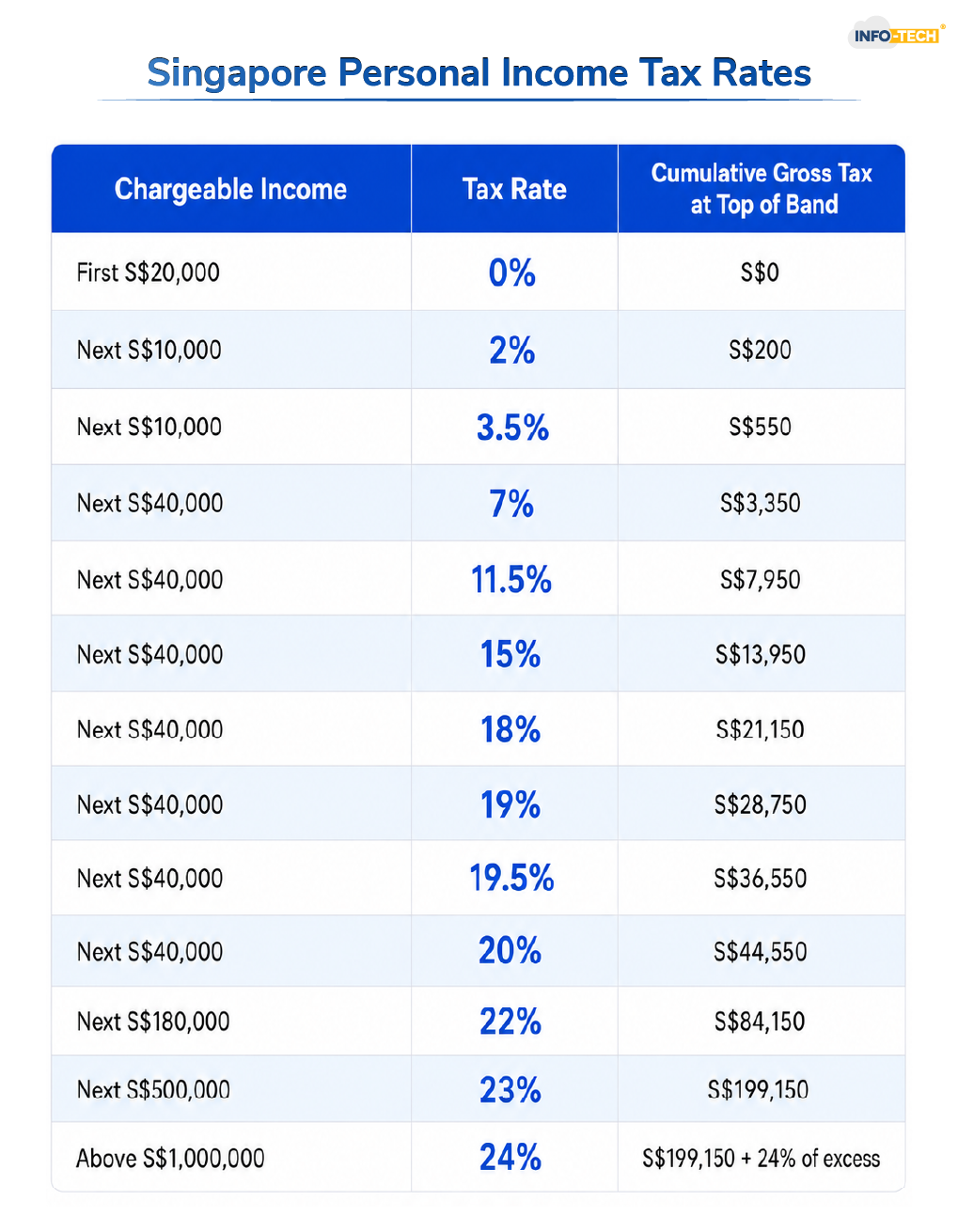
The progressive personal income tax system is used in Singapore. This means that different portions of your chargeable income are taxed at different rates. As the chargeable income increases, the tax rate applied to the additional income also increases.
For the Year of Assessment (YA) 2026, the individual income tax for Singapore residents is from 0% to 24%. For non-residents, they are taxed at 15% for employment income and 24% on all other incomes.
In this guide, you will the IRAS tax bracket, how the progressive tax system works, tax calculations and other things Singapore residents and non-residents should know about taxation.
What is the IRAS Tax Bracket?
IRAS tax bracket refers to the personal income tax rates administered by the Inland Revenue Authority of Singapore (IRAS).
According to this system, not a single tax rate is applied to your entire income. Instead, your income is divided into different bands. And each band is taxed at a corresponding rate.
For example, if the total chargeable income is S$60,000,
First S$20,000 × 0% = S$0
Next S$10,000 × 2% = S$200
For next S$10,000 × 3.5% = S$350
Next S$20,000 × 7% = S$1,400
Total Tax: S$1,950
You always start from the first bracket, but don’t necessarily reach all the brackets.
For example, if the total chargeable income is S$25,000,
First S$20,000 × 0% = S$0
Next S$5,000 × 2% = S$100
Total Tax: S$100
As you move into a higher tax bracket, it doesn’t mean the entire chargeable income is taxed at that rate. Only the income that falls within that bracket will be charged that high.
What is Chargeable Income?
It is the amount obtained after deducting allowable deductions, personal reliefs, and donations from the gross salary. IRAS tax applies only to your chargeable income and not to your gross salary.
Therefore, two people with same the gross salary may have different chargeable incomes. So, they may arrive at different tax liabilities as well.
Read Also: Estimated Chargeable Income
Who is a Singapore Tax Resident?
A Singapore citizen or permanent residents who reside in Singapore are considered tax residents and they should follow the IRAS rules. The tax residency status determines which income tax rules you should adhere to.
Foreigners are also considered tax residents if they have stayed or worked in Singapore for at least 183 days in the previous year. There are also other conditions that qualify them as tax residents.
Read Also: Personal income tax for Singapore tax residents
Who are Non-Residents?
Non-residents are individuals who do not meet Singapore’s requirements to be tax residents and still earn income in Singapore.
The tax rules are different for non-residents in Singapore. Employment incomes are taxed at 15%, and the rest of the other incomes are taxed at 24% for non-residents. The personal reliefs are not applicable to non-residents. Therefore, it becomes important for foreign employees to determine their residency status before estimating their income tax.
What is the Difference Between Gross Income and Chargeable Income?
One of the biggest mistakes is that people always assume gross income and chargeable income to be the same. But they are not.
Your gross income may include your salary and other taxable income. After deducting the allowable deductions, donations and reliefs, you may arrive at an amount to which the tax is calculated. So, the gross income alone does not determine which IRAS tax bracket you fall under.
What is the Connectivity Between Tax Relief and Tax Bracket?
Eligible tax reliefs can reduce your chargeable income and ultimately reduce your tax liability.
Some of the reliefs include,
- Parent-related reliefs
- Qualifying child reliefs
- Earned income reliefs
Not all the reliefs will be applicable to all taxpayers. So, it is important to check your eligibility before including the reliefs in your tax calculation.
Which Income is Taxed for the YA 2026?
Generally, Singapore uses the preceding year’s income for tax calculation. To calculate tax for YA 2026, the income earned from 1st January 2025 to 31st December 2025 will be considered. Therefore, when determining the tax bracket for YA 2026, both the income and deductions will be based on the previous year (2025).
Is it Important to file a Tax Return?
The tax liability and income tax filing are not the same. According to IRAS rules, tax filing becomes important in the following cases,
- If an individual’s total income was more than S$22,000 in the previous calendar year.
- If the net self-employment income was more than S$6,000 in the previous calendar year.
- If they derive income from Singapore as a non-resident.
- There are also other filing circumstances.
What is the difference between IRAS Tax Bracket and corporate tax rate?
IRAS tax and corporate tax are not the same. The IRAS tax is a progressive tax system that applies to individual income tax. In Singapore, corporate tax is flat 17% for both local and foreign companies. For individuals, the IRAS tax bracket is applicable. Whereas, for companies, corporate tax is applicable.
What are Some Misconceptions about the IRAS Tax Bracket?
- “If I enter the 22% tax bracket, my entire income will be taxed at 22%”
No, Singapore has a progressive tax system. So, only the chargeable income that falls within that band will be taxed at 22%.
- “The tax rate in Singapore is the same for everyone”
There are factors like tax residency, chargeable income and type of income earned that decide the tax rate. So, it won’t be the same for everyone.
- “My gross salary will be my taxable income”
No, there are allowable deductions, personal reliefs and donations that can alter the chargeable income. So, the gross salary will not be fully taxable.
IRAS Tax Bracket FAQs
What is the IRAS tax rate in Singapore?
Singapore follows a progressive tax rate system and the IRAS tax rate ranges from 0% to 24% for the YA 2026.
What is chargeable income?
It is taxable income that arises after deducting allowable deductions and reliefs.
What is the current tax rate for non-residents?
Employment incomes are taxed at 15% , and the rest of the incomes are taxed at 24%.
Which income period is considered for YA 2026 tax calculation in Singapore?
In Singapore, the income period considered for YA 2026 tax calculation is from 1st January to 31st December 2025.
