

In this article
- 1. What is Garden Leave?
- 2. Why is Garden Leave Called “Garden Leave”?
- 3. How Does Garden Leave Work In Singapore?
- 4. What Are the Employer and Employee Rights During Garden Leave?
- 5. What Should You Know Before Imposing Garden Leave?
- 6. Conclusion: How To Manage Garden Leave Efficiently
- 7. Garden Leave FAQs
When an employee resigns from the job or is asked to leave, employers do not always require the employee to work from the office as usual. They may want the employee to stay away from the workplace while still remaining a part of payroll. This is where Garden Leave plays its role in Singapore.
In this guide, we will learn the meaning of garden leave in Singapore, employee rights for it and employer obligations as per the Employment Act of Singapore. This will enable you to navigate notice periods confidently and compliantly.
What is Garden Leave?
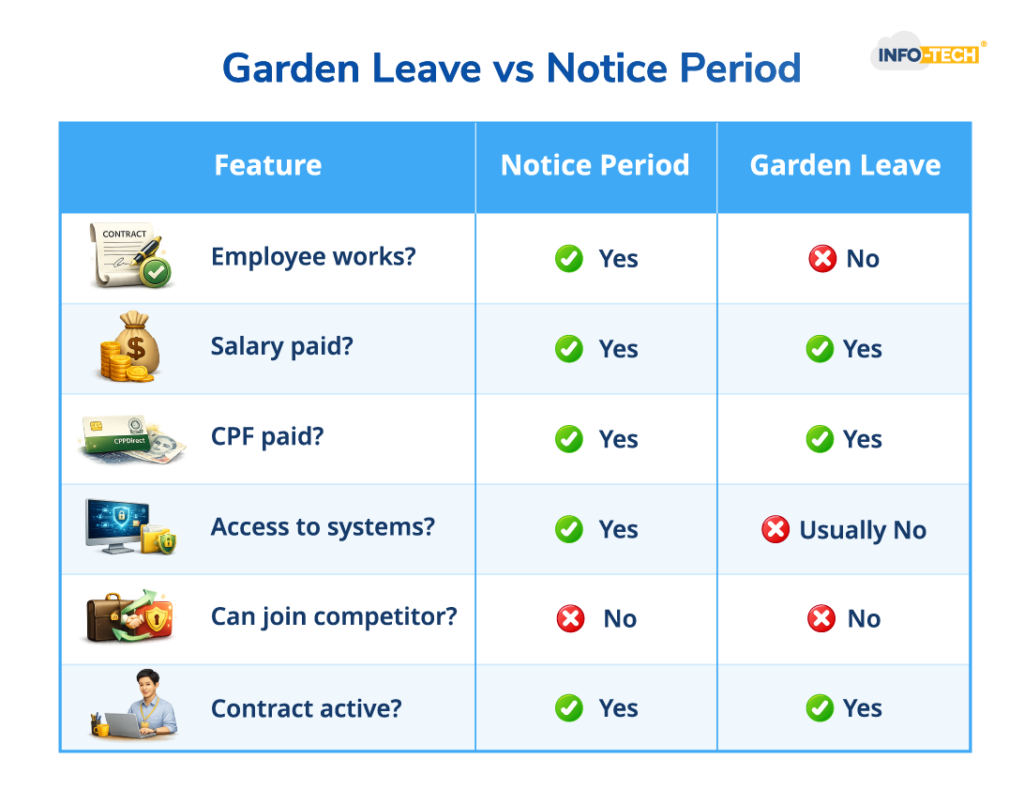
Garden Leave is a duration of an employee’s notice period, during which they are asked by the employer not to attend work, perform duties, or access company systems; while officially remaining employed and getting fully paid. In Singapore, this is applicable especially for the roles related to
- Senior management posts
- Sales and client-facing positions
- Access to confidential or commercially sensitive information
- Competitive industries such as finance, tech, or consulting
The garden leave must be supported by a clause in the employment contract for it to be enforceable. Usually, during garden leave
- The employment contract remains active
- Salary, CPF contributions, and contractual benefits continue
- The employee must remain available, if required
- Confidentiality and non-compete rules still apply
Why is Garden Leave Called “Garden Leave”?
The term paints a literal picture. The employees are asked to stay at home – ‘tend to their garden’, instead of coming to work. This suggests that the employee is paid but is not actively working. While it has a relaxed tone, garden leave serves a serious business purpose.
How Does Garden Leave Work In Singapore?
Though there are no set statutory provisions for garden leave in Singapore, it is generally regulated by the employment contract terms and the principles of contract law. It usually works in the following manner.
- Must be supported by the Employment Contract: Only if there is a clause stating the availability of garden leave, can it be enforceable. Without such clause, it may be legally questionable to place an employee on garden leave.
- Employee remains employed: Despite the employee not actively working, their salary must be paid, CPF contributions must be made, and benefits such as allowances and bonuses must be paid without fail.
- Access and duties are restricted: Employers may revoke access to company systems, restrict client contacting, require return of company’s property, and limit the employee’s involvement in projects.
- Employee must remain available: The employee may be required to be contactable at work hours, assist with handovers, and provide clarification wherever needed.
- Joining a competitor is usually not allowed: Since the employment relationship officially continues, the employee cannot start a new job or work for a competitor, unless the employer provides their written consent agreeing to it.
What Are the Employer and Employee Rights During Garden Leave?
Employer Rights During Garden Leave
- Restrict the employee’s access to company’s resources
- Enforce confidentiality obligations
- Require employee’s availability for handover
- Restrict competitive activities
Employee Rights During Garden Leave
- Full salary payment
- Protection under the employment act
- Right to seek clarification
What Should You Know Before Imposing Garden Leave?
Employers in Singapore must check upon the legal, operational, and contractual factors before placing an employee on garden leave. Since it is contract-driven, not implementing it properly can lead to claims of contract breach. Ask these questions before imposing garden leave –
- Is there a garden leave clause in the Employment Contract?
- What is the duration of the notice period?
- What is the business justification behind it?
- Is there compliance with salary, CPF, and benefits?
- What is the scope of restriction?
- What will be the impact on employee morale and employee branding?
Conclusion: How To Manage Garden Leave Efficiently
Garden leave is not just an administrative act, but a strategic step. While it is an aid to protect business interests, it can also lead to disputes, penalties, and reputational damage when poorly handled. To avoid these, using an integrated HRMS software is the smart solution, as it helps
- Track notice periods accurately
- Ensure compliant payroll processing
- Seamlessly manage leave accruals and final settlements
- Maintain proper documentation of garden leave letters and contract terms
- Coordinate offboarding workflows and asset return
- Generate audit-ready reports for internal records
As Singapore’s employment landscape becomes increasingly competitive, having a structured digital HR process is no longer optional. Get in touch with Info-Tech and Request A Demo Now.
Read also: Off in Lieu Explained here
Garden Leave FAQs
Is garden leave the same as notice period?
No, garden leave is not the same as a notice period; but it takes place during the notice period.
What is the maximum number of days for garden leave?
There is no statutory maximum number of days for garden leave in Singapore. Garden leave typically lasts for the duration of the employee’s notice period, as stated in the employment contract.
Can I work for another company while on garden leave in Singapore?
No, generally if you are on garden leave in Singapore, you are still legally employed by your current employer until your notice period officially ends. So, it is not right to work for another company when on garden leave.
Why are employees placed on garden leave?
Employees are placed on garden leave during the notice period to protect the employer’s confidential information, client relationships, and business interests.
