
Introduction: When a Simple Work Permit Online Renewal No Longer Feels Simple
Singaporean businesses are entering 2026 with heightened urgency around Work Permit (WP) online planning. Recent changes to sector-specific rules—covering qualifying salaries, dependency ratios, skills requirements, and levy structures—have made WP management more complex than in previous years.
Instead of minor annual adjustments, companies are now facing broader policy shifts that require quicker, more strategic responses HR teams across construction, manufacturing, services, process, and marine shipyard sectors are reporting the same challenge: Work Permit policies are evolving faster, and compliance requires closer monitoring of quota availability, salary benchmarks, and levy changes.
With 2026 shaping up to be a significant year of workforce recalibration, organisations must strengthen their workforce planning and ensure every renewal or new application meets the latest MOM criteria.
This guide breaks down the new Work Permit Singapore 2026 eligibility, updated quota and levy structure, and the sectoral trends driving these changes, in clear, human language. We also show how digital HR tools — such as Info-Tech HRMS — help companies stay audit-ready in a tightening compliance environment.
Work Permit Singapore 2026: What’s Changing?
Singapore’s manpower strategy continues shifting toward higher skills, productivity, and reduced dependency on low-wage labour. This explains the ongoing adjustments in Work Permit quotas, levy tiers, and minimum qualifying criteria across 2024–2026.
Most updates announced by MOM and MTI revolve around four themes:
- Tightened Dependency Ratio Ceilings (DRC) in selected sectors
- Higher levy for lower-skilled workers
- Stricter eligibility for source countries and job types
- Push toward digital compliance and traceable HR records
The next sections break down these changes in practical terms — based on the latest MOM-announced guidelines.
2026 Work Permit Eligibility Criteria (Updated Overview)
The core WP rules remain (approved source countries, age limits, medical exams, security bonds), but sector-specific requirements, particularly in services and manufacturing, are becoming more stringent.
Here is a consolidated 2026 snapshot:
| Eligibility Area | 2026 Requirement (Based on MOM guidelines) |
| Source Countries | Only MOM-approved source countries continue to qualify (e.g., Malaysia, China, India, Bangladesh, Myanmar, Thailand). MOM updates lists periodically. |
| Age Limits | First-time WP applicants: 18–50 years old (Construction & Process may allow up to 58 for renewals). |
| Medical Exams | Pre-employment medical check + 6-monthly mandatory medical exam (6ME) continues. |
| Security Bond | $5,000 for non-Malaysian workers, unless covered by insurance guarantee. |
| Skills Certification (Sectoral) | Mandatory for sectors like construction (e.g., BCA CoreTrade), marine, and process. Services sector sees tightening in 2025–2026. |
| Minimum Salary | While Work Permits do not have a fixed minimum salary, MOM raises levy incentives for higher-wage workers, effectively nudging wage floors upward. |
Work Permit Singapore 2026 eligibility remains tied to approved source countries, age limits, medical exams, security bonds, and sector-based skills requirements, with tighter controls in services and manufacturing.
Work Permit Quotas in 2026: What HR Must Prepare For
Quotas continue to be one of the most challenging compliance areas. MOM has been progressively adjusting the Dependency Ratio Ceiling (DRC) to reduce long-term reliance on lower-wage foreign labour.
Work Permit Singapore 2026 DRC Limits
| Sector | Current DRC |
| Construction | 87.5% |
| Process | 87.5% |
| Marine Shipyard | 77.8% |
| Manufacturing | 60% |
| Services | 35% |
Although no new mid-cycle tightening has been announced for 2026, the trend indicates:
- Services remain the most restricted.
- Manufacturing could see further tightening after 2026
- High-labour sectors must prepare for stricter manpower planning
Companies relying heavily on Work Permit manpower — especially retail, cleaning, food services, manufacturing, and logistics — need digital tools to track quota usage in real time. Over-allocating a single headcount can lead to penalties.
Work Permit Levy Rates 2026: What We Know Today
The levy system remains MOM’s clearest tool for steering labour demand.
Key 2026 Expectations Based on MOM Announcements
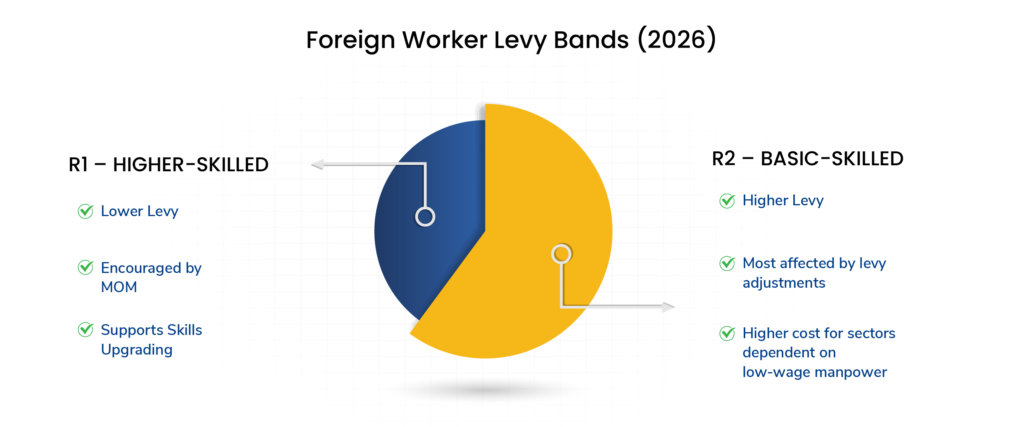
- Higher levies for lower-skilled (R2) workers in construction, marine, and process.
- No announced levy hike for higher-skilled (R1) workers.
- Services sector levy bands remain unchanged.
Why these adjustments matter
Singapore’s workforce strategy prioritises:
- Productivity-driven growth
- Wage transformation
- Reduced reliance on low-skilled labour
This explains the continued two-tier levy system:
Hire skilled workers → pay less levy.
Rely on lower-skilled labour → pay significantly more.
Work Permit Singapore 2026 rules tighten quotas, increase levy pressure, and raise skills requirements across construction, services, and manufacturing.
Why 2026 Compliance Will Be Harder Than Previous Years
HR teams now handle:
- Quota tracking
- Levy calculations
- Skills certification audits
- E-submission of employment records
- Medical exam reminders
- Housing and well-being documentation
MOM has also increased:
- Surprise dorm inspections
- Employer audits
- Housing compliance checks
- Enforcement of medical exam timelines
Companies relying on spreadsheets or manual tracking will slip into non-compliance by accident, not negligence.
This is why many SMEs are exploring unified systems that combine:
- HRMS
- Payroll
- Time Attendance
- Document management
- Levy forecasting
How Info-Tech HRMS Helps Employers Stay Work Permit–Compliant in 2026
Managing Work Permit workers in 2026 requires an integrated, real-time HR platform.
Info-Tech HRMS provides:
1. Automated Quota & Levy Calculations
2. Digital Worker Profiles
3. MOM-Compliant Record Keeping
4. Audit-Ready Logs
As regulations tighten, manual tracking becomes risky. A unified system like Info-Tech HRMS gives businesses real-time visibility into quotas, levy bands, expiries, and documentation, helping HR teams stay compliant without the stress.
Singapore’s workforce landscape will continue evolving, but companies equipped with the right digital tools will navigate these changes with confidence. Compliance may be complex, but managing it doesn’t have to be.
Frequently Asked Questions
What are the new Work Permit rules in Singapore for 2026?
Work Permit Singapore 2026 rules focus on tightened quotas, higher levy for lower-skilled workers, and stricter sector-based skills requirements. MOM continues pushing employers toward hiring higher-skilled workers and reducing dependency on low-wage labour.
Is Singapore reducing Work Permit quotas in 2026?
As of MOM’s latest updates, no mid-cycle DRC reductions have been announced for 2026. However, long-term signals suggest tightening in sectors such as manufacturing and services as Singapore moves toward automation and productivity-led growth.
What is the Work Permit levy for 2026?
Levy remains tiered for higher-skilled (R1) and basic-skilled (R2) workers. MOM has signalled potential upward adjustments for selected sectors with high reliance on low-skilled labour, particularly construction and marine.
What documents are needed for Work Permit applications in 2026?
Employers must submit the worker’s passport, educational or skills documents (where applicable), IPA details, medical exam reports, security bond, and sector-specific certifications like BCA or marine skills.
