
Introduction: The New Reality HR Didn’t See Coming
Everyone wants Flexible Work Arrangement (FWA) now. But how do we even track all this?
This question has become increasingly common leading up to 2026. Ever since the Ministry of Manpower (MOM) rolled out mandatory Flexible Work Arrangement (FWA) request processes, companies have been learning, sometimes the hard way that compliance is no longer a matter of goodwill. It is now a legal requirement backed by strict documentation rules
This is where the shift becomes clear: spreadsheets, email threads, and manual approval forms are no longer enough. As more employees submit formal FWA requests, HR teams are recognising that effective compliance depends on their ability to accurately record, justify, track, and store documentation.
This is exactly why many businesses have started adopting HRMS software as companies rely on systems built to safeguard audit trails, centralise communication, and ensure that what MOM expects, companies can actually demonstrate.
MOM requires employers to document all FWA requests, provide timely responses, and retain written records. HRMS automates this entire process. HRMS helps companies comply with FWA rules by centralising requests, standardising responses, and generating audit-ready documentation.
Understanding MOM’s FWA Documentation Requirements (2026 Update)
From December 2024 onward, MOM requires all employers to establish a formal system for:
- Receiving FWA requests
- Responding within a reasonable timeframe
- Providing proper reasons if rejecting requests
- Keeping written records of requests and responses
What changed in 2026 is not the rule itself, but the level of scrutiny.
During MOM inspections, employers must now show:
- How many FWA requests were made
- How each request was evaluated
- Whether employees received timely responses
- Whether rejection reasons align with MOM’s “business grounds” criteria
- Whether all documents are retained for reference
With a growing emphasis on fairness and accountability, HR leaders have adopted a simple guiding principle:
“If it’s not documented, it never happened.”
Manual systems make it far too easy for documentation gaps to form.
This is why digital recordkeeping is becoming the backbone of FWA compliance.
Why Singapore Businesses Are Turning to HRMS for Flexible Work Arrangement (FWA) Compliance
Many still associate HRMS with payroll or leave tracking. But in 2026, HRMS has evolved into a full-fledged compliance management system that ensures HR teams follow MOM’s FWA requirements consistently and transparently.
Modern HRMS platforms automate the entire compliance chain, from collecting employee requests to generating MOM-ready documentation with a single click.
Here’s how HRMS makes a difference:
1. Centralised FWA Request Tracking
In many SMEs, FWA requests are still scattered across WhatsApp chats, emails, and handwritten notes.
During MOM inspections, this creates a nightmare scenario; missing records, inconsistent explanations, and no timestamps.
With an HRMS system, every FWA request is:
- Submitted digitally
- Time-stamped
- Routed to the right manager
- Tracked until resolution
The system keeps a complete trail that MOM can easily verify.
This not only ensures FWA employer obligations are met but also reduces disputes because decisions are fully documented and transparent.
2. Standardised, Policy-Aligned Responses
MOM requires employers to justify FWA rejections using legitimate business ground, not personal preference, However, managers often struggle to phrase rejections properly or apply criteria consistently.
HRMS software solves this through:
- Pre-approved response templates
- Policy-aligned rejection reasons
- Embedded MOM guidelines for decision-makers
This ensures that every approval or rejection is aligned with MOM FWA guidelines 2026.
3. Automatic Record Retention for MOM Audits
One of the biggest compliance risks is missing documentation.
MOM may request past records to investigate if an employer has been fair and timely.
HRMS platforms automatically:
- Store every request
- Retain communication logs
- Archive approvals, rejections, and supporting documents
- Allow quick retrieval during audits
This eliminates the panic often experienced with MOM inspections and strengthens long-term HR audit readiness.
4. Data Insights That Strengthen Hybrid Work Strategy
Beyond compliance, companies also want to know:
- Which departments request the most FWAs?
- Are employees asking for work-from-home or flexible hours?
- How many requests were approved or rejected?
HRMS analytics reveal patterns that help employers refine their Flexible Work Arrangement policies.
Leaders can use the insights to refine hybrid work policies, manage workforce planning, and make strategic decisions about team structure and office utilisation.
5. Ensuring Fairness and Transparency Across Teams
One of MOM’s key motivations behind the FWA legislation is fair and unbiased evaluation of requests.
HRMS software helps HR leaders:
- Avoid inconsistent manager interpretations
- Apply the same policy framework across all departments
- Document objective reasoning
- Build trust through transparent workflows
As a result, HRMS strengthens workplace trust and reduces grievances over perceived unfair treatment.
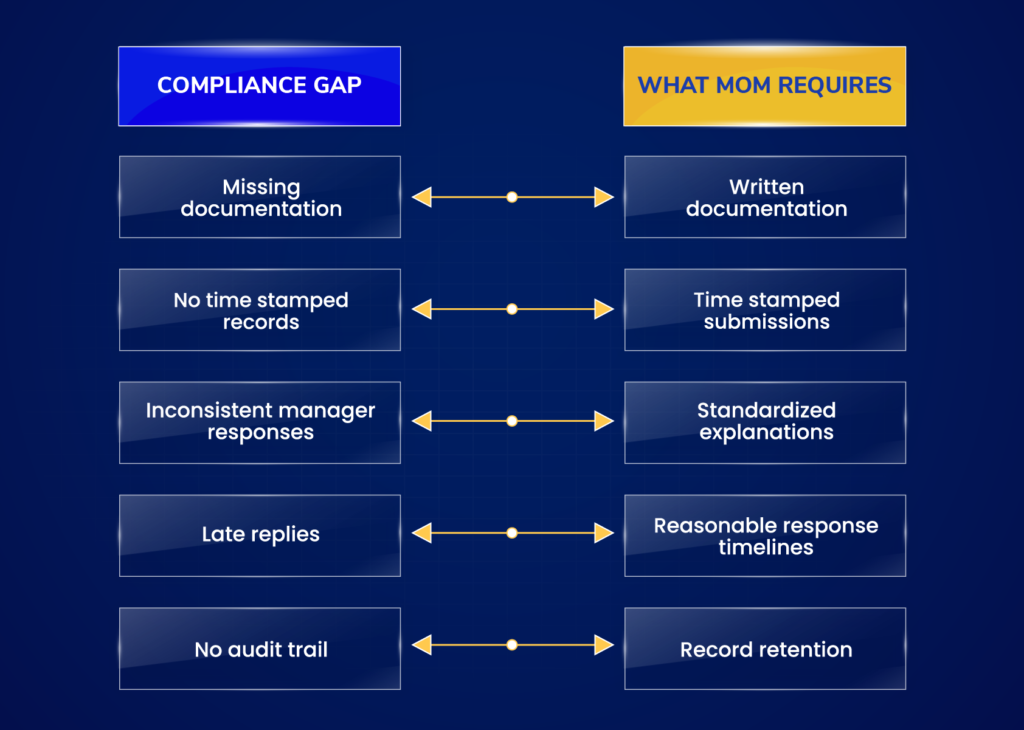
What MOM Data Shows About Flexible Work Arrangement (FWA) Compliance Gaps
While MOM does not publish company-level FWA audit records, several national studies provide clear evidence of the challenges employers face.
According to the MOM Labour Force in Singapore 2023/2024 reports, Flexible Work Arrangements are now a mainstream expectation among employees, yet many companies struggle with documentation, consistency, and process clarity.
The Tripartite Alliance for Fair & Progressive Employment Practices (TAFEP) also notes that employers frequently face issues such as:
- Inconsistent Flexible Work Arrangement (FWA) request handling across departments
- Lack of written documentation of approvals or rejections
- Insufficient record-keeping for audit or dispute purposes
- Misalignment with the Tripartite Guidelines on FWA Requests
These findings appear in publicly available resources such as:
- MOM Labour Force in Singapore (annual report)
- TAFEP: Tripartite Guidelines on Flexible Work Arrangement Requests
- MTI & MOM joint statements on workplace flexibility
For example, MOM’s 2023 Labour Force Survey reported that while over 50% of employees used at least one FWA, a significant share of employers still had no formalised system for documenting or evaluating requests.
This gap is precisely what the 2024 Tripartite Guidelines on FWA Requests—effective from December 2024—aim to address.
These national insights mirror what many Singapore SMEs experience:
Without a standardised digital system, HR teams often rely on ad-hoc email chains, resulting in missing records, unclear decision trails, and inconsistent responses across managers.
How Info-Tech HRMS Supports MOM FWA Compliance
Info-Tech’s HRMS is built with Singapore’s employment landscape in mind—including the latest MOM regulations.
Here’s how it supports companies:
- Digital FWA submission portal for employees
- Manager approval modules tied to company policy
- Auto-generated MOM-compliant documentation
- Pre-built business justification templates
- Centralised record retention for audits
- Analytics dashboards to improve HR decision-making
Conclusion:
The shift toward Flexible Work Arrangements reflects Singapore’s evolving workplace values—focus on fairness, productivity, and long-term sustainability.
And while compliance may feel overwhelming at first, an HRMS with a Flexible Work Arrangement Software turns it into a structured, confident, and repeatable process.
When documentation is automated, policies are standardised, and records are always audit-ready, HR teams can stop firefighting and start focusing on what truly matters: enabling people to do their best work.
If your organisation wants a future-ready, MOM-compliant foundation, the next step is simple:
Digitise now, so you won’t have gaps later.
Contact Us For A Free Demo!
Frequently Asked Questions
What documentation does MOM require for FWA?
MOM requires employers to maintain written records of all FWA requests, including the submission date, the employee’s reason, the company’s response, and any justification for rejection. These records must be stored in an accessible format and presented during audits when requested. A digital HRMS makes this documentation complete, consistent, and easily retrievable.
How can HRMS help track FWA requests?
HRMS software centralises all requests, timestamps submissions, logs manager actions, and stores documents securely. It ensures requests are handled within a reasonable timeframe and provides a full audit trail for MOM inspections. This eliminates missing information and ensures companies comply with Singapore’s FWA guidelines.
Is HRMS software mandatory for MOM FWA compliance?
HRMS is not mandatory, but it is highly recommended because MOM requires consistent documentation, fair evaluation, and proper record retention. Manual systems often lead to errors or missing records. HRMS software automates these processes, reduces administrative work, and ensures every request is documented correctly.
What happens if companies fail to document FWA requests?
Without proper documentation, companies risk non-compliance during MOM audits. Missing records can be interpreted as unfair treatment or unmanaged requests, which may damage employer reputation and lead to further investigation. Digital systems prevent these risks by maintaining secure, complete, and timestamped documentation.
